The performance came as the KOSPI more than doubled from the end of December through June before a correction began in July, leaving the latest pension report as a snapshot of returns near the height of the market rally.
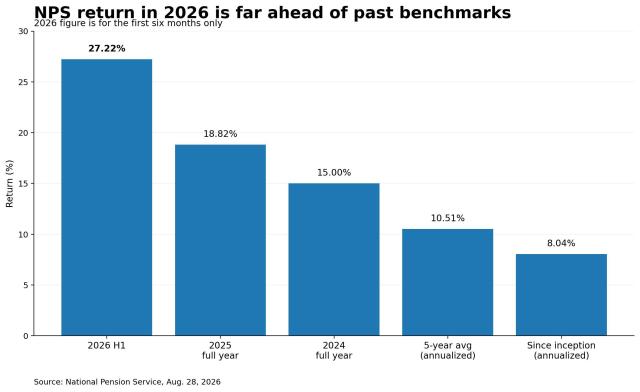
The National Pension Service (NPS), one of the world's third-largest pension funds, said Friday that its assets under management reached 1,866 trillion won ($1.35 trillion) at the end of June, with a preliminary money-weighted investment return of 27.22 percent.
The KOSPI soared 101.14 percent against an 8.99 percent gain in global equities. Bonds were the opposite. The three-year government yield climbed 74.6 basis points, more than three times the 20.7-basis-point increase in the U.S. 10-year Treasury yield.
The headline return stands out even against the NPS's strong recent performance as this year's return is over seven times 3.81-percent first-half return average over the last six years.
Domestic equities explain much of the extraordinary performance.
The NPS held 543.2 trillion won of Korean stocks at the end of June, representing 29.1 percent of its portfolio. Overseas stocks accounted for another 661.1 trillion won, or 35.4 percent, leaving almost two-thirds of financial assets exposed to equities.
Korean equities returned 107.37 percent for the pension fund, compared with 82.44 percent for all of 2025 and a long-term annualized return of 11.26 percent since inception.
Chipmakers were at the center of the surge as the artificial intelligence investment boom drove extraordinary earnings and expectations for Samsung Electronics and SK hynix.
The result gives the NPS an unusually large exposure to the same AI-driven wealth effect now running through Korea's corporate profits, exports and equity market.
The performance elsewhere in the portfolio was far more restrained.
Overseas equities returned 17.81 percent, slightly below their 19.74 percent return for all of 2025. Alternative assets earned 9.60 percent, broadly around their 10.08 percent annualized return since inception.
Domestic bonds were the conspicuous loser, falling 3.00 percent as interest rates rose and bond prices declined. Overseas bonds returned 9.22 percent, helped partly by the weaker Korean currency. The won stood at 1,541.5 per dollar at the end of June, 7.43 percent weaker than at the end of 2025, increasing the won value of foreign assets.
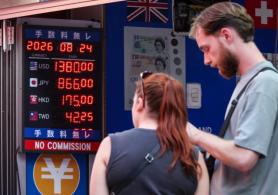
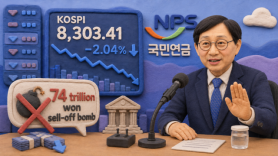
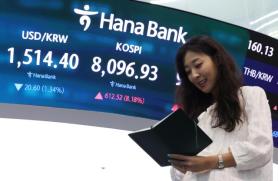
The first-half performance will likely be hard to march. Korean equities began correcting in July after the extraordinary first-half run. By 10:30 a.m. Friday, the KOSPI was trading at 6,818.87, almost 20 percent below its June-end level of 8,476.48. The currency tailwind has also partially reversed. The won was trading around 1,379 per dollar Friday morning, substantially stronger than its 1,541.5 level at the end of June.
NPS Chairman Kim Sung-joo acknowledged that the second half has brought greater volatility, saying some of the first-half gains have fluctuated while overall performance remains favorable.
- The NPS returned 27.22 percent in the first half, more than seven times the 3.81 percent average of the previous six first-half periods.
- Domestic stocks returned 107.37 percent as the KOSPI surged 101.14 percent from end-December through June, making Korean equities the dominant driver of the pension fund's performance.
- The six-month return already exceeds the NPS's record 18.82 percent full-year gain in 2025, although the periods are not directly comparable.
- The KOSPI has since fallen almost 20 percent from its June-end level, underscoring that the first-half report captures performance before the market correction that began in July.

Copyright ⓒ Aju Press All rights reserved.