President Lee Jae Myung has launched a broad Cabinet reset as his approval rating slides sharply barely into his second year in office, replacing six ministers at once in a bid to regain political momentum and accelerate delivery on the economy, housing and reform.
The decision is understandable. What the administration needs now is not another prolonged season of personnel speculation but demonstrable results, particularly on the economy and housing.
Lee's approval rating has fallen to a record-low 42 percent, with real estate policy by far the biggest reason cited by those unhappy with his performance. Economic and livelihood concerns and the government's prosecution overhaul are also weighing on public sentiment.
Against that backdrop, the choice of career officials to lead the finance and land ministries sends a sensible message.
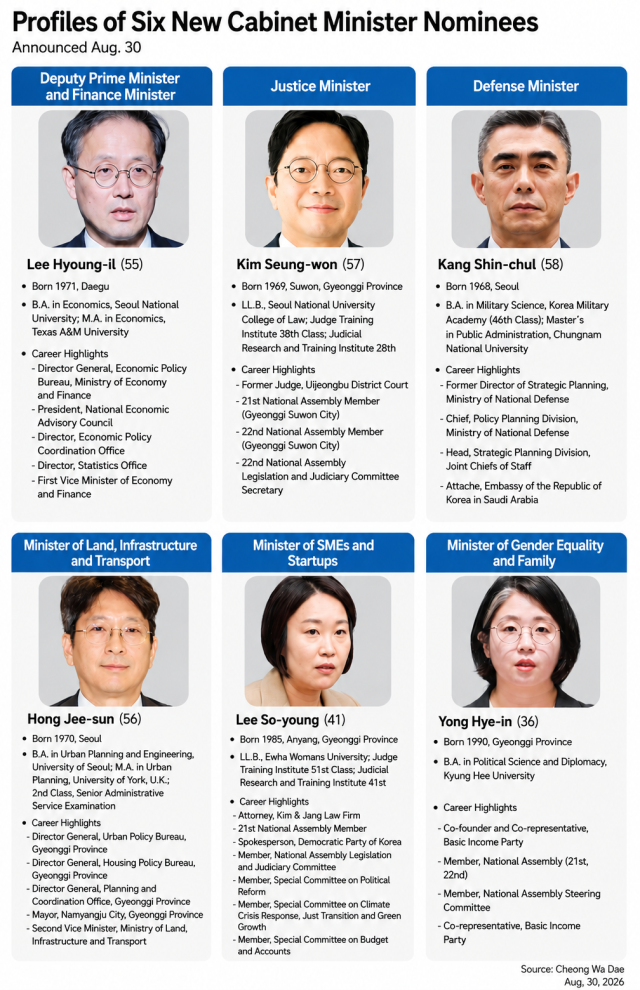
Finance minister nominee Lee Hyoung-il has spent much of his career making economic policy and, as first vice finance minister, can take over without a lengthy learning curve. Hong Jee-sun, tapped to lead the Ministry of Land, Infrastructure and Transport, likewise brings extensive experience in housing and transport policy.
The appointments suggest the presidential office understands that the public is increasingly interested in implementation rather than slogans. Economic growth targets, housing supply plans and support for households struggling with high prices will ultimately be judged by what happens on the ground.
The political appointments have a different logic.
Democratic Party lawmakers Kim Seung-won and Lee So-young were nominated to lead the justice ministry and Ministry of SMEs and Startups, respectively, while Basic Income Party lawmaker Yong Hye-in was tapped as gender equality and family minister.
Bringing politicians into the Cabinet can give the administration greater legislative muscle as major reforms move through the National Assembly. Yong's nomination also broadens the Cabinet beyond the Democratic Party and gives substance to Lee's stated desire to build a wider governing coalition.
The mix of bureaucrats and politicians therefore has merit - technocrats where continuity and execution matter most, politicians where legislation and political persuasion are indispensable.
But a reshuffle intended to advertise competence cannot begin with confusion.
The extraordinary scene surrounding outgoing Finance Minister Koo Yun-cheol on Sunday exposed precisely the kind of coordination failure the new Cabinet is supposed to eliminate.
Koo arrived at Incheon International Airport to depart for a Group of 20 finance ministers and central bank governors meeting in the United States, only to learn that he was among the ministers being replaced. He initially canceled the trip and accompanying bilateral meetings before reversing that decision and boarding the flight after all.
It was the correct decision to go. Until his successor completes a National Assembly confirmation hearing and formally takes office, Koo remains finance minister. International negotiations do not stop because Seoul has announced a Cabinet reshuffle.
More importantly, this is hardly a routine moment in Korea-U.S. economic relations.
Washington has been pressing Seoul over its pledged U.S. investment commitments , while tariff issues, digital trade and other bilateral economic disputes remain unresolved. At such a time, continuity in communication with U.S. counterparts is not optional.
For Korea's finance minister to cancel and then restore a major international trip because he learned of his replacement only after arriving at the airport suggests that domestic political scheduling was allowed, however briefly, to interfere with economic diplomacy.
A Cabinet reshuffle is the president's prerogative, and surprise is sometimes necessary to prevent lobbying and political maneuvering ahead of appointments. But there is a difference between maintaining confidentiality and failing to coordinate the transition of one of the government's most internationally exposed positions.
The finance minister represents Korea before markets, investors and foreign governments. Continuity during a transition is not a courtesy to an outgoing official; it is a matter of national interest.
The timing also deserves scrutiny.
Lee opted for a six-minister package just two days before the regular National Assembly session begins. The decision may allow the presidential office to finish the reshuffle quickly rather than stretch uncertainty through the autumn. It also means six confirmation battles will now unfold alongside budget deliberations, prosecution reform and other contentious legislation.
That is a political gamble the administration is entitled to make. But having made it, Lee must ensure that the government does not become consumed by personnel battles at the expense of policy execution.
This reshuffle should therefore be judged neither by how many ministers have been replaced nor by the political symbolism of their backgrounds. The administration is right to demand speed. Korea faces unusually complicated economic conditions at home and an increasingly transactional relationship with Washington abroad. It cannot afford months of drift.
But speed without coordination creates mistakes. Changing the people is the easy part. Making the machinery of government work more coherently is the real test.
Copyright ⓒ Aju Press All rights reserved.