SEOUL, August 31 (AJP) - Discretionary spending on cars, furniture and other high-end goods in South Korea’s semiconductor-heavy communities rose by as much as 4 percent relative to areas with little chip exposure after Samsung Electronics and SK hynix began paying outsized bonuses from the industry boom, a Bank of Korea study showed Monday.
The latest edition of BOK Issue Note estimated that bonuses at the two chipmakers generated about 1.1 trillion won ($790 million) in additional consumption between February 2025 and June 2026.
The cumulative increase could reach about 1.7 trillion won by the end of this year if recent spending patterns persist, or an annual average of roughly 800 billion won in 2025 and 2026, equivalent to about 2 percent of last year’s increase in total private consumption.
The findings offer some of the clearest evidence yet that Korea’s AI-driven semiconductor windfall is beginning to spill into household demand, the reasoning for the back-to-back increase in the benchmark rate to contain the spread of demand-side inflationary pressure.
But the study also highlighted that the trickle-down remains concentrated in a relatively narrow group of high-priced discretionary purchases rather than spreading evenly across the domestic economy.
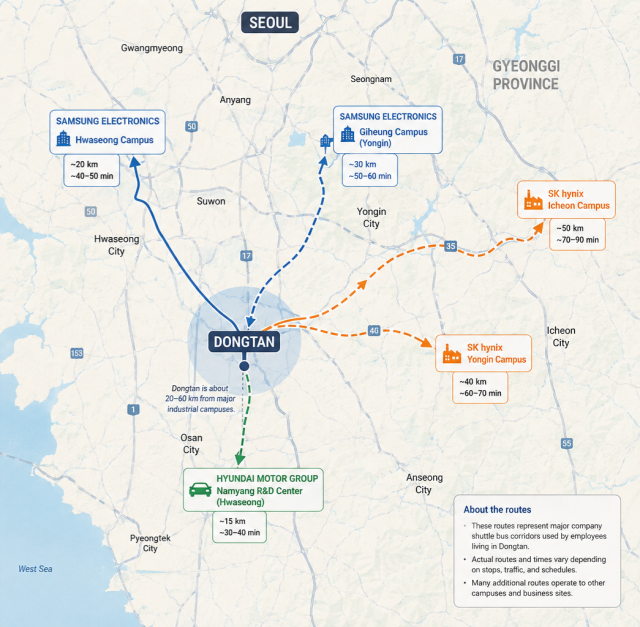
The study analyzed regional card spending in areas where Samsung and SK hynix employees are concentrated, including Icheon, Hwaseong, Pyeongtaek, Cheongju and Giheung in Yongin.
The card data, drawn from NH NongHyup Card and Hana Card, are based on cardholders’ billing addresses rather than the locations where purchases were made.
In the three areas with the highest semiconductor exposure — Icheon, Hwaseong and Cheongju’s Heungdeok District — monthly consumption rose as much as 1.6 percent relative to areas with little semiconductor exposure after bonus payments began in 2025.
The gap narrowed later that year before widening again as bonus payouts increased in 2026, reaching 3.7 percent in June. Across high-exposure regions more broadly, the estimated spending boost reached as much as about 4 percent.
The BOK researchers defined semiconductor exposure as the share of adult residents estimated to work for Samsung Electronics or SK hynix. Icheon ranked highest at 6.8 percent, followed by Hwaseong at 4.6 percent and Cheongju’s Heungdeok District at 3.6 percent.
The spending response was heavily skewed toward goods that tend to react strongly to changes in income.
Cars, department stores, appliances, furniture and other expensive discretionary purchases accounted for much of the increase, while everyday spending at supermarkets and convenience stores and outlays on medical care and education showed little noticeable change.
Tesla deliveries provide one of the clearest examples.
Average monthly deliveries in major semiconductor-beneficiary areas jumped 105.6 percent from their 2025 average in the first half of this year, compared with a 77.2 percent increase nationwide, according to Korea Automobile Importers & Distributors Association data cited in the study.
The pattern is consistent with other indicators of high-end consumption in semiconductor hubs.
Lotte Department Store’s Dongtan branch posted a 25 percent year-on-year increase in first-half sales, while sales of luxury goods and foreign-brand watches and jewelry rose roughly 40 percent to 45 percent, according to Lotte Department Store.
Imported vehicle registrations in Hwaseong, home to Samsung Electronics’ major semiconductor operations and the Dongtan residential district, increased 42.5 percent to 4,273 vehicles in the first half from 2,998 a year earlier, according to the Korea Automobile Importers & Distributors Association. Nationwide registrations rose 33.2 percent over the same period.
The BOK study, however, suggests that some of the semiconductor windfall is flowing into property rather than consumption, limiting its immediate spillover into the broader economy.
Property registration data showed that Icheon residents sharply increased purchases of homes elsewhere in the Seoul metropolitan area after bonus payments.
Purchases were concentrated in Dongtan, Yongin and Suwon in southern Gyeonggi Province as well as Seongnam and Hanam. The average monthly number of purchases in Dongtan roughly doubled from a year earlier.
Cheongju showed a contrasting pattern. Residents there largely continued buying homes locally, while consumer spending responded more strongly than in Icheon despite the area’s lower semiconductor-worker exposure.
The researchers said the comparison suggests that bonuses have a greater impact on consumption when less of the additional income is absorbed by property purchases.
So far, the additional spending is estimated to have lifted the level of gross domestic product by 0.01 percent in 2025 and 0.03 percent in 2026.
The potential impact becomes much larger next year.
Samsung’s semiconductor division and SK hynix are estimated to pay a combined 62 trillion won in performance bonuses for 2027, based partly on brokerage earnings forecasts. Of that, about 21.9 trillion won could be immediately available after tax, roughly five times this year’s 4.4 trillion won.
Under the researchers’ scenarios, the resulting consumption could lift the level of GDP by 0.08 percent to 0.12 percent in 2027, translating into an increase of 0.06 to 0.09 percentage point in annual economic growth.
The ultimate effect will depend on how much of the windfall reaches more households and more parts of the economy.
The researchers said the spillover could strengthen if semiconductor companies expand employment as well as wages, if additional income flows into consumption rather than property and other assets, and if spending eventually broadens from cars and luxury goods into services and everyday consumption.
That distinction matters because the study found that spending on cars, online purchases and high-end discretionary goods generates relatively less domestic labor income and more imports than spending on many services and everyday goods.
Past manufacturing booms suggest that broader spillovers can take time.
During earlier upswings in Korea’s automobile and chemical industries, wage gains came first, while employment and service-sector consumption strengthened later.
The researchers said a similar pattern could emerge in semiconductors as Samsung and SK hynix accelerate capacity expansion and hiring to meet chip demand.
AJP Takeaways
• Samsung Electronics and SK hynix bonuses lifted consumption in Korea’s most semiconductor-exposed communities by as much as about 4 percent relative to low-exposure areas, according to a BOK study.
• Chip bonuses generated an estimated 1.1 trillion won in additional consumption through June 2026, with the cumulative amount projected to reach about 1.7 trillion won by year-end.
• The windfall remains concentrated in cars, department stores, appliances and other high-end discretionary goods, while some additional income is flowing into property purchases.
• Much larger 2027 bonuses could add 0.06 to 0.09 percentage point to South Korea’s economic growth, depending on how much income is spent rather than saved or invested in assets.

Copyright ⓒ Aju Press All rights reserved.