
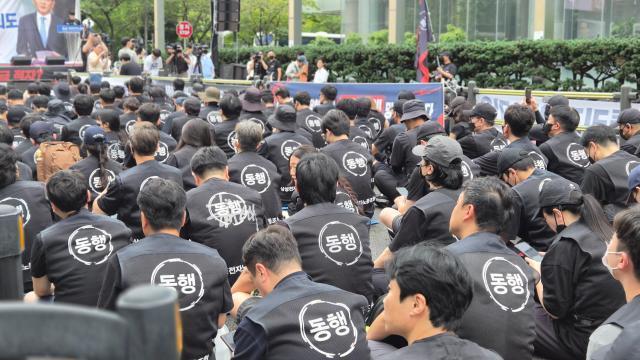
The guidelines shown Thursday follow the so-called Yellow Envelope Act, the revised Trade Union Act that widened the grounds for bargaining and industrial action.
They also come after a year in which labor activism spread beyond South Korea's traditionally union-heavy auto, shipbuilding and manufacturing sectors into semiconductors and information technology, as workers sought a larger share of windfall profits generated by the global AI boom.
Samsung Electronics narrowly averted an 18-day strike in May after agreeing to a special bonus pool equivalent to 10.5 percent of semiconductor operating profit.
At SK hynix, where workers last year secured bonuses funded by 10 percent of operating profit, production workers in August rejected a new wage agreement amid disputes over how the payouts would be made.
The trend has spread into IT. Kakao workers staged the company's first-ever strike in June and later took coordinated leave after demanding that roughly 13 to 14 percent of operating profit be distributed as performance incentives.
The ministry said demands that curb the rights of shareholders and others or that hinge on a mere possibility of changing working conditions fall outside that scope.
At issue are demands popularized by a pay dispute at Samsung Electronics, where the union sought a bonus pegged to a percentage of operating profit.
The ministry said such demands may be negotiated voluntarily but cannot trigger mediation or a lawful walkout.
Operating profit is earned before interest, taxes and dividends and funds research and capital spending, the ministry said, and carving it out first for bonuses could fundamentally restrict a company's freedom to operate.
Bonuses fixed as a share of salary or a flat sum remain open to bargaining.
"Large-scale projects such as new plants take a long time from announcement to actual operation, so their impact on working conditions is uncertain in the early stages," the ministry said, adding that a possibility of future transfers alone does not create a duty to bargain.
The measures will fall into the chip plants to be built in the Honam region, where Samsung's umbrella union sought to make the new plant a bargaining item over staff redeployment.
Bargaining becomes mandatory only once layoffs, restructuring or transfers are confirmed and changes to working conditions are objectively expected.
The same test applies to the introduction of artificial intelligence and new technology, such as Hyundai Motor Group's deployment of the Atlas robot.
Employers who reject such demands will not be deemed to have committed unfair labor practices, the ministry said, and labor authorities may recommend that unions soften unreasonable claims or face administrative guidance akin to a court dismissal.
AJP Takeaways
• South Korea's Labor Ministry issued binding guidelines on Sept. 3, 2026, barring unions from making profit-linked bonus demands or opposition to new plant construction the basis for mandatory bargaining or legal strikes.
• The guidelines interpret the revised Trade Union Act, known as the Yellow Envelope Act, and target disputes raised at Samsung Electronics over operating-profit bonuses and a planned chip plant in the Honam region.
• Employers refusing such demands will not be found to have committed unfair labor practices, and the National Labor Relations Commission may direct unions toward administrative guidance rather than granting the right to strike.

Copyright ⓒ Aju Press All rights reserved.
