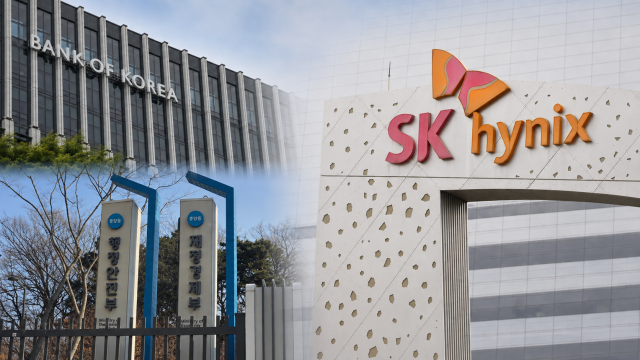
The Foreign Exchange Stabilization Fund, or FESF, bought about $20 billion in dollars repatriated after SK hynix raised $26.5 billion through an American depositary receipt offering in July, Reuters reported Wednesday, citing a source with direct knowledge of the matter.
The transactions were conducted over the counter rather than through the domestic spot foreign-exchange market, according to the report.
Neither the Ministry of Economy and Finance nor the Bank of Korea provided a substantive response to AJP by publication time. Inquiries were repeatedly referred among internal departments at both institutions.
The authorities did not confirm the reported amount, timing or execution of the transactions. Details including the intermediating financial institutions and exchange rates also remain unclear.
The reported purchase represents roughly three-quarters of SK hynix's ADR proceeds.
Absorbing the dollars outside the spot market would reduce the amount of corporate dollar supply reaching Seoul at once, limiting the risk of a sharp appreciation in the won from a single large transaction.
Reuters said the purchases were intended to reduce foreign-exchange volatility and replenish foreign-currency holdings after earlier efforts to support the won.
The won nevertheless strengthened sharply Thursday.
The Korean currency closed daytime trading at 1,359.3 per dollar, 9.4 won stronger than Wednesday's close of 1,368.7, putting it near levels last seen in July 2025.
Exporter dollar selling has remained a major source of supply, while a softer U.S. currency and a firmer yen have provided additional support in recent sessions.
An FESF purchase outside the spot market would have reduced potential dollar selling and slowed the won's appreciation. Continued gains point to additional supply from exporters and shifts in global currency markets.
SK hynix's $26.5 billion fundraising had drawn attention from currency traders for months because of uncertainty over how much of the proceeds would ultimately be converted into won.
Direct conversion of such a large amount could create a strong one-way flow in Seoul, giving authorities an incentive to smooth the transaction outside the spot market.
The report also comes as South Korea's foreign-exchange reserves recorded their largest monthly increase on record in August.
Reserves rose $14.33 billion to $442.28 billion at the end of August, the BOK said Thursday.
Foreign securities increased $7.07 billion to $387.07 billion, while foreign-currency deposits rose $7.17 billion to $30.30 billion.
The BOK attributed the increase to larger foreign-currency deposits by financial institutions, investment income and an increase in the dollar value of assets denominated in other currencies.
Publicly available information does not establish whether the reported SK hynix purchase contributed to the August reserve increase or, if it did, by how much.
Foreign-exchange conditions have changed sharply since the first half of the year.
The won weakened to around 1,550 per dollar in late June, prompting concern over rapid depreciation and demand for dollars.
Large exporter and corporate dollar inflows now present a different challenge as the won moves in the opposite direction.
Foreign-exchange authorities have generally described their role as limiting excessive volatility rather than defending a particular exchange-rate level. The reported transaction would fit that objective by reducing the market impact of an exceptional corporate dollar flow, although its size and execution remain officially unconfirmed.
With the won closing Thursday at 1,359.3 per dollar, traders are watching how much exporter and corporate dollar supply remains and whether importer demand strengthens at firmer won levels.
AJP Takeaways
South Korean foreign-exchange authorities reportedly bought about $20 billion of SK hynix's $26.5 billion ADR proceeds through off-market transactions, keeping most of the potential dollar flow from reaching the Seoul spot market at once.
The won nevertheless closed Thursday at 1,359.3 per dollar, 9.4 won stronger, pointing to additional support from exporter selling and broader global currency moves.
Neither the finance ministry nor the BOK provided a substantive response to AJP, while available data do not establish whether the reported transaction contributed to August's record increase in foreign-exchange reserves.

Copyright ⓒ Aju Press All rights reserved.