
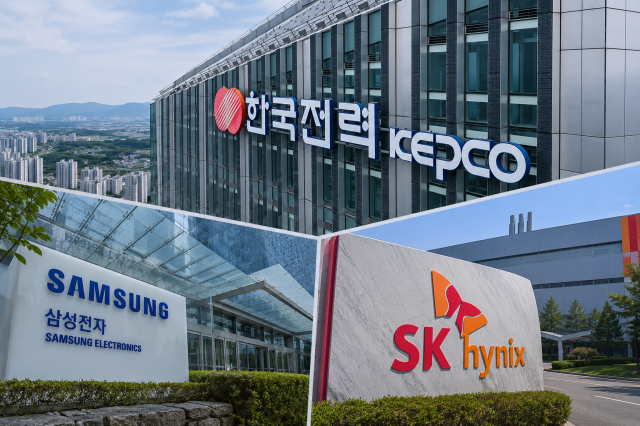
SEOUL, September 03 (AJP) - South Korean memory makers envisioning an expansive build-out under government's ambitious push to turn the country into a chip republic involves more than billions of dollars for construction and purchases of land and equipment as chip facilities rely on seamless power and water supplies to keep the fab running 24/7.
Under unprecedented government eagerness to the chip expansion to add chip facilities in Yongin as well as Honam region, southern part of the country, the country's state utility monopoly is proposing an unusual arrangement – a lump-sum power deal that can possibly save Samsung Electronics and SK hynix unpredictable disturbances and the state utility an one-off windfall to erase its deficit.
Korea Electric Power Corp. (KEPCO) has proposed an advance-payment scheme to major electricity consumers including Samsung Electronics and SK hynix as the state-run utility searches for new ways to finance transmission infrastructure needed for rapidly expanding chip production and AI data centers.
The logic appears straightforward. KEPCO gets money upfront to build the grid, while semiconductor companies gain greater certainty that the enormous amounts of electricity required by their future fabs will be available when production begins.
But whether that bargain works for both sides is more complicated.
KEPCO confirmed that discussions with large electricity consumers are underway but stressed that the proposal remains at an early stage.
"Discussions are underway, but details including the amount and period have not been decided," a KEPCO official told AJP.
The utility also pushed back against reports that Samsung Electronics and SK hynix had been asked to prepay a combined 25 trillion won ($18 billion), saying no such figure had been set.
Participation, interest rates, payment amounts and payment periods have yet to be finalized.
A 72.8 trillion won grid bill
Behind the proposal is the sheer scale of investment required to connect South Korea's next generation of semiconductor factories and other power-intensive industries to the grid.
KEPCO's latest long-term transmission and substation plan calls for 72.8 trillion won in grid investment through 2038, up 16.3 trillion won from its previous plan.
The Yongin semiconductor cluster alone is eventually expected to require more than 10 gigawatts of electricity, underscoring the infrastructure demands behind South Korea's attempt to build one of the world's largest semiconductor manufacturing hubs.
The issue carries wider significance as Samsung and SK hynix expand capacity to meet surging global demand for memory used in artificial intelligence.
Unlike ordinary industrial facilities, semiconductor fabs require huge volumes of stable electricity around the clock. Building the fab itself therefore solves only part of the problem. Transmission lines, substations and other infrastructure must also be ready when production starts.
Such project creates a timing mismatch for KEPCO as enormous sums must be invested in the grid before the factories consuming the electricity are fully operational and paying their bills.
The proposed advance-payment system seeks to close part of that gap by bringing future electricity revenue forward.
Large consumers would prepay a portion of their future electricity charges, with KEPCO using the funds to finance grid infrastructure.
KEPCO said the scheme could provide an alternative to bond issuance while offering participating companies returns above government bond yields.
Why KEPCO wants cash upfront
The proposal also reflects the financing constraints facing the utility as its investment burden rises.
KEPCO has traditionally relied heavily on bond issuance alongside electricity revenue to finance investment.
But heavy issuance by the highly rated state utility can reverberate across South Korea's credit market.
In 2022, KEPCO issued 31.8 trillion won worth of bonds as soaring energy costs strained its finances, raising concerns that utility debt was soaking up investor demand that might otherwise have gone into corporate bonds.
KEPCO argues advance payments could reduce its dependence on such borrowing.
The utility said securing investment funds through a channel other than bonds could leave more capital available in the domestic bond market for private companies, including small and midsized businesses.
For KEPCO, the math is simple. Revenue that would normally arrive years later becomes available today to finance infrastructure that must be built before demand materializes.
For Samsung Electronics and SK hynix, however, the calculation is different.
What's in it for Samsung and SK hynix?
Paying electricity bills before consuming the power means tying up capital that could otherwise be deployed elsewhere.
Two memory giants are pouring enormous sums into fabs, advanced manufacturing equipment and research and development to compete in the global AI chip race – partly on and against their will.
KEPCO is considering returns above government bond yields to make participation financially attractive. Those returns could potentially be provided through deductions from future electricity bills rather than cash payments.
But a return above government bonds does not by itself establish that prepaying electricity is the best use of corporate capital.
Yang Jun-mo, an economics professor at Yonsei University, questioned whether private companies should be asked to bring forward future electricity payments to help finance infrastructure investment by a financially constrained public utility.
"If a public corporation is facing financial difficulties, the government should provide support where those difficulties stem from government policy, or it should raise funds by issuing bonds," Yang said.
He also questioned the economic rationale for requiring companies to pay electricity charges before consuming the power, saying corporate capital should ultimately remain available for productive investment.
The issue comes down partly to opportunity cost.
Money committed to advance electricity payments cannot simultaneously be invested in semiconductor production capacity, equipment or technology. The return offered by KEPCO therefore represents only one part of the calculation for chipmakers.
The other — and potentially more important — consideration is whether paying upfront can help ensure that power infrastructure is ready when their new factories need it.
A semiconductor fab represents an enormous capital investment, but it cannot generate returns if sufficient electricity is unavailable when production is scheduled to begin.
For chipmakers competing globally to bring new capacity online as quickly as possible, a grid delay can become a manufacturing delay.
If advance payments materially accelerate construction of transmission lines and substations, the value of avoiding delays at multibillion-dollar fabs could outweigh the opportunity cost of committing cash early.
But financing is only one obstacle to expanding the grid.
Large transmission projects can also face lengthy permitting procedures, land acquisition difficulties and opposition from communities along proposed routes. More money does not automatically mean electricity can be delivered sooner.
If capital is the principal bottleneck, bringing future electricity revenue forward could help KEPCO build infrastructure faster while giving semiconductor companies a tangible reason to participate.
If the larger obstacles are permitting, transmission routes and local acceptance, the case for tying up billions of dollars in advance becomes harder to make.
Who should pay for Korea's chip-era grid?
The debate ultimately goes beyond how KEPCO raises money.
South Korea's semiconductor and AI ambitions are creating electricity demand on a scale that requires enormous infrastructure investment, raising a broader question over how the cost should be divided among the state, the utility and the companies driving that demand.
There is an economic argument for asking major beneficiaries of new infrastructure to shoulder some of the cost.
Semiconductor companies require vast amounts of new transmission capacity, and delays in delivering electricity could directly constrain their expansion at a time when Korea is competing with the United States, Taiwan, Japan and China to secure the next wave of semiconductor investment.
At the same time, the national power grid is public infrastructure serving far more than individual companies or industries.
For now, the arrangement remains a proposal.
KEPCO said no decision has been made on how much companies would prepay, for how long, what return they would receive or whether individual companies would participate.
Those details will determine whether advance electricity payments become a new way to finance South Korea's chip-era power grid.
For Samsung Electronics and SK hynix, the more fundamental question is what they receive for committing capital years early: whether doing so can actually deliver electricity where and when their next generation of fabs needs it.
AJP Takeaways
• Korea's chip build-out is running into a grid challenge — New semiconductor fabs require not only billions in factories and equipment but massive transmission and substation investment, with the Yongin cluster eventually expected to demand more than 10 gigawatts.
• KEPCO wants future power revenue upfront — The utility is considering advance electricity payments from major users including Samsung Electronics and SK hynix as it faces 72.8 trillion won in grid investment through 2038.
• Chipmakers face a capital-allocation trade-off — Prepaying power bills could improve certainty over future electricity supply but tie up money otherwise available for fabs, equipment and R&D in the global AI chip race.
• The real test is whether prepayment speeds delivery — The proposal becomes more compelling if upfront cash accelerates grid construction, but permitting, land acquisition and local opposition could remain bottlenecks regardless of financing.

Copyright ⓒ Aju Press All rights reserved.
