
SEOUL, September 18 (AJP) -South Korea's producer prices spiked toward an on-year increase of 8 percent on re-accelerating energy costs and unrelenting chip prices, pointing to sticky price pressure and a tightening bias in the latter half, central bank data showed Friday.
The producer price index for August added 0.2 percent from July and 7.9 percent from a year earlier, reversing an easing trend in July, when it fell 0.4 percent on month and rose 7.7 percent on year, according to the Bank of Korea (BOK).
Energy prices resumed their climb after retreating in July. The BOK's energy subindex rose 1.0 percent from the previous month after falling 3.6 percent in July, while its on-year gain accelerated to 11.1 percent from 9.7 percent.
Coal and petroleum products gained 0.4 percent on month, reversing a 4.2 percent fall in July, and were 54.3 percent higher than a year earlier. Industrial city gas prices surged 11.0 percent from July and 37.8 percent on year.
The renewed energy pressure came as Dubai crude, South Korea's benchmark, averaged $88.75 per barrel in August, up 15.6 percent from $76.75 in July. Worse, the upper pressure has worsened from renewed tensions in the Middle East.
International oil prices during Sept. 1-16 were about 29 percent higher than the August average, while wholesale industrial city gas rates rose 6.6 percent this month, which could add upward pressure to producer prices, said Lee Heung-hoo, head of the BOK's price statistics team.
Chip prices remained another persistent source of inflation. Semiconductor producer prices rose 1.4 percent from July and 147.6 percent from a year earlier, while prices for computer and peripheral equipment jumped 6.3 percent on month and 158.3 percent on year.
Computer memory device prices alone surged 8.8 percent from July, while DRAM prices were 476.1 percent higher than a year earlier, according to the BOK.
Market researcher TrendForce expects conventional DRAM contract prices to rise 13 to 18 percent in the third quarter from the previous quarter as strong AI-server demand and tight supply continue to support prices.
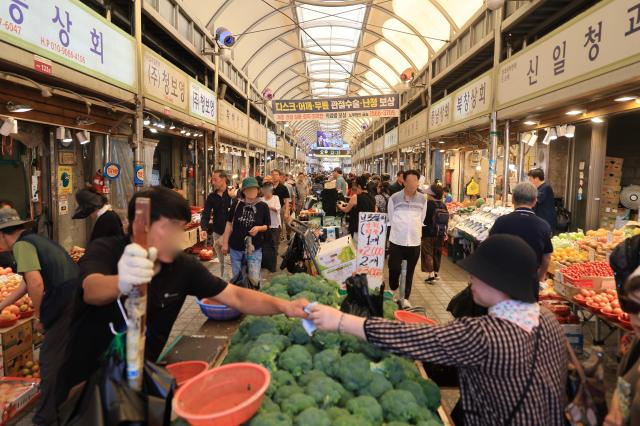
Higher agricultural prices from a scorching heat wave added to the monthly rise. Agricultural, forestry and fishery products climbed 3.8 percent from July, led by a 4.9 percent increase in agricultural products and a 2.8 percent gain in livestock prices. Fresh food prices jumped 7.4 percent on month.
Underlying price pressure remained elevated even without food and energy. The producer price index excluding the two categories was unchanged from July but stood 8.2 percent higher than a year earlier despite a stronger won.
The won averaged 1,406.3 per dollar in August, strengthening 6.1 percent from 1,497.4 in July, according to BOK data.
The effect was evident in the domestic supply price index, which combines domestically produced and imported goods.
It fell 1.3 percent from July as imported raw-material prices dropped 6.4 percent, imported intermediate goods fell 5.9 percent and imported final goods declined 5.8 percent. The overall index nevertheless remained 8.6 percent higher than a year earlier.
The renewed uptick in producer price suggests sustained pressure on consumer inflation front through much of the second half.
The BOK raised its benchmark rate by 25 basis points to 3.00 percent on Aug. 27, its second consecutive increase, saying inflation was likely to stay above its 2 percent target for a considerable period.
Its September monetary policy report maintained a tightening bias, saying the bank would determine the timing and pace of additional rate hikes based on inflation, growth and financial stability conditions.
AJP TAKEAWAYS
- South Korea's producer inflation reaccelerates: August PPI rose 0.2% on month and 7.9% on year, reversing July’s monthly decline and edging closer to 8%.
- Energy and chips stay hot: Energy prices rose 1.0% m/m and 11.1% y/y, while semiconductor producer prices climbed 1.4% m/m and 147.6% y/y; DRAM prices were up 476.1% y/y.
- Second-half inflation pressure persists: The renewed producer-price uptick points to continued pass-through pressure on consumer prices, reinforcing the BOK’s tightening bias even as a stronger won cushions imported costs.

Copyright ⓒ Aju Press All rights reserved.
