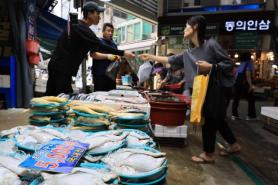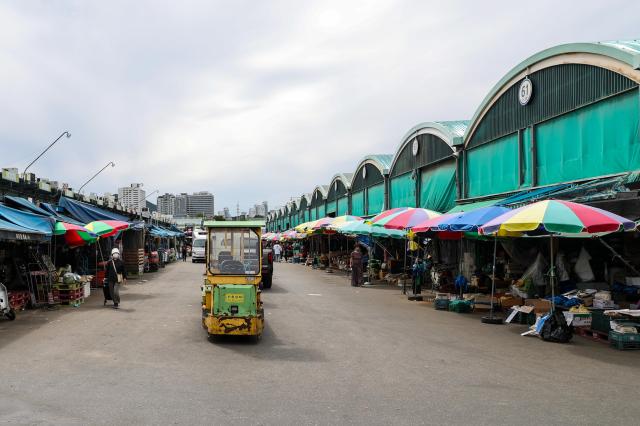
"The holiday is shorter this year, and it looks like many are skipping this year. The business is not good," said a wholesaler at Garak Market in southern Seoul.
"The fruit prices are horrific. Instead of a box of pears, I bought only a couple for the jaesa (a food table to pay respect to ancestors)," said 72-year-old Kim Yoo-jeong, a Seoul resident.
Exports are on course to reach the $1 trillion milestone, and the economy is enjoying a semiconductor-led boom. But in grocery shops and around dinner tables, the abundance is not widely shared.
The gap presents a difficult judgment for policymakers. How much tightening can households bear when the growth and wage figures supporting higher interest rates reflect gains many have yet to receive?
September consumer sentiment data due Wednesday will offer another measure of that divide as the Bank of Korea weighs further rate increases. A weaker reading would sharpen the tension between responding to inflationary pressure in the broader economy and adding to the strain on household budgets.
The survey will be the first since the BOK raised its base rate by 25 basis points to 3 percent on Aug. 27, its second consecutive increase. Consumer sentiment softened in August but remained above 100, indicating greater optimism than its long-term average.
The case for tightening rests partly on the strength of the headline numbers.
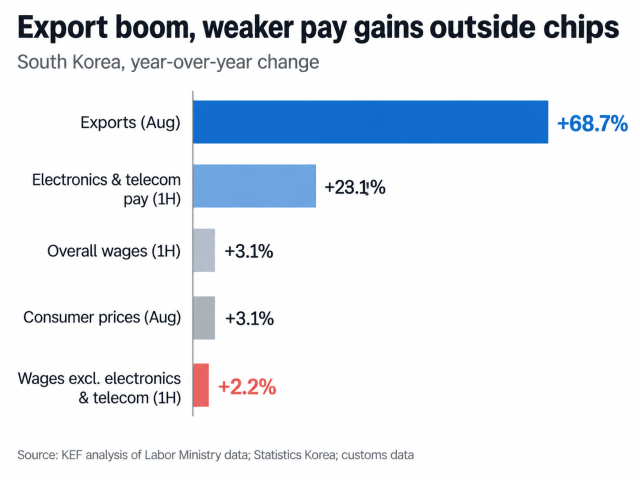
Exports surged 68.7 percent in August from a year earlier, led by record semiconductor shipments. Consumer prices rose 3.1 percent, while the central bank has cited the risk of wage gains feeding into demand and prices in arguing for preemptive rate increases.
Yet the wage figures show how unevenly that purchasing power is distributed.
Average monthly pay for regular employees, excluding overtime payments, rose 3.1 percent in the first half from a year earlier to 4.318 million won, according to a Korea Enterprises Federation analysis of Labor Ministry data released Sunday.
Growth in fixed monthly pay slowed to 2.2 percent. Special payments, including performance bonuses, rose 9.3 percent to a monthly average of 601,000 won, the highest level since 2011.
Much of the windfall was concentrated in electronics and telecommunications manufacturing, which includes the semiconductor industry.
Average monthly pay in the sector jumped 23.1 percent to 9.434 million won, with special payments surging 66 percent. Its roughly 377,000 workers accounted for just 2.5 percent of the workforce covered by the analysis, but the sector generated 32.4 percent of the overall increase in special payments.
Excluding the sector, average monthly pay rose just 2.2 percent to 4.187 million won, which can partly explain why everything feels so expensive as the gain falls below the annual inflation rate.
Borrowing costs can rise before those benefits arrive.
Further rate increases could add to repayment difficulties and delinquency risks for vulnerable borrowers before the benefits of slower debt growth emerge, Lim Kwang-kyu, director general of the BOK’s Financial Stability Department, said Tuesday.
A 25-basis-point increase would add about 7 trillion won ($5.1 billion) to the combined interest burden on households and companies, Lim said. Vulnerable households and smaller companies tend to feel the effects sooner than borrowers overall, according to the central bank’s analysis.
For families preparing for Chuseok, the immediate pressure is at the checkout.
The government has responded with record discount subsidies and increased supplies of holiday staples.
Support for discounts on domestic agricultural and livestock products has nearly tripled to 149 billion won from 50 billion won last year.
The Korea Agro-Fisheries & Food Trade Corp.’s survey across 22 regions put the cost of a traditional ancestral offering table 1.5 percent below last year’s level. A separate Seoul Agro-Fisheries & Food Corp. survey found an average increase of 5.1 percent.
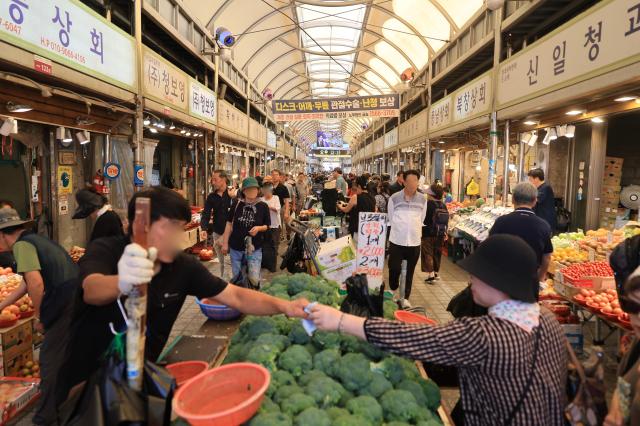
To address supply constraints, the government is also increasing supplies of 13 major holiday products, including apples, pears and Korean beef, to 163,000 tons, or 1.6 times normal levels.
The measures can provide immediate relief. But temporary discounts cannot by themselves resolve production losses from extreme weather or higher labor and distribution costs. When the subsidies expire, shoppers could face higher out-of-pocket costs even without a further rise in underlying prices.
How households interpret those pressures will be an important part of Wednesday’s survey.
Expectations for inflation over the following year held at 2.7 percent in August, below that month’s actual inflation rate of 3.1 percent. A rise in the September expectations reading could strengthen the case for continued tightening, even if confidence in household finances weakens.
A broader recovery in semiconductor-related activity could eventually support domestic-demand industries and ease financial vulnerabilities, BOK officials said Tuesday.
For now, policymakers must judge how far that recovery has traveled beyond chip factories and export accounts.
AJP Takeaways
- South Korea’s export boom has yet to translate evenly into household income, with wage gains heavily concentrated in the semiconductor-heavy electronics sector.
- Chuseok shoppers continue to face high food and living costs even as the government expands discount support and holiday food supplies.
- The Bank of Korea must weigh resilient growth and inflation pressures against rising borrowing costs and uneven household finances as it considers further rate increases.

Copyright ⓒ Aju Press All rights reserved.