
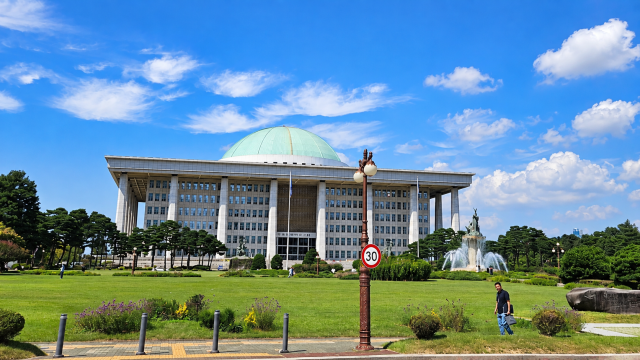
SEOUL, October 04 (AJP) - South Korea’s National Assembly will open its annual state audit on Tuesday, setting the stage for three weeks of clashes over everything from housing and North Korea to a massive semiconductor project, nuclear exports and an unlikely new health-policy controversy involving skin injections made from donated human tissue.
The audit, the second to scrutinize President Lee Jae Myung’s administration, will run from Oct. 6 through Oct. 27, with several overlapping committees continuing through the end of the month. The ruling Democratic Party has cast the session as an audit focused on policy and people’s livelihoods, while the main opposition People Power Party is preparing a broad challenge to what it calls the Lee government’s failures in economic, security and personnel policy.
Interviews with lawmakers and government officials by AJP suggest that the political battle will play out through a strikingly wide range of issues, from bread-and-butter economic concerns to highly technical questions over nuclear intellectual property and medical regulation.
“This audit is about people’s livelihoods. The other side may engage in partisan fighting, but as the ruling party responsible for people’s lives, we intend to focus solely on livelihood issues,” Kim Nam-joon, a Democratic Party lawmaker on the National Assembly’s Strategy and Finance Committee, told AJP.
Kim’s committee is expected to be one of the main economic battlegrounds. Government tax policy, fiscal spending and the newly created future response fund are among the issues facing scrutiny. Kim, a former presidential spokesperson and first secretary to Lee, sits on both the finance committee and the Special Committee on Budget and Accounts.
The opposition sees the same audit very differently.
“We need to call out and correct the Lee Jae Myung government’s policy failures,” said Ahn Sang-hoon of the People Power Party, also a member of the Strategy and Finance Committee.
“The biggest problem is that national policy dances to a single word from a president who is not an expert. In this government, ministers simply obey orders from above and offer no candid advice. Professional bureaucrats should be willing to tell even the president, ‘This cannot be done.’”
Ahn, who served as a senior social policy secretary under former President Yoon Suk Yeol, is among the opposition lawmakers expected to use the audit to challenge the administration’s decision-making process as well as its policy results.
Financial policy will provide another frontline.
“The opposition will probably keep hammering away at leveraged ETFs,” Democratic Party lawmaker Son Myoung Soo of the National Policy Committee told AJP. “I plan to propose alternatives to the real-estate PF problem to help stabilize housing supply.”
Single-stock leveraged exchange-traded funds have already emerged as an opposition target, while concerns over real-estate project financing, or PF, remain closely tied to housing supply and financial-sector stability.
The People Power Party has sought to bring senior presidential officials before parliamentary committees over both leveraged ETFs and housing policy.
Inside Cheong Wa Dae, officials are preparing for the audit as both a policy examination and a political defense of the administration.
“We have to defend against the opposition during the audit and also properly explain the Lee Jae Myung government’s achievements,” Bae Jin-gyo, presidential secretary for public engagement, told AJP.
Some of the sharpest clashes, however, are likely to come over foreign policy and national security.
“I expect next week’s audit to focus mainly on the repatriation of North Korean prisoners of war from Ukraine, the DMZ mine incident and Alaska LNG, among other pending issues,” People Power Party lawmaker Kim Gunn, a former South Korean chief nuclear envoy and member of the Foreign Affairs and Unification Committee, told AJP.
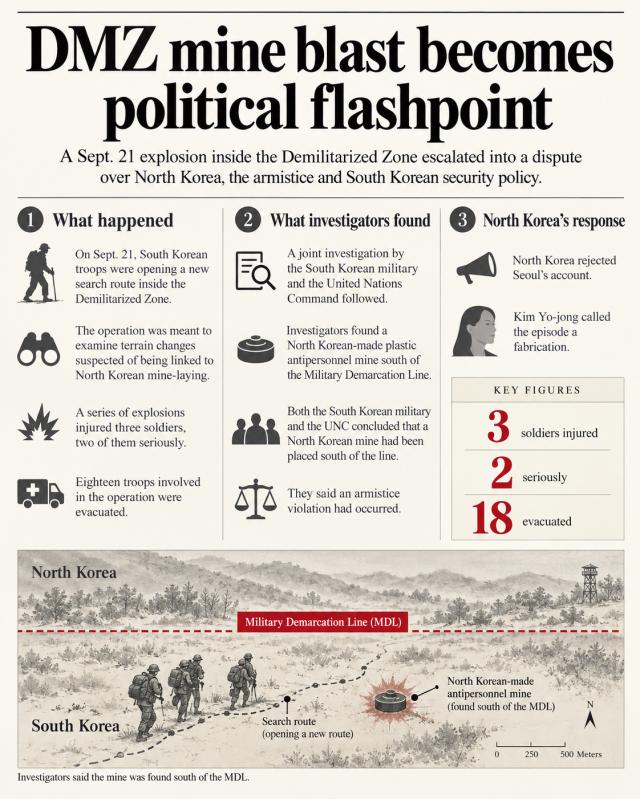
The DMZ case has already developed into a politically explosive dispute.
On Sept. 21, South Korean troops were opening a new search route inside the Demilitarized Zone to examine terrain changes suspected of being connected to North Korean mine-laying when a series of explosions injured three soldiers, two seriously. Eighteen troops involved in the operation were evacuated.
A subsequent joint investigation by the South Korean military and the United Nations Command found a North Korean-made plastic antipersonnel mine south of the Military Demarcation Line. Both the South Korean military and the UNC concluded that a North Korean mine had been placed south of the line and that an armistice violation had occurred. North Korea rejected Seoul’s account, with Kim Yo-jong calling the episode a fabrication.
The incident is likely to feed a broader opposition argument that Lee’s efforts to lower tensions with Pyongyang have gone too far.
“I plan to examine the diplomatic and security breakdown stemming from the Lee government’s submissive posture toward North Korea and its efforts to cater to Kim Jong-un, as well as what I regard as Unification Minister Chung Dong Young’s policies that effectively aid the enemy,” People Power Party lawmaker Park Choong-kwon of the Foreign Affairs and Unification Committee told AJP.
Park’s language reflects the confrontational line the PPP is expected to take toward the administration’s North Korea policy. The party has already blamed what it describes as the government’s overly conciliatory approach for weakening deterrence after the DMZ incident.
But criticism of Lee’s foreign policy will not come only from the conservative opposition.
“The core of this audit is livelihoods and reform. Our party intends to focus especially on inequality,” Kim Joon-hyung, floor leader of the Rebuilding Korea Party and a member of the Foreign Affairs and Unification Committee, told AJP.
“As a member of the committee, I plan to critically examine foreign policy across the board because I believe it has not changed much from the Yoon Suk Yeol government.”
Kim, a former chancellor of the Korea National Diplomatic Academy, represents a critique of the Lee administration from the progressive flank rather than the right.
Industry policy will provide another major test, with lawmakers preparing to scrutinize both one of Lee’s flagship regional development projects and the legacy of a controversial nuclear agreement signed under Yoon.
“I plan to focus my questions on the Honam semiconductor cluster,” Democratic Party lawmaker Jung Jin-wook of the Trade, Industry, Energy, SMEs and Startups Committee told AJP.
Jung said he also plans to examine what he called the Yoon administration’s “sellout Settlement Agreement” involving Korea Electric Power Corp., Korea Hydro & Nuclear Power and U.S. nuclear company Westinghouse, while highlighting what he described as Industry Minister Kim Jung-kwan and “Team Korea’s” success in overcoming some of its constraints.
The agreement has been contentious since KEPCO and KHNP settled a long-running intellectual-property dispute with Westinghouse in January 2025, clearing a major obstacle to Korea’s Czech nuclear project.
Reported provisions required the Korean side, for every exported reactor, to purchase about $650 million in goods and services from Westinghouse and pay roughly $175 million in technology fees. The agreement also imposed restrictions on independent Korean entry into some major nuclear markets and subjected future technologies, including small modular reactors, to procedures intended to verify technological independence from Westinghouse.
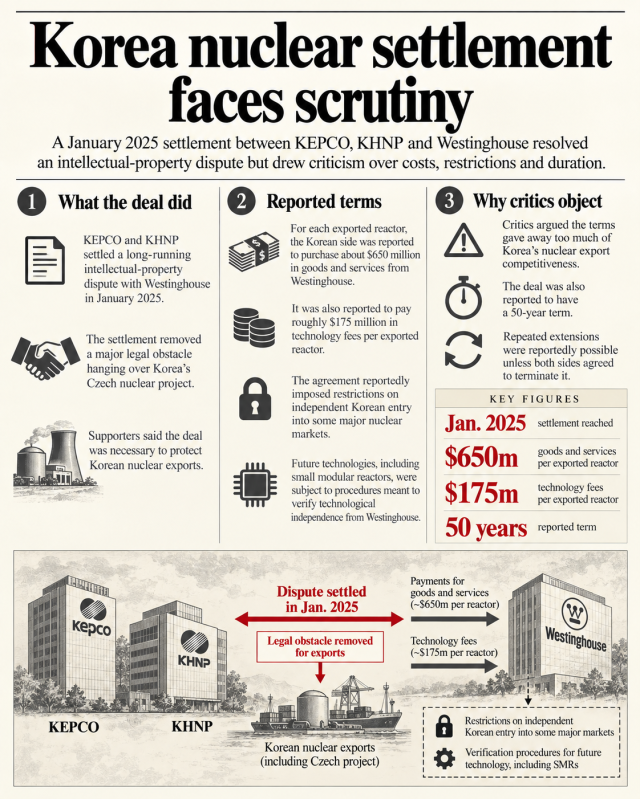
Critics have argued that the terms gave away too much of Korea’s nuclear export competitiveness. The deal was also reported to have a 50-year term, with repeated extensions possible unless both sides agreed to terminate it. Supporters, however, have argued that settlement of the dispute was necessary to remove a legal obstacle hanging over Korean nuclear exports.
That dispute has taken on new significance after Seoul and Washington unveiled plans for up to $120 billion in U.S. nuclear investment involving eight large reactors — six Westinghouse AP1000 units and two Korean APR1400s.
Kim Jung-kwan has said the existing Westinghouse agreement would be amended to make the deployment of APR1400 reactors in the United States possible. Seoul has also been negotiating to acquire a roughly 5 to 10 percent stake in Westinghouse, with the government saying even such a stake could carry voting rights.
For Jung, that contrast — between restrictions accepted under Yoon and an attempt under Lee to reopen the U.S. market to Korean reactors — is likely to become a central line of attack and defense during the industry committee’s hearings.
The Honam semiconductor project will be another.
The Lee government has selected the site of Gwangju’s military airport for a new Honam semiconductor cluster, part of its signature regional “mega-project” strategy. Samsung Electronics and SK hynix are expected to build four semiconductor fabs in the region, with infrastructure planners estimating the complex could eventually require about 6.3 gigawatts of electricity and 650,000 tons of water a day.
The project is already politically sensitive. People Power Party lawmakers have sought to question Samsung Electronics Chairman Lee Jae-yong and SK Group Chairman Chey Tae-won over whether the government pressured the companies to invest in Honam, while the Democratic Party has dismissed the allegation as an attempt to turn a regional industrial project into a political conspiracy.
Health care may produce some of the audit’s most unusual debates.
Democratic Party lawmaker Kim Yoon, a physician and Health and Welfare Committee member, told AJP that his agenda will cover the relationship between non-covered medical services and private indemnity insurance, shortages and poor working conditions among essential-care doctors, reimbursement reform, cross-hospital staffing networks and legal burdens on physicians.
But Kim also plans to take up two increasingly visible consumer health issues: ECM skin boosters and high-caffeine drinks.
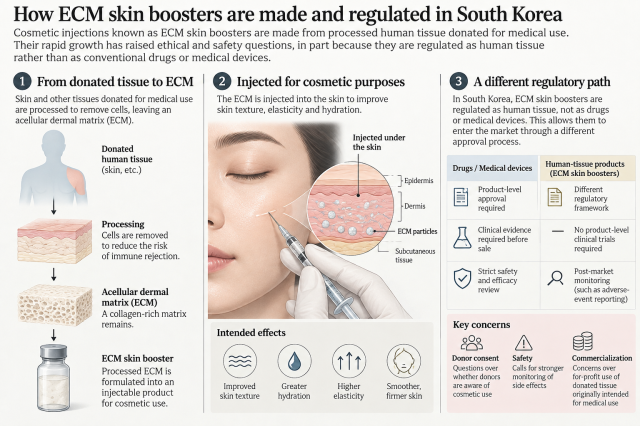
ECM, or extracellular matrix, skin boosters are cosmetic injections made from processed acellular dermal matrix derived from donated human tissue. The treatments have expanded rapidly in South Korea, but critics have raised both ethical and safety questions because the products are regulated as human tissue rather than as conventional pharmaceuticals or medical devices.
That distinction matters. Unlike drugs and medical devices, which generally require product-level approval and clinical evidence before sale, human-tissue products can enter the market through a different regulatory framework. The rapid commercialization of material originally donated for human-tissue use has also raised questions over donor consent and the use of donated tissue in for-profit cosmetic procedures. Regulators have moved to strengthen post-market monitoring, including tighter adverse-event reporting requirements.
High-caffeine drinks pose a different problem.
Data obtained by Kim’s office from South Korea’s four major convenience-store chains showed sales rising around major school exam periods in neighborhoods dominated by private academies. Average daily sales at stores analyzed in Daechi, Mokdong and Junggye rose from 2,445 drinks in March to 2,887 in April, an increase of about 18 percent. They rose from 2,533 in May to 3,154 in June, a jump of roughly 25 percent ahead of final exams.
South Korea classifies liquid products containing at least 0.15 milligrams of caffeine per milliliter as high-caffeine products. The Food and Drug Safety Ministry recommends that children and adolescents consume no more than 2.5 milligrams of caffeine per kilogram of body weight per day and warns that excessive intake can cause sleep problems, anxiety and heart palpitations.
The ministry already restricts the sale of high-caffeine children’s favorite foods at schools and designated “excellent sales” stores, but the new sales data are likely to intensify debate over whether existing protections are sufficient. The ministry’s latest October notice again listed high-caffeine products subject to school and designated-store restrictions.
AJP Takeaways
- South Korea’s annual state audit will open Tuesday, with lawmakers preparing for major clashes over economic policy, North Korea, housing, nuclear exports and regional industrial projects.
- Opposition lawmakers plan to challenge President Lee Jae Myung’s handling of security and economic policy, while ruling-party lawmakers say they will focus on livelihoods, inequality and policy reform.
- Key committee battles are expected over the DMZ mine incident, the Westinghouse nuclear settlement, the Honam semiconductor cluster, leveraged ETFs, real-estate project financing and emerging health issues including ECM skin boosters and high-caffeine drinks.
Copyright ⓒ Aju Press All rights reserved.
