
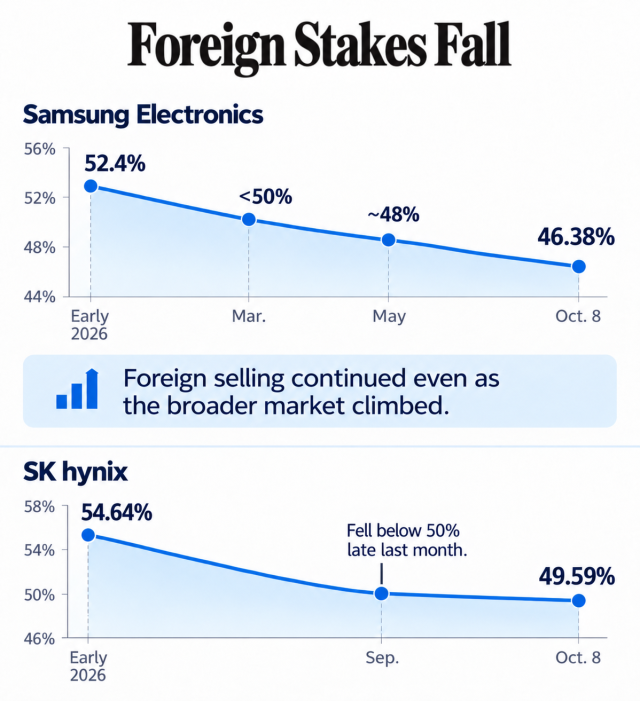
The retreat has been led by record foreign net selling exceeding 227.6 trillion won as of Monday — roughly 25 times the 9 trillion won sold throughout 2025 — despite stronger-than-ever fundamentals, according to the Financial Supervisory Service.
Memory bellwethers Samsung Electronics and SK hynix have been setting earnings records quarter after quarter, fueling red-hot exports on course to reach the $1 trillion annual milestone, with chips accounting for roughly half of shipments.
The won has strengthened more than 7 percent against the dollar this year, reversing its first-half weakness. It closed at 1,335.1 per dollar, strongest since October 2024.
Inflation remains around a manageable 3 percent, although persistent price pressures prompted the Bank of Korea to raise interest rates in both July and August.
Major international investment banks have raised their average growth forecast for 2026 to 3.5 percent, which would mark the strongest expansion since the post-pandemic rebound in 2021.
Yet the foreign retreat suggests deepening unease over the froth in the AI boom and the Korean companies powering it. Investors are questioning how much longer extraordinary chip profits can last — and how much of that prosperity share prices have already anticipated.
What began as profit-taking and portfolio rebalancing increasingly reflects questions about future demand. Higher U.S. bond yields have raised the returns competing for investors’ money, while the approaching end of major share buybacks is weakening the market’s ability to absorb continued selling.
“For foreign investors, the durability of the earnings boom may matter more than the latest quarterly profit figure alone,” a Yuanta Securities analyst told AJP.
Monday’s trading sharpened that disconnect.
Returning from the Hangeul Day holiday, the KOSPI closed down 241.69 points, or 3.65 percent, at 6,384.24 — its steepest daily decline since Sept. 2. It lost both the 6,500 and 6,400 levels during the session.
The benchmark has fallen for four consecutive sessions, shedding 619.50 points, or 8.85 percent, over that period. Foreign investors extended their selling streak to five sessions, unloading a net 2.025 trillion won at the regular-session close. Institutions sold another 110.6 billion won.
The KOSPI 200 volatility index jumped 10.65 percent to 40.73, reflecting heightened market anxiety.
The pressure followed Samsung Electronics’ Oct. 8 guidance for record third-quarter operating profit of 107.4 trillion won ($80.2 billion). Its shares fell about 2.4 percent on the announcement day.
“The earnings were better than expected, but not dramatically so,” the Yuanta analyst said.
Strong results offer less support when investors have already anticipated them and are looking for evidence of the next advance.
Foreign selling also predates the latest market decline.
“The KOSPI was one of the world's strongest-performing markets through June, yet foreign ownership continued to decline,” the analyst said. “Foreign investors were rebalancing their portfolios while retail investors were buying heavily.”
That pattern suggests the initial retreat included locking in gains and reducing exposure to stocks whose rapid appreciation had increased their weight in portfolios.
The concern has since broadened.
“Investors are now increasingly uncertain about the outlook for the broader AI market,” said Woo Seok-jin, an economics professor at Myongji University.
September’s selling was concentrated in the two companies benefiting most directly from the boom. Foreigners sold a net 21.51 trillion won of KOSPI shares, with Samsung Electronics and SK hynix accounting for 16.47 trillion won, or 76.6 percent, according to Korea Exchange (KRX) data.
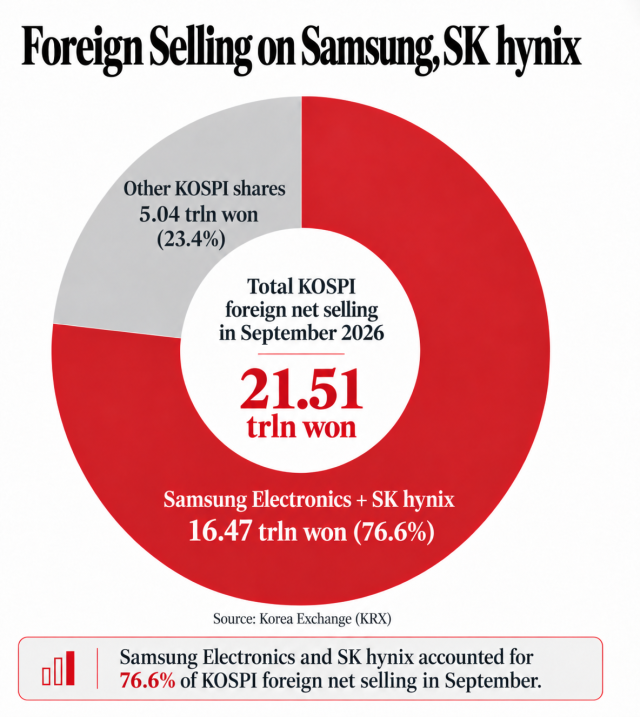
The concentration points to a reassessment of Korea’s dominant investment theme. The semiconductor exposure that powered the rally leaves the market vulnerable when investors question the durability of AI spending.
Current shortages and rising memory prices demonstrate strong demand today. Investors must also judge whether spending on AI services and data centers will keep expanding fast enough to sustain exceptional profitability as chipmakers add capacity.
“There are concerns about whether the overall pie of AI investment will keep growing and which companies will get a bigger slice,” Woo said.
The selling does not establish that an AI collapse is imminent. It suggests some investors are becoming less willing to assume that the current pace of growth will continue.
Higher U.S. Treasury yields reinforce that caution. They increase the return available without taking equity risk and reduce the present value of profits expected further into the future, making investors more demanding about the price they pay for growth.
The Institute of International Finance reported $19.2 billion in emerging-market equity outflows in September following a more hawkish Federal Reserve stance. Korean selling was a major contributor to that total, placing the retreat within a broader tightening of global financial conditions.
“Oil prices have fallen, but U.S. bond yields remain high, so stocks have shown little response,” the Yuanta analyst said.
A major source of buying support is also fading.
Samsung and SK hynix announced combined share repurchases of 55 trillion won in August. Samsung’s 15 trillion won program was intended for employee compensation, while SK hynix committed 40 trillion won to repurchases and cancellations.
By Oct. 6, Samsung had purchased its planned number of shares, while SK hynix had completed about 83 percent of its program by value.
The approaching end of those purchases helps explain why continued foreign selling can now have a greater impact on prices. A buyer that had absorbed substantial supply is stepping back.
The Yuanta analyst said further repurchases remained possible after the companies’ detailed earnings announcements. But additional corporate buying would support prices without necessarily resolving doubts about future earnings.

Copyright ⓒ Aju Press All rights reserved.
