
The 57th Korea Electronics Show opened Tuesday at COEX in Seoul, hosting CES Asia Unveiled Seoul as a preview for Korean companies heading to CES 2027.
Its halls were filled largely with semiconductor production-line components and home appliances. Robots were mostly confined to LG Electronics' CLOiD and a handful of industrial arms.
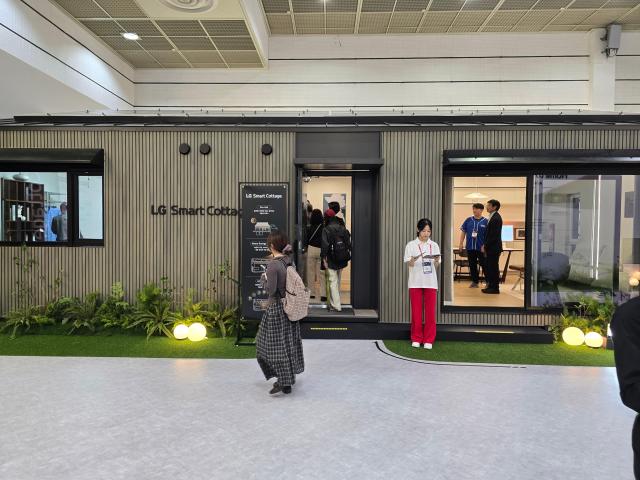
At LG's pavilion, the crowd gathered around something more familiar in shape, if less familiar on an electronics showroom floor: a house.
MONO Core 72, the newest model in LG's Smart Cottage line, resembles an upscale steel shipping container from the outside, with full-height windows and glass doors opening onto the yard.
Inside, an LG OLED TV sits behind blinds that lower automatically. The kitchen pairs an induction cooktop with ThinQ ON, LG's AI home hub. A stacked LG Tromm washer and dryer fills the utility room, while an LG Styler clothing-care closet stands in the bedroom.
For an appliance maker, the appeal is straightforward. Why compete for a place in someone's kitchen when you can sell the kitchen — and the house around it?
"We no longer look at an appliance individually but as a part of package. Our marketing focus and target have changed. We want to offer the full package," an LG Electronics public relations official said.
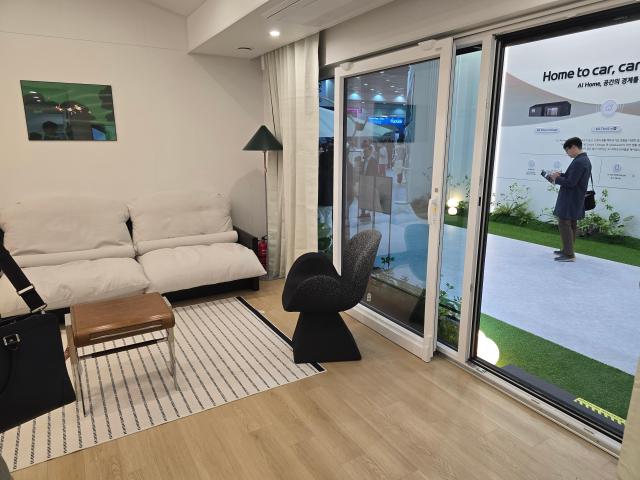
LG and Samsung take that process a step further by fitting the homes with their appliances and connecting them to their smart-home platforms before buyers move in.
The result is a house that doubles as an appliance package, with much of the shopping already done.
MONO Core 72 measures 72.9 square meters and starts at 199.5 million won ($148,336), according to LG. That works out to about 2.74 million won per square meter.
It is roughly 32 percent above the 2.08 million won per square meter listed by the Korea Real Estate Board as the average construction cost for a low-rise multi-household building, the closest residential category in its 2025 construction cost table.
The comparison is not exact. LG's starting price includes a system air conditioner, a boiler and smart-home devices, but excludes land, foundation work and permits.
With the premium appliance package on display, the total rises to about 250 million to 260 million won.
Factory production does not yet mean a cheaper home. The Land Ministry, which plans to order 20,000 modular public homes from 2027 to 2030, estimates that modular construction costs about 30 percent more than conventional methods.
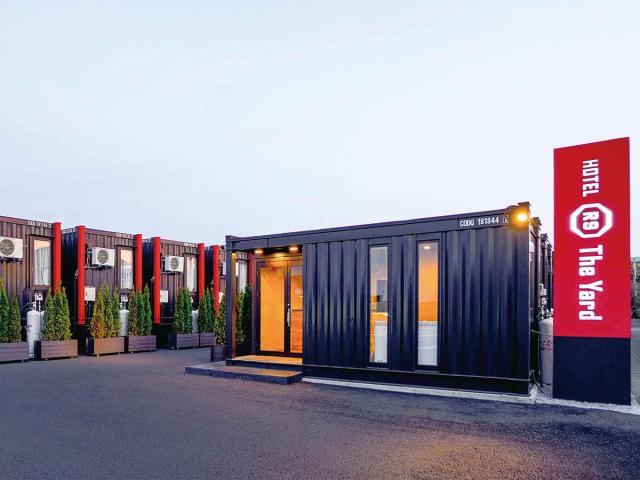
Samsung entered the market in June with its AI Modular Home, developed with Gonggan Jejakso, a wooden modular housing company. More than 80 percent of each house is made in the factory, where Samsung installs its appliances and registers them on its SmartThings platform.
For both companies, the home offers a way to sell an entire connected household in a single transaction.
For buyers, part of the appeal is the possibility of separating the house from the land beneath it — often the costliest part of homeownership near Seoul. The idea is to lease a plot, install a cottage and potentially take it along when moving, much like an upgraded camper.
At COEX, the cottage stood ringed by artificial plants, screened from neighboring booths crowded with appliances. It looked as though a piece of a quiet rural village had been lifted whole and dropped into the exhibition hall.
Where it would stand once it left the hall was the one thing not on display.
AJP Takeaways
- LG Electronics showcased MONO Core 72, a 72.9-square-meter modular house in its LG Smart Cottage line, at the 57th Korea Electronics Show, which opened at COEX in Seoul on Oct. 13, 2026.
- Samsung Electronics launched its AI Modular Home with wooden modular builder Gonggan Jejakso in June 2026 and aims to put its appliances in 10,000 modular homes within three years.
- Modular construction in South Korea costs about 30 percent more than conventional methods, according to the Land Ministry. The ministry plans to order 20,000 modular public homes through LH from 2027 to 2030.

Copyright ⓒ Aju Press All rights reserved.
