

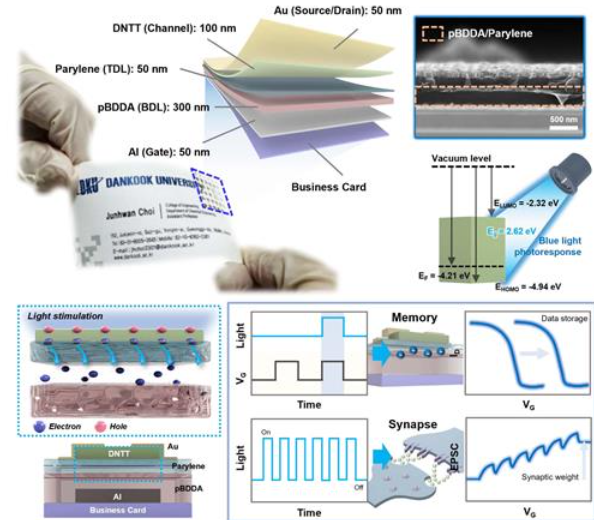
SEOUL, August 06 (AJP) - A research team at Dankook University in Seoul has developed a next-generation artificial intelligence semiconductor that mimics the human brain by learning through light, the university announced Wednesday — a potential breakthrough in the emerging field of neuromorphic computing.
Led by Professor Choi Jun-hwan of the Department of Chemical Engineering, the team engineered a neuromorphic chip that replicates the structure and function of biological neural networks.
Unlike traditional semiconductors, which separate memory and processing units, the new device integrates both into a single chip, drastically reducing power consumption and enabling the simultaneous processing of massive data flows.
“This device integrates both memory and synaptic functionalities using optoelectronic mechanisms,” said Professor Choi in a statement. “What’s more, it can be implemented on paper substrates, opening new doors for applications in wearable electronics, AI-based sensors, and security systems.”
The chip operates on the principles of synaptic learning, with photonic signals triggering charge storage and processing — a method that mirrors how synapses in the human brain transmit and retain information.
Its dual-mode memory transistor is capable of both data retention and adaptive learning in response to external stimuli.
The study was conducted in collaboration with Professors Yoo Ho-cheon and Oh Se-yong of Hanyang University.
The announcement comes at a time when neuromorphic computing — which aims to replicate the cognitive processes of the brain — is attracting increasing interest from both academia and industry.
Analysts project the global market for such technologies could grow from $28.5 million this year to $1.3 billion by 2030, representing a compound annual growth rate of nearly 90 percent.
Key drivers include the rise of edge computing, Internet of Things (IoT) applications, and autonomous systems, all of which require efficient, real-time data processing at low energy costs — areas where neuromorphic devices excel.

Candice Kim
Candice Kim is a dedicated business and technology reporter specializing in the intersection of high-tech innovation and fast-paced consumer trends. Her core beats span the semiconductor, IT, cosmetics, and retail sectors, where she provides in-depth coverage of industry titans including Samsung Electronics, SK hynix, and LG Electronics, alongside leading consumer brands like Olive Young and Musinsa. Whether analyzing complex silicon supply chains or tracking the latest shifts in beauty and fashion retail, Candice is committed to delivering sharp, accurate reporting that keeps readers informed on the forces shaping today's most dynamic markets.
Copyright ⓒ Aju Press All rights reserved.