
“Language is the dress of thought,” wrote Samuel Johnson, suggesting that the words a society adopts reveal what it values, often more clearly than any manifesto or statistic.
If that is true, then the latest update to the Oxford English Dictionary offers an unusually revealing glimpse into the cultural mood of the moment.
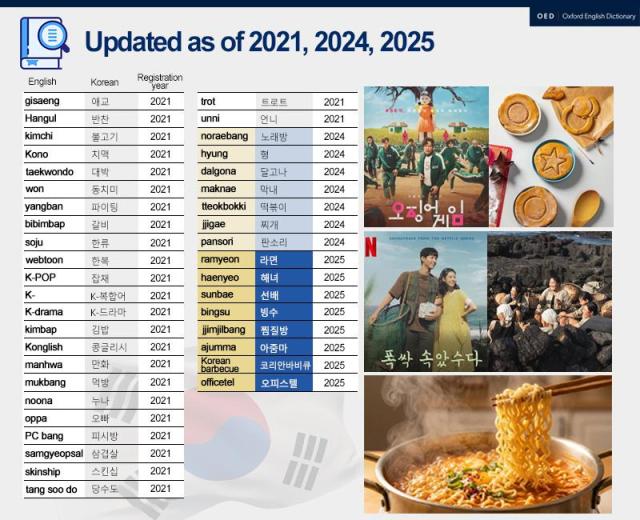
This year, the dictionary added several Korean-origin words, including haenyeo and ramyeon, alongside terms such as jjimjilbang, bingsu, sunbae, ajumma, Korean barbecue and officetel. The additions follow last year’s inclusion of words like dalgona, maknae and tteokbokki, marking a second consecutive expansion of Korean vocabulary in English’s most authoritative record.
The Oxford English Dictionary does not chase trends. It documents language only after words have been used repeatedly, across contexts, and with enough consistency to leave a durable trace.
Once entered, words are not removed, even if their popularity fades. Inclusion, therefore, signals not momentary fascination but cultural absorption.
What stands out is the shift in emotional tone between last year’s additions and this year’s. In 2024, dalgona entered the dictionary on the back of the global phenomenon Squid Game. The candy, fragile and unforgiving, became a symbol of competition, survival and elimination—an object perfectly suited to a story about pressure and precarity. It captured the anxieties of an era defined by zero-sum contests and relentless performance.
This year’s standout word, haenyeo, points in a different direction. The term refers to the traditional women divers of Jeju Island, whose lives have recently drawn global attention through the Netflix drama When Life Gives You Tangerines.
Unlike spectacle-driven narratives, the series portrays endurance rather than victory, responsibility rather than escape. The haenyeo are not heroic in a conventional sense; they are steady, repetitive and deeply embedded in family and community. Their appearance in the English dictionary suggests a growing global attentiveness to quieter forms of dignity.
The same sensibility runs through other newly added words. Ramyeon, long familiar as instant food, has taken on a broader cultural meaning through Korean storytelling. In dramas and films, it is rarely eaten alone.
It appears late at night, after hardship, shared between people who may lack the words to express what they feel. In K-Pop Demon Hunters, ramyeon is not fuel for action but what comes afterward—a pause, a moment of regrouping, a sign of togetherness. Such scenes require no explanation for global audiences, because food-sharing is one of the most universal human rituals.
Words like jjimjilbang tell a similar story. They describe spaces designed not for efficiency or privacy, but for rest and shared presence. A jjimjilbang is not simply a facility; it is a place where strangers lie side by side, where time slows, and where bodies and conversations are allowed to exist without urgency.
The word resists translation because it names an experience rather than a function, a way of being together rather than a service rendered.
Taken together, these words suggest that the global appeal of Korean content lies not only in style, technology or production value. It also lies in the moral texture of the stories being told. What travels across borders is a sensibility that values endurance over dominance, care over spectacle and shared time over solitary achievement.
Dictionaries change slowly. But when they do, they leave a long shadow. The movement from dalgona to haenyeo—from games of survival to lives patiently lived—marks a subtle but meaningful shift in what resonates globally. '

As BTS prepares to return as a full group, expectations are rising not only for new music but for another wave of Korean language entering everyday global life—this time through lyrics that linger, phrases that are repeated, and emotions that are learned before they are translated.
If language is indeed the dress of thought, then English today is beginning to wear words shaped by Korean experiences of food, labor, rest and song. These are not just borrowed terms. They are signals of what the world is learning to notice—and perhaps, to value.
*The author is the managing editor of AJP
Copyright ⓒ Aju Press All rights reserved.
