
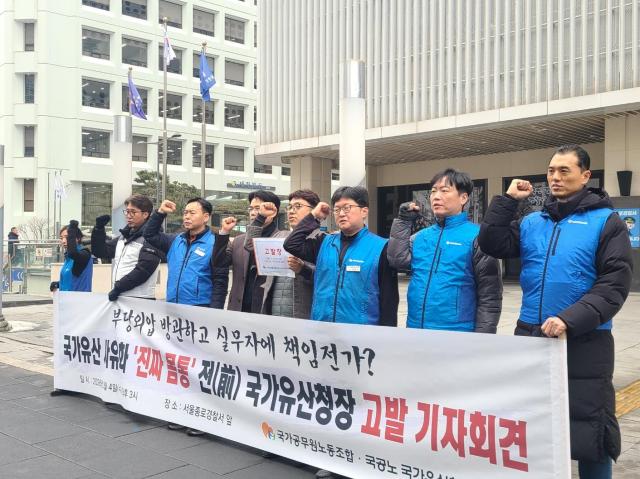
The controversy over allegations that Kim Keon Hee, wife of former President Yoon Suk Yeol, improperly used national heritage sites has escalated into an internal clash at the Korea Heritage Service. The agency’s internal audit led to heavy discipline for working-level officials who followed instructions, while excluding Choi Eung-chon, who led the agency at the time — a result unions described as scapegoating.
Some in the civil service say the fallout will be hard to resolve unless administrative structures that leave officials vulnerable to improper demands from those in power are changed.
The Korea Heritage Service branch of the Government Employees’ Union and the broader union held a news conference Feb. 4 outside Jongno Police Station in Seoul and filed a complaint with investigators against Choi. They accused him of abuse of authority, dereliction of duty and obstruction of business.
They said investigating Choi, the top decision-maker at the time of the alleged incidents, should come first.
Hwang Jin-gyu, head of the agency’s union, criticized the lack of action against Choi, saying it has long been common for political appointees to avoid responsibility after a change in administration or retirement while shifting blame to lower-level staff. He added that, based on Choi’s position and past actions, it is “common sense” to conclude Choi had a close relationship with Kim, and said it was “contradictory” that only working-level officials would be punished.
Last month, the Korea Heritage Service filed a complaint with Jongno Police Station against Kim on suspicion of obstructing official duties and violating the Cultural Heritage Protection Act. The agency’s internal probe found Kim held a private tea gathering at Mangmyoru Pavilion at Jongmyo Shrine. It also said she inspected a storage facility at the National Palace Museum of Korea and sat on the royal throne at Geunjeongjeon Hall at Gyeongbokgung Palace, interfering with the agency’s management activities.
The unions objected that the audit did not hold Choi accountable, while the agency removed Lee Jae-pil, former head of the Royal Palaces and Tombs Headquarters, from his post and asked the Ministry of Personnel Management to impose heavy discipline. Hwang said the unions “cannot accept” the audit results and urged police to thoroughly investigate Choi as the top official responsible at the time so that “legal justice” can be realized.
Kim Ik-hwan, a lawyer at Law Firm Suseong representing the complaint, said it alleges four offenses: abuse of authority, dereliction of duty, aiding obstruction of official duties and violations of the anti-graft law. He said additional complaints could follow.
Some civil servants warn similar incidents could recur unless conditions change that make it difficult for junior officials to refuse orders from superiors. In November, South Korea revised Article 57 of the State Public Officials Act to remove a “duty of obedience” provision, allowing officials not to follow illegal orders. But critics say the change has limited effect because it includes no penalty provisions for those who issue such orders.
* This article has been translated by AI.
Copyright ⓒ Aju Press All rights reserved.