
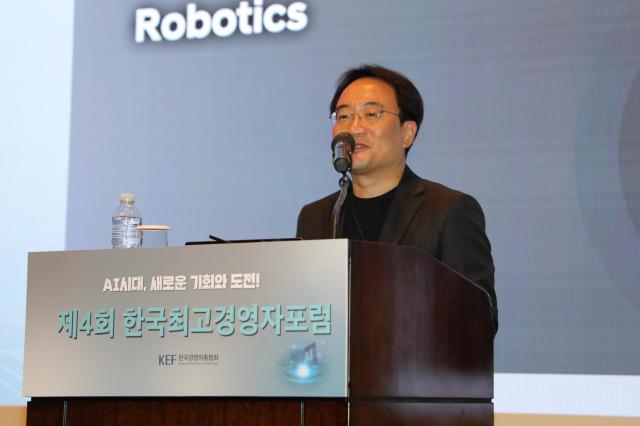
Speaking Thursday at the fourth Korea Top CEO Forum at the Westin Josun Seoul, Hyun said, “Rather than imagining a dystopia, if we think about how technology can solve social problems, our society can become a warm, technology-based society.”
His remarks come as Hyundai Motor Group’s plan to introduce the humanoid robot Atlas is seen as signaling structural changes in the labor market, underscoring the need for productive public discussion and consensus.
“Engineers’ efforts and social consensus are needed for robots to fully replace people,” Hyun said. “I think we still have time.”
After outlining the development path of artificial intelligence from large language models, or LLMs, to vision-language models, or VLMs, and then vision-language-action, or VLA, Hyun said automation of physical work will arrive last because VLA is the most technically behind.
Introducing a dual-arm robot under research at the lab, Hyun said the goal is not to replace people but to take on tasks that could cause illness if done by humans.
On Chinese robotics companies, Hyun said China benefits from government support and a large market that allows firms to optimize products through trial and error, adding that they are showing signs of being leaders in physical AI.
“We must always stay alert that we could fall behind,” he said, adding, “I will fight fiercely like Adm. Yi Sun-sin, who fought with 12 ships.”
Hyun cited functionality and price as key factors in whether robots succeed commercially. “From quality to maintenance and after-sales service, we must manage everything well and offer prices consumers are willing to pay,” he said, stressing the need for engineering efforts toward common use, standardization and modularization.
Hyundai Motor and Kia’s Robotics Lab last year unveiled a mass-production model of its autonomous-driving mobility robot platform MobED, and in 2024 launched the industrial wearable robot X-ble Shoulder.
* This article has been translated by AI.
Copyright ⓒ Aju Press All rights reserved.