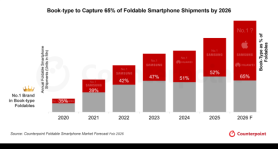
SEOUL, February 23 (AJP) - Familiar scenes were repeated at the 2026 Milan–Cortina Winter Olympics: medalists capturing once-in-a-lifetime moments by flipping open pocket-sized Samsung phones.
Despite strong sales of its foldable fleet, Samsung Electronics lost its decade-long position as the world’s top smartphone vendor last year to Apple, buoyed by the popularity of the iPhone 17 lineup.
Samsung readies a rematch with the unveiling of its flagship Galaxy S26 series in San Francisco on Thursday.
Moving away from traditional hardware specification battles, Samsung is repositioning its top-tier Ultra model — expected to approach 2 million won (about $1,500) — as a fully autonomous “AI Studio” aimed at short-form video creators on platforms such as TikTok and YouTube Shorts.
Rather than competing solely on camera sensors, display resolution and processing speed, the company is shifting its focus to software-driven creativity, automation and personalization.
The move reflects a long-standing challenge in the domestic market. According to Gallup Korea, more than 60 percent of South Koreans in their 20s use iPhones, while older generations remain more loyal to Galaxy devices.
“For younger demographics, a smartphone is a status symbol that must be instantly recognizable,” said Lee Eun-hee, professor emeritus of consumer science at Inha University. “Samsung has historically struggled to match Apple’s strong design identity that creates this sense of pride.”
To loosen Apple’s grip on young users, Samsung is positioning the Galaxy S26 as a mobile production suite.
Powered by an upgraded neural processing unit (NPU) with a claimed 113 percent performance increase, the device introduces “EdgeFusion,” an on-device generative AI model that allows users to generate images and perform professional-level edits through simple text prompts — without requiring an internet connection.
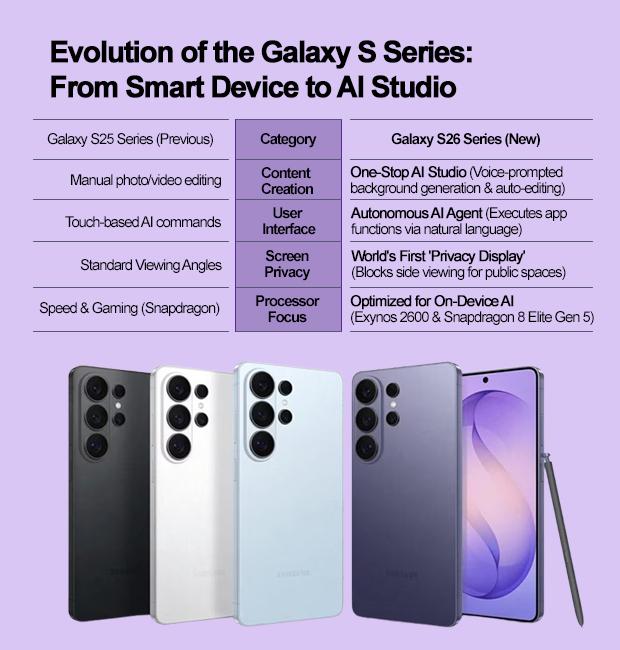
The system enables automatic background generation, lighting adjustment, object removal and style conversion, reducing the need for external editing apps.
The Ultra model is also expected to feature an industry-first “Privacy Display,” using Samsung Display’s Flex Magic Pixel technology to restrict side viewing angles. The feature targets young users who frequently consume and produce content in public spaces such as subways, cafés and campuses.
Additional upgrades include an improved f/1.4 aperture for low-light photography and a first-ever 60-watt fast-charging system, allowing creators to shoot, edit and upload content throughout the day.
“Younger consumers are highly responsive to AI,” Lee said. “Having an autonomous AI agent feels like carrying a personal assistant — or even a digital companion — in your pocket. That appeal could be decisive.”
The central question is whether younger consumers are willing to pay the premium.
Amid rising global semiconductor and component costs, all S26 models are expected to see price increases of about 99,000 won ($75). Industry estimates suggest the base model will start at around 1.25 million won ($940), with the Plus and Ultra versions beginning at roughly 1.45 million won ($1,090) and 1.8 million won ($1,350), respectively. The top 512GB Ultra model could approach the 2 million won threshold.
For many Gen Z consumers, already facing high living costs and stagnant income growth, the higher price point may pose a hurdle.
Yet Samsung is betting that advanced AI features will justify the increase by transforming smartphones from communication devices into portable studios.
In K-pop, gaming and short-form video culture, smartphones increasingly function as tools for self-branding and content production. Samsung’s strategy reflects an effort to align its flagship devices with this shift.
If successful, the Galaxy S26 could help the company reclaim relevance among younger users and narrow the gap with Apple in key markets.
If not, higher prices and software-heavy features may struggle to overcome entrenched brand preferences.
As the industry watches the San Francisco launch, the Galaxy S26 will serve as an early test of whether consumers are ready to accept higher prices — and what some analysts call a “chipflation tax” — in exchange for next-generation AI capabilities.


Copyright ⓒ Aju Press All rights reserved.