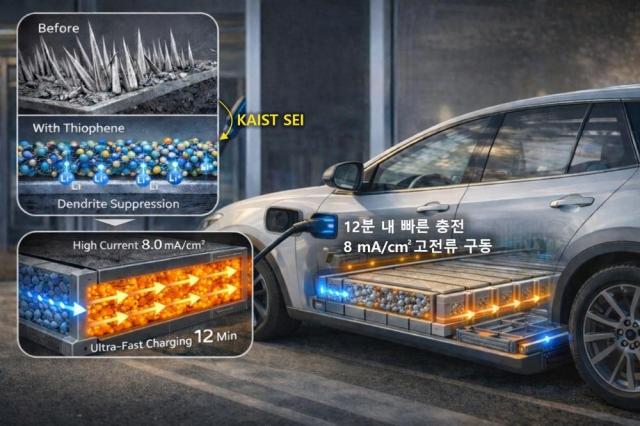
SEOUL, February 24 (AJP) - A joint research team from the Korea Advanced Institute of Science and Technology and Korea University has developed a technology to overcome stability issues that have hindered the commercialization of lithium metal batteries. The team created an intelligent protective layer that allows for rapid charging within 12 minutes while preventing the internal damage that typically shortens battery life.
Lithium metal batteries are considered the next generation of energy storage because they can hold much more energy than current lithium-ion batteries. This could allow electric vehicles to travel much further on a single charge. However, during charging, lithium often forms needle-like structures called dendrites. These structures can pierce internal components, causing the battery to fail or catch fire.
To solve this, the researchers added a substance called thiophene to the battery electrolyte. This additive creates a smart protective film on the electrode surface that acts like a flexible traffic management system for ions. Using a chemical structure known as a pi-conjugated system, the film rearranges its internal electrical charge in real time to create the easiest path for lithium ions to move through.
By guiding the ions smoothly, the technology ensures that lithium builds up evenly on the surface rather than forming dangerous needles. The researchers confirmed this process at the molecular level using specialized microscopes that allowed them to watch the battery charging in real time.
The study demonstrated that the battery could operate at high currents exceeding 8 milliamperes per square centimeter, which is double the level usually considered high in battery research. This performance level is close to what is required for the rapid acceleration and fast charging of real-world electric vehicles in South Korea and abroad.
Professor Choi Nam-soon of the Korea Advanced Institute of Science and Technology (KAIST) Department of Chemical and Biomolecular Engineering stated that the research solves fundamental battery problems by designing the electronic structure of the materials. He noted that the technology could become a core foundation for next-generation electric vehicle batteries that require both fast charging and long lifespans.
The technology is compatible with various existing battery materials, including lithium iron phosphate and nickel-cobalt-manganese oxides. This versatility suggests it could be applied to a wide range of future industries, including long-range electric vehicles and urban air mobility such as flying taxis.
The research involved Professor Choi Nam-soon and Professor Hong Seung-bum from KAIST, alongside Professor Kwak Sang-kyu from Korea University. The findings were published in the academic journal InfoMat on February 2.
(Paper information)
Journal: InfoMat
Title: Conjugation-mediated and polarity-switchable interfacial layers for fast cycling of lithium-metal batteries
DOI: http://doi.org/10.1002/inf2.70126

Copyright ⓒ Aju Press All rights reserved.