
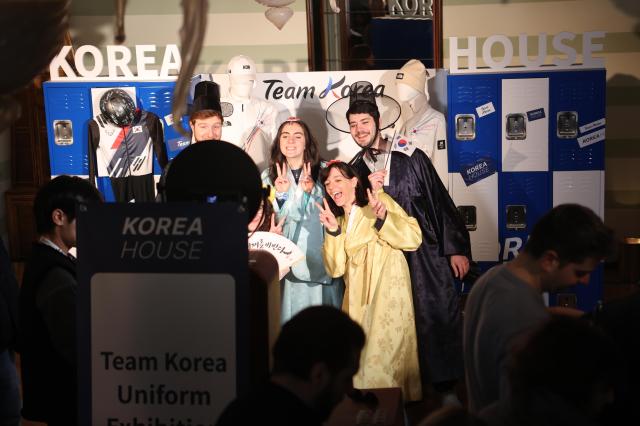
The ministry said Korea House, opened at Villa Necchi Campiglio in central Milan, drew 32,656 visitors over 18 days, or about 1,800 a day on average. Online reservations for about 1,700 people per day sold out throughout the period, prompting organizers to raise the daily reservation cap to 2,000.
Visitors were largely local and international, the ministry said. About three-quarters were Italians. In a satisfaction survey, Italian and English accounted for 95% of response languages, and about 90% of respondents said they were satisfied, citing strong interest in the programs and content.
The ministry said Korea House also produced results as a venue for sports diplomacy. For the first time at a Korea House opening event, 13 International Olympic Committee members attended, including IOC Executive Board member Spyros Capralos. Visits continued after the opening, including by IOC Vice President Juan Antonio Samaranch Jr.
Officials from international sports federations and national Olympic committees, along with athletes and other figures in international sport, also visited for exchanges and cooperation, the ministry said. Kim Jaeyeol, elected to the IOC Executive Board, attended the opening and other key official events, and IOC Athletes’ Commission member Won Yoonjong held a news conference at Korea House after his election.
Korea House also served as a support hub for South Korea’s athletes, the ministry said. It hosted four group cheering events for the national team, including for short track and curling, and ran a visit program for athletes. On the final day, it held a team wrap-up ceremony to mark the close of the competition and recognize athletes’ efforts.
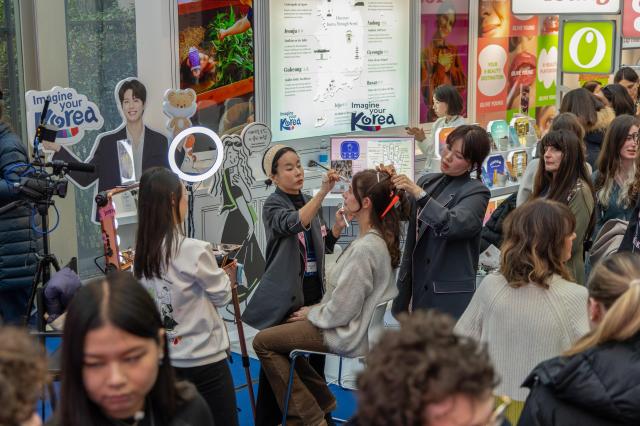
Organizers also ran cultural programs aimed at showcasing South Korea, drawing strong interest from visitors. The Korea Tourism Organization and CJ presented a hands-on tourism program under the “K-Dailycation” concept, and 320 people took part in a K-beauty experience over five days. A four-day K-pop cover-dance program drew 600 participants, who learned choreography to songs including those associated with K-pop Demon Hunters and BLACKPINK’s Jennie.
A business-to-business tourism event was also held, inviting Italian travel agencies and media. The ministry said it sought to link on-site promotion to the development and sale of future travel products to South Korea.
Average daily sales at Korea House were about 3.61 million won, the ministry said. That was about three times the roughly 1.2 million won in average daily MU:DS sales during the Lee Kun-hee Special Exhibition held at the Smithsonian museum in the United States from last November through February.
Korean street foods such as hotteok and fish cakes were also popular. Culture Minister Choi Hwi-young visited Korea House on the 7th and sold street food himself to promote Korean food, the ministry said.
Hands-on events linking traditional culture to the global popularity of Squid Game and K-pop Demon Hunters also drew attention. Traditional games featured in Squid Game, including ddakji and gonggi, drew an enthusiastic response from local visitors, and Italy’s state broadcaster said “Squid Game was recreated at Villa Necchi Campiglio in Milan.” Trying on hanbok and the gat, which drew worldwide attention through K-pop Demon Hunters, was also among the most popular programs, the ministry said.
Choi said, “On the Olympic stage, where the world’s attention is focused, we were able to vividly feel the stature of Korean culture and Korean sports through Korea House.” He added, “At the upcoming 2028 Los Angeles Summer Olympics, we will operate a Korea House where the appeal of K-sports and K-culture comes together, based on this experience and these results.”
* This article has been translated by AI.
Copyright ⓒ Aju Press All rights reserved.