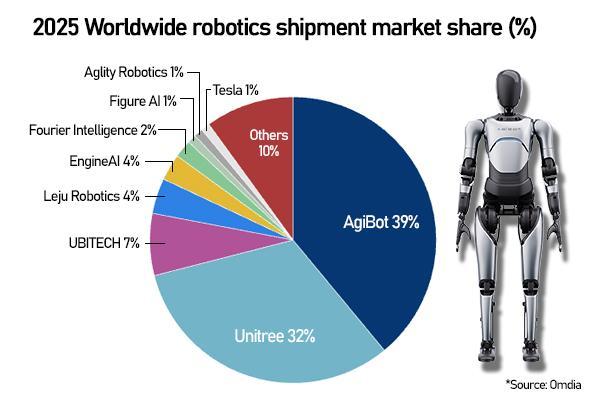
SEOUL, February 27 (AJP) - A line of humanoid robots flips in unison. They lunge, pivot, brandish swords beside children in a synchronized kung fu routine. In the next sequence, they stagger theatrically, swaying through a stylized "drunken boxing" set — collapsing backward only to rebound with uncanny balance.
The spectacle, staged by China's Unitree Robotics at the Spring Festival Gala, ricocheted across the globe. For many viewers it was entertainment. For roboticists elsewhere, it was a reckoning.
In South Korea, some scientists watched with admiration; others, with a familiar pang. Decades of painstaking work still sit largely confined to laboratories — brilliant machines, but rarely public performers.

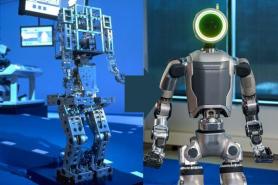
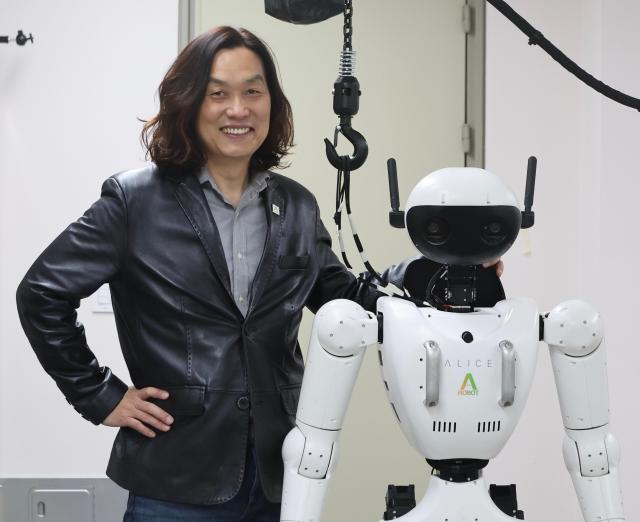
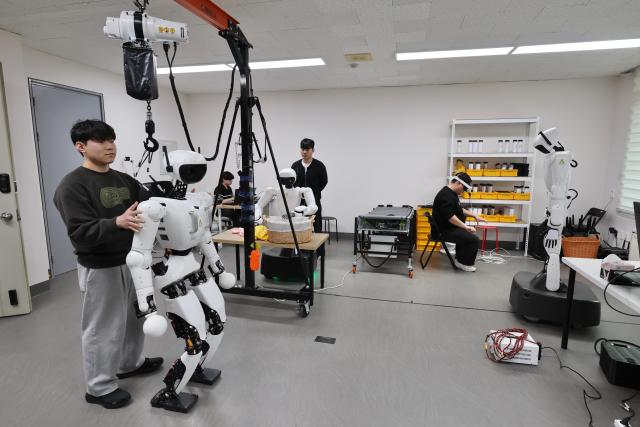
A humanoid named Alice 4 stands tethered to a rear frame — a metal Pinocchio awaiting animation. With a light tap on a keyboard, the machine jolts to life. It runs in place, almost straining against its restraints, optical sensors fixed straight ahead — on its creator.
Han Jae-kwon, professor of robotics at Hanyang University and chief technology officer of Aei Robot, watches without theatrical flourish.
"It's not about the kung fu or the backflips," he said. "The essence of a humanoid robot is what it does for work. Replace dangerous, undesirable labor. Help address the population cliff."
That, he insists, is the measure that matters.
South Korea's humanoid lineage stretches back more than two decades, to an era when bipedal machines were symbols of national ambition.
"Centaur was a small project we undertook to understand intelligent machines. Not long after Japan's Honda showcased ASIMO, we were asked to build ubiquitous robot companions capable of performing multiple tasks," recalled You Bum-jae, principal research scientist and former head of humanoid development at KIST.
Japan's unveiling of ASIMO had electrified the region. In response, two Korean institutions embarked on parallel paths.
At the Korea Advanced Institute of Science and Technology (KAIST), Professor Oh Jun-ho and his team introduced HUBO in late 2004 — a full-scale biped capable of walking, grasping and limited speech.
"HUBO is the beginning of that history, we believe," Han said. "There was a sense of national pride — we could do what only Japan had done."
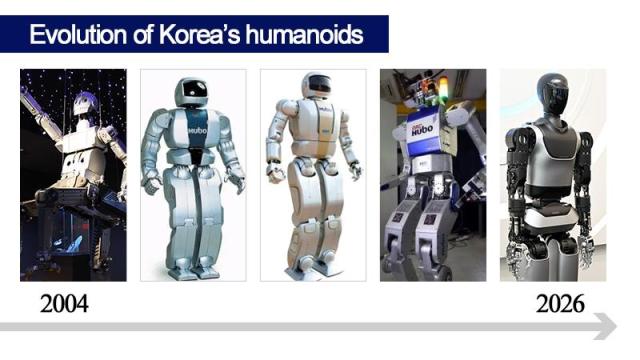
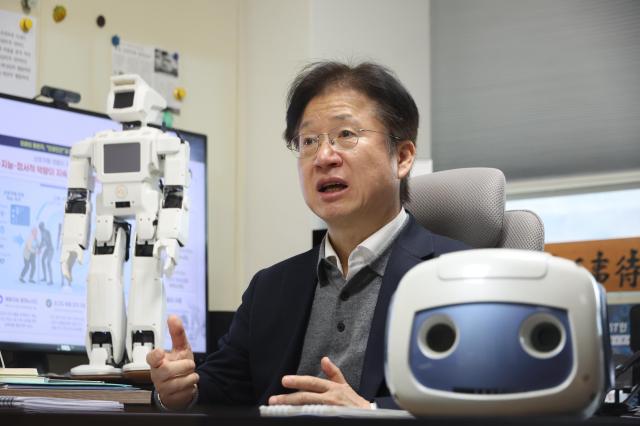
"MAHRU was a network-based humanoid, capable of understanding vocal commands. It could walk to a microwave, open it, pick up a piece of toast, place it in the toaster, take it out and deliver it to its master," said Yoo, gently patting the robot's original plastic head.
"We didn't have advanced AI back then — only recognition skills and programs to support it. But that's essentially how all humanoids aim to function even today: a body running light, a powerful computer supporting it through a network, now equipped with AI."
Then disaster intervened.
The Fukushima nuclear accident in 2011 prompted the U.S. Defense Advanced Research Projects Agency to launch the DARPA Robotics Challenge in 2012. The competition was designed to push robots into hazardous environments no human should enter.
By the finals in June 2015, 24 teams had qualified. Three were Korean — each fielding its own platform rather than relying on Boston Dynamics' Atlas.
Team KAIST, led by Professor Oh, won in 44 minutes and 28 seconds. Han's team from Robotis and a team from Seoul National University also competed — both using robots Han had helped design.
For a brief moment, Korea stood at the apex of disaster-response robotics.
But the aftermath told a more complicated story.
In Korea, talent dispersed. Rainbow Robotics, spun off from Team KAIST, pivoted to collaborative industrial arms and was later acquired by Samsung Electronics. Robotis listed publicly and diversified.
"The people who competed back then — it's such a waste," Han said. "Many went to the U.S., others became professors but stopped working on humanoids. If all of them had stayed, the situation would be very different today."
Research continued, though largely out of public view. A five-year project funded by the Ministry of Trade, Industry and Energy sustained further development at KAIST, including hydraulically actuated humanoids capable of dynamic motion.
"But if the media doesn't cover much of it, the public simply doesn't notice," said Park Hae-won, who now leads KAIST's humanoid lab.
The motor that changed the race
Ironically, the decisive shift did not originate in humanoids at all.
At the Massachusetts Institute of Technology, Professor Kim Sang-bae's MIT Cheetah project advanced quasi-direct drive (QDD) motor technology — compact, high-torque electric actuators that allowed quadruped robots to run with unprecedented speed and efficiency. Crucially, the designs were open-sourced.
Korean researchers argue that China moved quickly to absorb this architecture and adapt it to bipedal platforms.
"China absorbed the QDD technology very quickly, establishing firm baseline requirements for humanoid development. That includes critical reinforcement learning for robots as well — we now believe the government distributes it to Chinese robotics firms," said Yoo.
"That's how so many Chinese humanoids can run from the start, while ours begin with baby steps. We can't share reinforcement learning in Korea — institutions and private firms alike refuse to give up hard-earned data."
The divergence, in this telling, is less about talent than about scale and coordination.
AI as accelerant
The recent resurgence of humanoid ambition in Korea owes much to artificial intelligence.
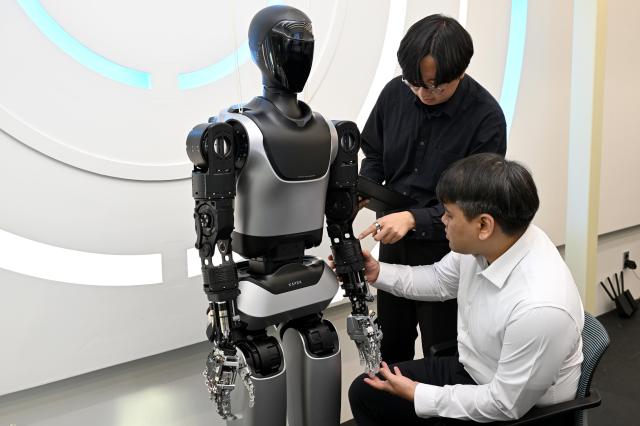
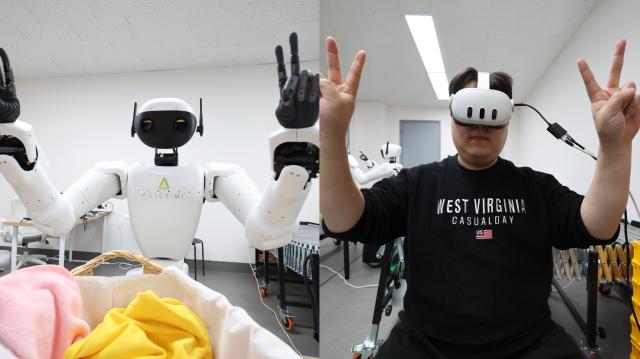
"Bipedal robots could perform tasks, but they required heavy engineering and years of coding. Imagine AI guiding them — robots understanding whatever their operators say and handling tasks without tedious step-by-step instructions. It was sensational," Yoo said.
At KAIST, Park's team is assembling a fully domestically developed humanoid under MOTIE funding, targeting full integration by April 2026. At KIST, a joint effort with LG Electronics is producing KAPEX, described as Korea's first AI humanoid platform, with more than 70 degrees of freedom and predominantly domestic actuators.
Yet laboratory elegance is not factory reliability.
"What you see at trade shows is the most refined version," Park said. "If a robot falls over at the exhibition, imagine how many times it crashed in the lab."
The initial commercial target, Park suggests, is not spectacle but small and medium-sized factories — cramped, uneven spaces where wheeled automation struggles.
"If you visit Korean SME factories, the floors are uneven, spaces are narrow — wheels can't even get through," he said. "Humanoids could help there, if they can handle tasks without disrupting existing workflows."
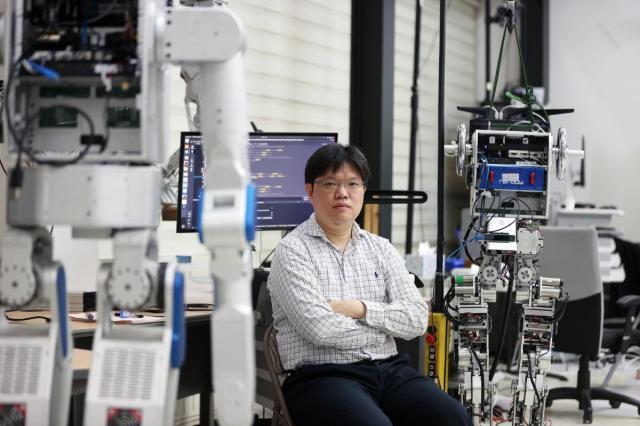
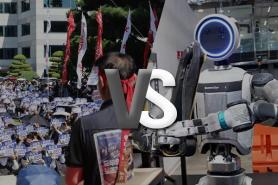
"This year's Chinese Spring Festival Gala — robots were doing gymnastics, flipping like athletes," he said. "Our spirits sink. But the essence of a humanoid is not dancing or kung fu. The real question is: what are you going to do with it?"
He argues that Korea's strength lies in manufacturing depth — batteries, semiconductors, precision motors and bearings — the physical half of "physical AI."
Equally important is data.
"Which country has industrial complexes in every neighborhood?" Han said. "That's all data. If we digitize it quickly and feed it to our robots, ours will outperform the competition."
China's scale and cost advantages loom large. The United States is reviewing robotics imports under a Section 232 national security investigation. Korea is unlikely to erect similar barriers.
"The only option is to make them cheaper than China," Han said.
More pressing than tariffs, however, is demonstration.
Korea spends substantially on humanoid research, Han noted, but allocates only a fraction of that to large-scale deployment trials.
"What's needed now is getting existing robots into factories, gathering data and proving they work," he said. "That's demonstration projects — not more lab R&D."
Yoo tempers expectations.
"It's going to take at least five years for robots to be genuinely useful. They can only perform simple tasks like moving items, and even that carries a 10 percent margin of error. Humanoid-tailored AI has yet to arrive — the global race is now on," he said.
"We should stop comparing robots against one another and instead draw on each one's unique characteristics to work as a team, talents putting heads together. Of course, that would require a new breed of engineers — ones who understand both software AI and hardware robotics. Attention, money, time — we need all of it."
Korea's humanoid story — from HUBO and MAHRU to Alice and KAPEX — is neither triumphalist nor moribund. It is incremental, intermittently brilliant, frequently underfunded.
Han's closing line carries neither romance nor despair.
"Try running in a factory," he said. "They'll tell you to stop."
Robots, he implies, must earn their keep the same way humans do — not by acrobatics, but by utility.
For steel and silicon, the future will not be written on a gala stage. It will be decided on the factory floor.

Copyright ⓒ Aju Press All rights reserved.