
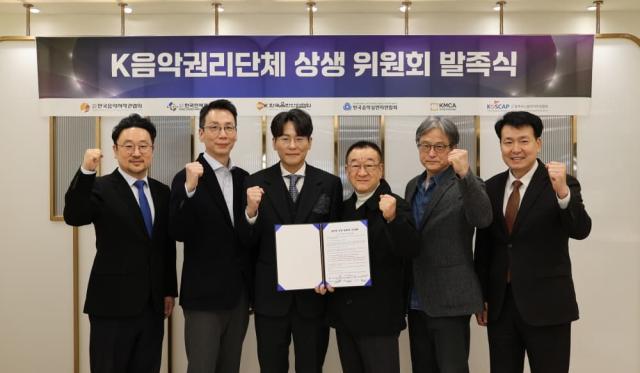
From left: Lee Jeong-hyeon, president of the Korea Music Performers Association; Woo Seung-hyeon, chairman of the Korea Music Content Association; Lee Si-ha, president of the Korea Music Copyright Association; Lim Baek-woon, president of the Korea Entertainment Producers Association; Han Dong-heon, chairman of the Together Music Copyright Association; and Park Seong-min, department head at the Korea Record Industry Association. (Photo provided by the Korea Music Copyright Association)
Lee Si-ha, president of the Korea Music Copyright Association, has launched what the group called a “declaration of war” for the AI era in his first official move since taking office.
Citing rapid growth in generative AI and what he described as unprecedented upheaval in the global music business, Lee called an emergency meeting of music rights organizations. On Feb. 26, the heads of six groups formally launched the K-Music Rights Organizations Coexistence Committee, known as the Coexistence Committee.
The committee brings together the Korea Music Copyright Association (President Lee Si-ha), the Korea Record Industry Association (President Choi Kyung-sik), the Korea Entertainment Producers Association (President Lim Baek-woon), the Together Music Copyright Association (Chairman Han Dong-heon), the Korea Music Performers Association (President Lee Jeong-hyeon) and the Korea Music Content Association (Chairman Woo Seung-hyeon). Lee was elected chair.
The committee said the industry faces a “fourfold crisis”: the spread of generative AI, blockchain-driven decentralization, overseas outflows of Hallyu-related revenue, and a reshaping of the platform market. It said it aims to go beyond policy proposals and position South Korea as a rule-setter by taking the lead in “copyright management technology.”
At the center of its plan is a blockchain-based integrated infrastructure to unify fragmented rights data. The committee said it will seek core technology to link four major codes into a single data structure: ISWC (International Standard Musical Work Code) for musical works such as composition and lyrics; ISRC (International Standard Recording Code) for sound recordings; YouTube’s CID (Content ID) system used to identify rights holders by recognizing audio and content in uploaded videos; and UCI (Universal Content Identifier), a national content identification system.
The goal, it said, is to complete a “K-copyright standard model” that can track, collect and distribute royalties in real time without missing a single use, and to strengthen leadership in the copyright market.
To carry out the plan, the six groups agreed to form a joint AI response task force, create a single negotiation channel and establish a joint fund, aiming to speak with one voice rather than respond separately.
At the launch ceremony, the leaders also signed a joint declaration titled, “In the AI era, we declare the noble sovereignty of human creation,” pledging to protect creators’ rights against big capital and algorithms.
The declaration calls for banning AI training without creators’ consent, requiring transparency in AI generation processes, and institutionalizing clear distinctions between human-created works and AI-generated output.
“The next two years are a golden time that will determine the survival of Korea’s music industry,” Lee said. “Individual responses cannot stop this massive wave, so six organizations have joined hands. We will establish the copyright management system we build as a global standard and make Korea lead the world’s copyright order.”
The committee said it will begin regular meetings and move quickly to design an integrated platform and pursue related institutional improvements.
Citing rapid growth in generative AI and what he described as unprecedented upheaval in the global music business, Lee called an emergency meeting of music rights organizations. On Feb. 26, the heads of six groups formally launched the K-Music Rights Organizations Coexistence Committee, known as the Coexistence Committee.
The committee brings together the Korea Music Copyright Association (President Lee Si-ha), the Korea Record Industry Association (President Choi Kyung-sik), the Korea Entertainment Producers Association (President Lim Baek-woon), the Together Music Copyright Association (Chairman Han Dong-heon), the Korea Music Performers Association (President Lee Jeong-hyeon) and the Korea Music Content Association (Chairman Woo Seung-hyeon). Lee was elected chair.
The committee said the industry faces a “fourfold crisis”: the spread of generative AI, blockchain-driven decentralization, overseas outflows of Hallyu-related revenue, and a reshaping of the platform market. It said it aims to go beyond policy proposals and position South Korea as a rule-setter by taking the lead in “copyright management technology.”
At the center of its plan is a blockchain-based integrated infrastructure to unify fragmented rights data. The committee said it will seek core technology to link four major codes into a single data structure: ISWC (International Standard Musical Work Code) for musical works such as composition and lyrics; ISRC (International Standard Recording Code) for sound recordings; YouTube’s CID (Content ID) system used to identify rights holders by recognizing audio and content in uploaded videos; and UCI (Universal Content Identifier), a national content identification system.
The goal, it said, is to complete a “K-copyright standard model” that can track, collect and distribute royalties in real time without missing a single use, and to strengthen leadership in the copyright market.
To carry out the plan, the six groups agreed to form a joint AI response task force, create a single negotiation channel and establish a joint fund, aiming to speak with one voice rather than respond separately.
At the launch ceremony, the leaders also signed a joint declaration titled, “In the AI era, we declare the noble sovereignty of human creation,” pledging to protect creators’ rights against big capital and algorithms.
The declaration calls for banning AI training without creators’ consent, requiring transparency in AI generation processes, and institutionalizing clear distinctions between human-created works and AI-generated output.
“The next two years are a golden time that will determine the survival of Korea’s music industry,” Lee said. “Individual responses cannot stop this massive wave, so six organizations have joined hands. We will establish the copyright management system we build as a global standard and make Korea lead the world’s copyright order.”
The committee said it will begin regular meetings and move quickly to design an integrated platform and pursue related institutional improvements.
* This article has been translated by AI.
Copyright ⓒ Aju Press All rights reserved.