
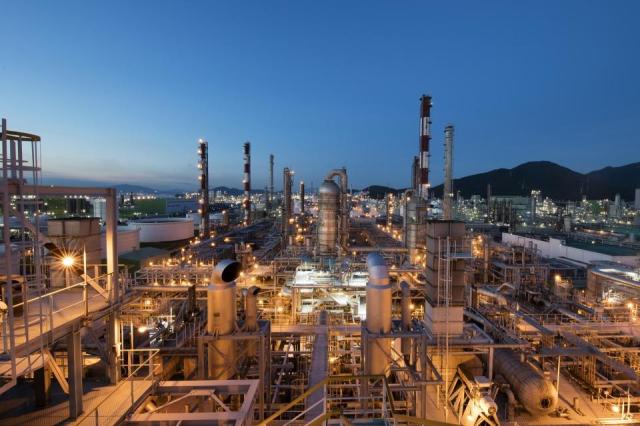
South Korea’s petrochemical makers are facing an unprecedented squeeze as instability in the Middle East disrupts supplies of raw materials, but the government and major creditors are holding firm on cutting domestic ethylene output.
The Ministry of Trade, Industry and Energy and creditor institutions led by the Korea Development Bank are telling companies that if they want government support to weather the downturn, they must produce a voluntary plan by the end of March to reduce output at naphtha cracking centers, or NCCs. The main focus is the Yeosu industrial complex, where competing interests have slowed progress, unlike the Daesan complex, which has prepared merger and reduction plans, and the Ulsan complex, which has more financial room after earlier voluntary cuts.
Industry officials said March 10 that Hanwha Solutions, DL Chemical and Lotte Chemical, along with GS Caltex and LG Chem, are in talks to meet the government-creditor demand. The companies have broadly agreed to set up a jointly funded subsidiary to operate NCCs together, but are reported to differ over how much capacity to cut.
Government and creditors are watching Hanwha Solutions, DL Chemical and Lotte Chemical most closely, expecting the biggest potential reduction if the three reach a deal. Annual ethylene capacity at Yeocheon NCC’s No. 1 and No. 2 plants — a joint venture of Hanwha Solutions and DL Chemical — and at Lotte Chemical’s Yeosu NC plant totals about 3.05 million tons, about 25% of South Korea’s overall ethylene output. A senior creditor official visited Yeocheon NCC late last year to discuss reductions with company executives.
The three companies favor a “merge first, cut later” approach: establishing the joint subsidiary within the year and then finalizing reductions based on changes in global market conditions. Government and creditors, however, are said to be pushing “cut first, merge later,” using the prospect of financial and tax support to press for a reduction plan by the end of March before creating the joint unit.
A key obstacle is that all three run downstream petrochemical businesses that rely on basic feedstocks supplied by the NCC operations, making it difficult to agree quickly on cuts. Yeocheon NCC’s No. 1 plant is known to mainly produce feedstocks for DL Chemical, while No. 2 largely supplies Hanwha Solutions. Some creditors are seen as favoring shutting No. 2 and having the three companies jointly source feedstocks from Lotte Chemical’s Yeosu NC plant, but it is unclear whether companies that have had stable supplies will accept that plan. Tensions between Hanwha Group and DL Group, deepened by last year’s debt-default scare, are also cited as complicating a broader compromise.
Even if the companies agree on additional cuts, they still face likely resistance from workers and unions. Industry officials say that for every 300,000 tons of NCC output reduced, about 100 workers are believed to lose their jobs. With the implementation of a revised Trade Union and Labor Relations Adjustment Act — known as the “Yellow Envelope Act” — expanding protections for strikes, the companies could face the risk of a general strike if they move unilaterally on reductions.
Still, industry officials said it will be difficult for the companies to reject government and creditor demands as their finances have deteriorated after accumulated losses, including at Yeocheon NCC. They said the government and creditors are pressing their case with offers of new funding support and conversion to perpetual bonds.
“Variables such as the Iran war and differences among companies make it hard to reach a voluntary reduction agreement,” a petrochemical industry official said. “This is a time when flexible policy management is needed, such as extending the deadline set by the government.”
* This article has been translated by AI.
Copyright ⓒ Aju Press All rights reserved.