
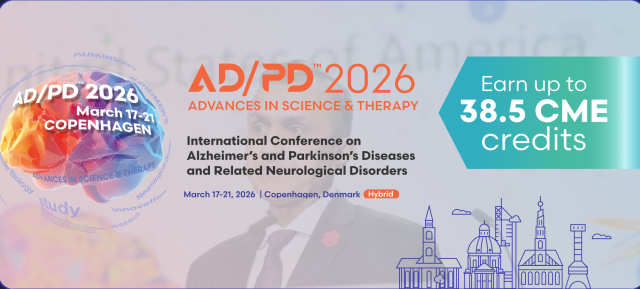
[Photo = AD/PD International Conference website]
According to the industry on March 17, the Alzheimer’s and Parkinson’s Diseases International Conference (AD/PD 2026) will be held March 17-21 (local time) in Copenhagen, Denmark. The meeting is a leading conference in the Alzheimer’s and Parkinson’s fields, drawing more than 5,000 attendees, with next-generation treatment strategies set as a key session theme. Global drugmakers including Novo Nordisk and Eisai are also expected to participate, sharing next-generation pipelines and biomarker strategies and seeking to expand partnerships.
Aribio will present progress and data from the global Phase 3 trial (Polaris-AD) of its oral Alzheimer’s candidate AR1001. Polaris-AD is a large study enrolling 1,535 patients with mild to mild-to-moderate Alzheimer’s disease at about 230 clinical sites in 13 countries. The trial design includes 52 weeks of double-blind dosing followed by a 52-week extension period.
The company said that of about 500 patients who completed 52 weeks of dosing, more than 95% voluntarily joined the additional one-year extension study, raising expectations for efficacy and safety. The trial is in its final stage, Aribio said. The company plans to announce key topline results in the first half of next year and pursue a New Drug Application with the U.S. Food and Drug Administration in the second half.
Aribio said AR1001 is designed as a once-daily oral drug, offering greater convenience than injections, and that no ARIA-E/H (brain swelling and brain hemorrhage) side effects commonly seen with antibody therapies have been observed so far in the Phase 3 trial.
Neurofit, an AI company focused on brain disease diagnosis and treatment, will showcase a brain imaging analysis portfolio spanning the full lifecycle of Alzheimer’s therapies. At its booth, Neurofit will display its prescription support solution Neurofit AQUA AD Plus, neurodegeneration analysis software Neurofit AQUA, and PET quantitative analysis software Neurofit SCALE PET.
Neurofit AQUA AD Plus quantitatively analyzes MRI and PET images to support, in one workflow, patient suitability assessments, side-effect monitoring during treatment, and post-treatment effectiveness analysis. Neurofit will also present two abstracts on Alzheimer’s brain imaging, including deep learning-based segmentation research on ARIA and hemorrhagic lesions in cerebral amyloid angiopathy, and a comparative study of Centiloid analysis.
“Interest is growing in imaging analysis for prescribing Alzheimer’s treatments, including Neurofit AQUA AD Plus,” co-CEO Bin Jun-gil said. “We will use this conference to expand strategic partnerships with big pharma and deliver tangible business results.”
The Alzheimer’s drug market is seen as a key battleground for next-generation biopharmaceuticals, including antibody therapies, genome-based drugs and brain delivery platforms. In the United States, amyloid beta-targeting antibody treatments such as Eisai and Biogen’s Leqembi (lecanemab) and Eli Lilly’s Kisunla (donanemab) have received approvals, expanding the market.
Market growth is also drawing attention. Market Insights forecasts the global Alzheimer’s therapeutics market will grow from about 8.9 trillion won last year to about 26.7 trillion won by 2034.
* This article has been translated by AI.
Copyright ⓒ Aju Press All rights reserved.