
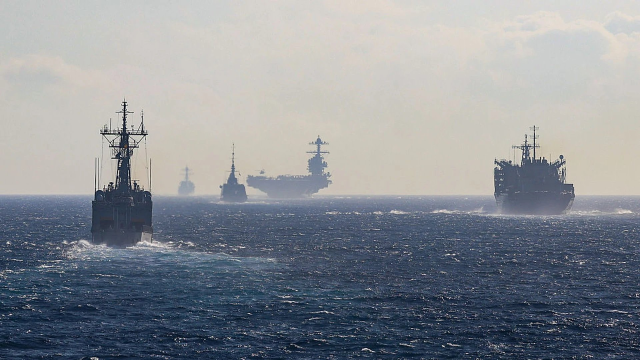
The presidential office said Thursday that President Lee Jae Myung is “positively” considering participation in a video summit set for Friday, bringing together 70 to 80 countries and international organizations with stakes in the strategic waterway, which carries roughly one-fifth of global energy shipments.
“It is in our interest to work with like-minded states to ensure the free and safe reopening of the Strait of Hormuz,” a senior official said.
The meeting, led by the United Kingdom and France, is expected to focus on postwar plans to restore freedom of navigation in the chokepoint.
Defense Minister Ahn Gyu-back told a parliamentary hearing earlier this week that London and Paris are spearheading discussions on forming a multinational maritime force, adding that Seoul has already signaled its willingness to take part.
“As a responsible member of the international community, we are preparing step-by-step plans,” Ahn said, noting that a four-phase strategy has been drawn up in coordination with the Joint Chiefs of Staff and the Defense Ministry.
Military officials say options under review range from dispatching personnel to a multinational command structure to providing remote or logistical support without a direct deployment to the strait.
Germany, historically cautious about overseas deployments, is also likely to participate, according to a senior official. Its involvement would broaden the scope of the mission, given Berlin’s financial resources and key military capabilities.
Seoul has already taken part in online consultations led by the UK and France. Joint Chiefs of Staff Chair Jin Young-seung joined videoconference discussions on March 26 and again on Wednesday, alongside parallel vice foreign minister-level talks.
With limited allied support to reopen the chokepoint — where traffic has dwindled under tight Iranian control — Washington has moved unilaterally. U.S. forces began a “reverse blockade” on Iranian activities over the water corridor since earlier this week.
President Donald Trump said on Truth Social that the United States had begun “clearing out” the strait “as a favor” to countries including China, Japan, South Korea, France and Germany, while criticizing them for failing to act.
Despite a ceasefire, uncertainty persists over when the strait can fully reopen. A report by The New York Times said Iran has been unable to locate or remove naval mines it previously deployed, complicating efforts to resume maritime traffic.
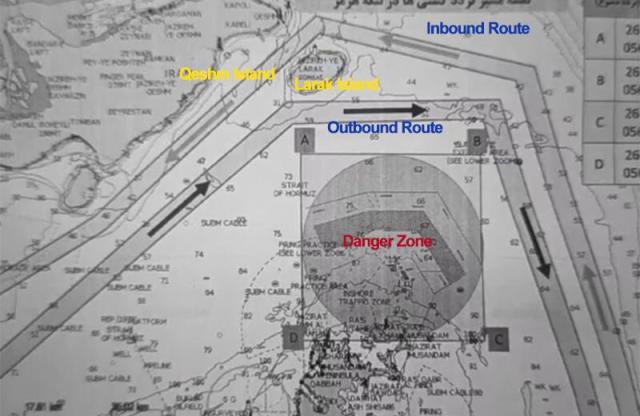
Citing U.S. officials, the report added that Tehran may not have recorded the precise locations of all the mines, some of which were designed to drift with ocean currents. While Iran has released maps indicating safe routes, those corridors are considered limited.
Analysts say South Korea could be assigned mine-clearing duties if it joins the mission.
“Possible roles would likely include mine removal, securing the strait and escorting oil tankers,” said Jeong Kyung-woon, a researcher at the Korea Association of Military Studies. He added that even the formation of a multinational naval force could itself serve as pressure on Iran by narrowing its strategic options.
Experts urged caution.
“While South Korea is allied with the United States, it is important to avoid being drawn into a conflict that is not directly our own,” said Choi Gi-il, a professor of military studies at Sangji University.
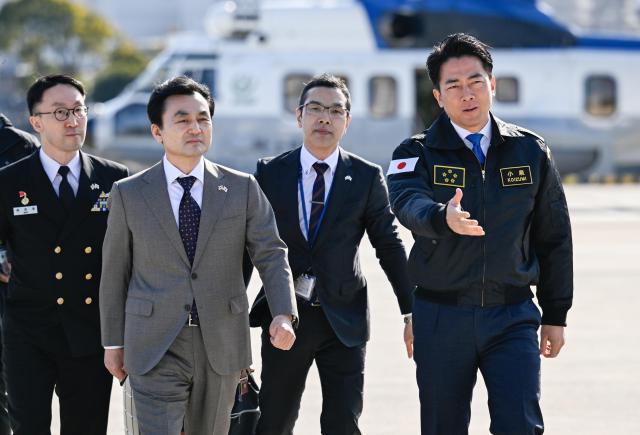
Separately, top naval commanders from South Korea, the United States and Japan held talks in Seoul on Wednesday — the first such trilateral meeting since 2022 — fueling speculation that Washington may seek broader allied support for Hormuz-related operations.

Copyright ⓒ Aju Press All rights reserved.
