
South Korean pharmaceutical and biotech companies are increasingly securing orphan drug designations from the U.S. Food and Drug Administration, a step they see as helping open doors to global markets. The designation does not guarantee a successful drug, but it can cut time and costs in the approval process and is widely viewed as a strategic pathway.
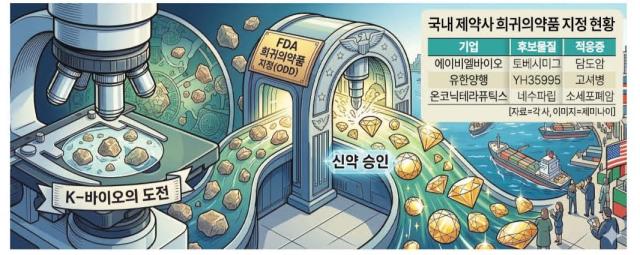
Industry officials said April 16 that candidates being developed by ABL Bio, Yuhan Corp. and Onconic Therapeutics have recently received FDA orphan drug designation. The FDA program targets rare diseases with small patient populations and few or no alternative treatments.
The designation comes with regulatory incentives. The FDA offers benefits such as waiving application fees and providing expedited review, and it supports a 25% tax credit for clinical trial costs. After a product is approved for sale, it also grants seven years of market exclusivity in the United States.
ABL Bio said its bile duct cancer candidate tovecimig, a bispecific antibody it licensed out to Compass Therapeutics, was designated an orphan drug. The drug is designed to block both the DLL4 and VEGF-A pathways, which play key roles in new blood vessel growth and tumor vascular formation. It is being developed for bile duct cancer, where treatment options are limited.
Yuhan said its Gaucher disease candidate YH35995 also received orphan drug designation. Gaucher disease is a hereditary rare disorder in which a specific enzyme deficiency disrupts metabolism, leaving significant unmet medical needs. The company said only about 100 patients are registered in South Korea, but the market is shaped around high-priced therapies, making it potentially profitable.
Onconic Therapeutics, a subsidiary of Jeil Pharmaceutical, said its synthetic lethality-based dual-target anticancer drug nesuparib was recently designated an orphan drug for small cell lung cancer. Nesuparib had previously received orphan drug designation for pancreatic and gastric cancers, and the latest decision again points to broader development potential, the company said.
The rare-disease drug market is growing as diagnostic tools improve and aging populations contribute to rising patient numbers, expanding demand for treatments. Evaluate, a pharmaceutical data analytics firm, said rare-disease therapies accounted for about 17% of the global prescription drug market as of last year and are projected to reach about 20% of the total prescription market by 2030.
Still, orphan drug designation does not necessarily translate into commercial success. Because the designation is granted at an early stage, candidates must still prove themselves through clinical trials, regulatory review and market entry.
"Even candidates with orphan drug designation are often discontinued because they fail to prove efficacy or run into safety issues," a pharmaceutical industry official said. "Even if they clear clinical trials, there can be variables at the commercialization stage, such as failing to meet production cost targets."
Even so, a track record of orphan drug designation is often taken as a signal that a candidate has cleared a certain level of screening and that regulators recognize unmet needs in the disease area. That can be a positive factor in global partnerships, industry officials said. "Rare diseases have limited market size, but institutional support can reduce the burden," another industry official said. "Building approval experience can help earn trust in the global market."
* This article has been translated by AI.
Copyright ⓒ Aju Press All rights reserved.