
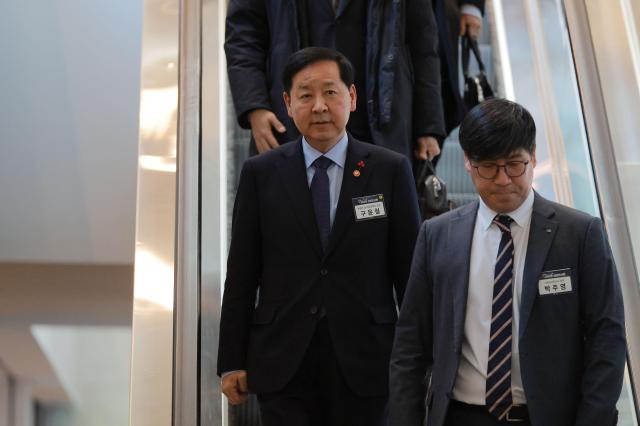
Seoul, April 19 (AJP) —South Korean and U.S. finance chiefs agreed a volatile exchange rate is undesirable for the interests of the two countries, the Ministry of Finance and Economy said in a statement Monday.
Finance Minister Koo Yun-cheol met with U.S. Treasury Secretary Scott Bessent during the G20 Finance Ministers and Central Bank Governors Meeting in Washington, D.C., last Friday to discuss key bilateral issues including the action plan for Seoul's pledge of investments in the U.S., foreign exchange rate, and supply chain disruptions from the Gulf conflict.
The primary agenda was the high volatility of the Korean won.
"Both ministers agreed that excessive volatility in the Korean won is not desirable, and agreed to continue consultations on foreign exchange market developments," the statement said.
Last month, the average daily gap between the appropriate non-deliverable forward (NDF) rate—based on the weekly closing price of the won at 3:30 p.m.—and the actual final quote for one-month NDFs in New York was tallied at 12.2 won. This marks the first time since 2020 that the gap between the appropriate quote and the actual exchange rate has exceeded 10 won.
"We shared the view that the volatility of the Korean won has been particularly high and decided to maintain a cooperative relationship to stabilize foreign exchange market trends," Koo separately wrote on his X page, adding that the two leaders also discussed the impact of the U.S.-Israel and Iran conflict on the Korean economy.
Another key issue was the ongoing discussion regarding investment in the U.S. following tariff negotiations. South Korea plans to invest a total of $350 billion in the U.S. market over the next 10 years, including a $150 billion investment in the shipbuilding industry.
The U.S. had once rolled back tariffs on Korean automobiles from 15 percent to 25 percent, citing delays in legislation by the Korean National Assembly. In response, the National Assembly passed the Special Act on Investment in the U.S. on March 12.
Koo explained the Korean government's efforts to implement memorandums of understanding regarding bilateral investments, including the Special Act, to which Bessent responded positively.
In the Seoul foreign exchange market on Monday, the won opened at 1,479.5 per dollar.

Copyright ⓒ Aju Press All rights reserved.
