
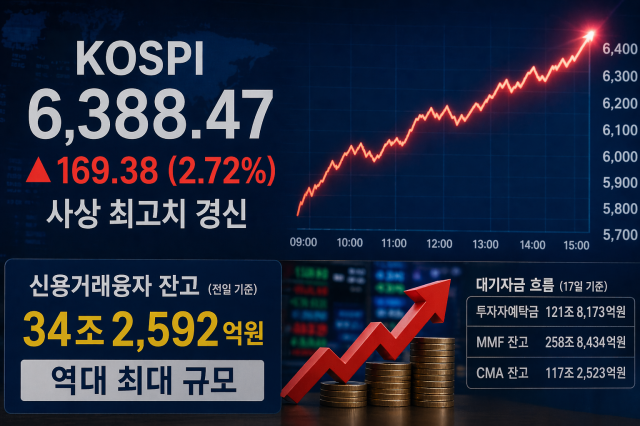
The KOSPI closed at 6,388.47 on April 21, setting a record high, as outstanding margin loans also climbed to an all-time peak. With expectations for further gains, retail investors have increasingly used leverage to take part in the rally. The rapid inflow of funds, however, is also heightening concerns about bigger swings ahead.
According to the Korea Financial Investment Association on April 21, outstanding margin loans totaled 34.2592 trillion won as of April 17. The balance rose broadly across both markets — 23.6256 trillion won in the KOSPI and 10.6336 trillion won in the KOSDAQ — surpassing the previous record of 34.0279 trillion won.
The pace of growth has been steep. After first exceeding 30 trillion won at the end of January, the balance expanded to 32.6690 trillion won in February and 33.6945 trillion won in March, reaching the 34 trillion won range this month.
Sideline cash flowing toward equities has also increased quickly. Investor deposits stood at 121.8173 trillion won the same day, up 11.5283 trillion won from the end of March. Compared with about 87 trillion won at the end of last year, that is an increase of more than 30 trillion won in roughly four and a half months. Money market fund balances were 258.8434 trillion won, holding near record levels, while CMA balances rose to 117.2523 trillion won, continuing an uptrend from the mid-110 trillion won range.
The moves have been linked to improving sentiment. Expectations for renewed talks between the United States and Iran have eased geopolitical uncertainty, strengthening retail investors’ appetite for risk assets and lifting demand for margin trading. Margin loans typically expand quickly in rising markets, and the recent index gains appear to have encouraged leveraged bets.
Analysts cautioned that heavier leverage can amplify volatility. Margin loans can fuel gains in an up market, but in a downturn they can trigger forced selling, adding to downward pressure.
Brokerage analysts said sentiment has improved, but volatility tied to external factors remains a risk. Han Ji-young, a researcher at Kiwoom Securities, said U.S.-Iran ceasefire talks have been thrown into confusion by conflicting statements from both sides since last weekend. She added that markets should keep open the possibility of a two-week extension of the ceasefire negotiation deadline.
Seo Sang-young, a researcher at Mirae Asset Securities, said President Donald Trump has suggested the chance of extending the ceasefire is low and indicated the possibility of renewed clashes if talks fail, while Iran has officially maintained distrust and a hard-line stance. As a result, he said, markets are staying cautious rather than fully relieved.
* This article has been translated by AI.
Copyright ⓒ Aju Press All rights reserved.