
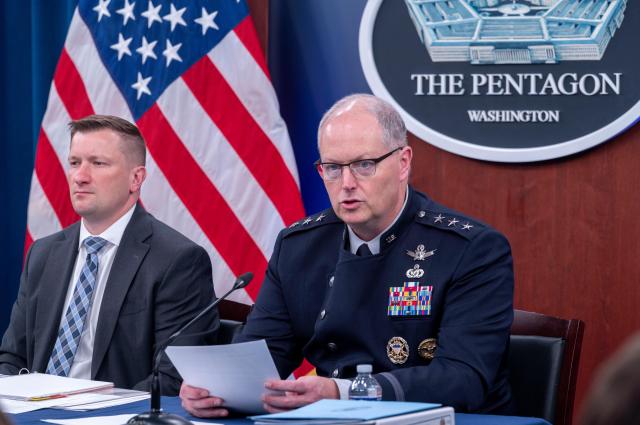
The Pentagon plans to raise spending on drones and related technologies to more than $74 billion — about triple previous levels — and to put more than $30 billion into securing key munitions such as missile-intercept systems, The Associated Press reported on April 21.
The proposal would significantly expand funding for drones and counter-drone systems. It allocates about $54 billion for military drones and related technology and $21 billion for weapons designed to shoot down enemy drones.
AP said the wars in Ukraine and Iran have underscored the growing role of drones and unmanned systems, and the U.S. military is arguing for a major budget increase in that area.
In munitions, the Pentagon highlighted replenishing stocks of Patriot and Terminal High Altitude Area Defense, or THAAD, interceptors. The systems can be used against ballistic missiles as well as low-cost drones, and stockpiles were reported to have fallen sharply during the war. The plan also includes procurement of the Army’s long-range precision strike missile and a midrange strike capability.
The Navy plans to increase Tomahawk cruise missile procurement to 785 from 55 last year, though limited production capacity was cited as a constraint.
The Air Force plans to invest about $600 million to develop low-cost munitions that can be mass-produced instead of relying on expensive precision weapons. “We want to shift from a small number of high-performance weapons to an approach that can overwhelm the enemy with volume,” said Frank Verdugo, the Air Force’s budget chief.
The budget proposal also includes adding 44,500 troops and spending more than $2 billion on operations at the U.S.-Mexico border. The Navy plans to spend more than $65 billion to acquire 18 additional ships. A battleship construction program promoted by President Donald Trump was not included in this proposal and is expected to be addressed in next year’s budget. Repair costs for U.S. bases in the Middle East are expected to be requested through a separate budget later.
Todd Harrison, a senior fellow at the American Enterprise Institute, said the budget is aimed at building a force that could prepare for a large-scale war with countries such as Russia and China. He said it “looks more similar to the defense strategy under President Biden than to the Trump administration’s strategy.”
* This article has been translated by AI.
Copyright ⓒ Aju Press All rights reserved.