
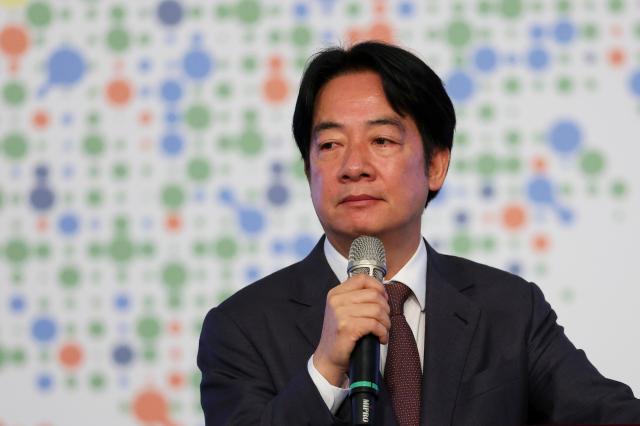
Taiwan President Lai Ching-te’s planned trip to Eswatini, the island’s only diplomatic ally in Africa, was canceled a day before departure after three countries withdrew overflight permission for his charter flight. Taiwan said China’s economic pressure was behind the move and condemned it.
According to Hong Kong’s Ming Pao and other outlets on April 22, Pan Meng-an, secretary-general of Taiwan’s Presidential Office, said at a news conference the previous evening that Seychelles, Mauritius and Madagascar canceled the overflight permits without prior notice. Lai had planned a state visit to Eswatini from April 22 to 27.
Pan said the “real reason” was that Chinese authorities applied heavy pressure, including economic coercion, on the three countries. He said attempts to use coercive means to change a third country’s sovereign decision undermine aviation safety, violate international norms and practices, and amount to “blatant interference” in other countries’ internal affairs. He added that the move disrupts regional order and hurts the feelings of the Taiwanese people.
A Taiwanese security official, speaking on condition of anonymity, told AFP that China pressured the countries by raising the possibility of reversing debt relief, cutting off funding and imposing economic sanctions.
Wu Chih-chung, Taiwan’s deputy foreign minister, said he understood the countries’ heavy economic dependence on China but said he hoped the incident would make the international community clearly recognize that China is intervening in other countries’ internal affairs through various means.
It was the first time a Taiwanese president’s overseas trip was derailed by a revoked overflight permit. Lai said on Facebook that he accepted his national security team’s recommendation to postpone the visit, adding, “The schedule has been postponed, but our respect and friendship for Eswatini remain unchanged.” Taiwan plans to send a special envoy instead to events marking the 40th anniversary of the Eswatini king’s accession.
Lai, who took office in early 2024 and is from the Democratic Progressive Party, has made only one overseas trip that year: a December tour of three South Pacific diplomatic allies that included a stop in Hawaii. In July last year, he also sought to travel to Central and South America via the United States, but the trip fell through after the U.S., then preparing for tariff talks with China, did not allow the transit. Bloomberg said it was the longest gap in overseas travel by a Taiwanese president since 2012, excluding the COVID-19 pandemic period.
The episode comes as China expands its influence in Africa. China has been Africa’s largest trading partner for 16 consecutive years, wielding significant economic leverage. A “2025 China Belt and Road Investment Report” released early this year by Australia’s Griffith University and China’s Fudan University said Chinese investment and construction project contracts in Africa totaled $61.2 billion last year, up 283% from the previous year. Africa has overtaken the Middle East as the biggest beneficiary region of China’s Belt and Road projects.
The Center for Strategic and International Studies said countries in the Global South within China’s sphere of influence support the “one China” principle, which it said is a key factor in Taiwan’s international isolation.
On the same day Lai’s trip was called off, China’s state-run Xinhua News Agency reported that Chinese President Xi Jinping met in Beijing with Mozambique President Daniel Chapo, who was on a state visit, and agreed to elevate ties to a “China-Mozambique community with a shared future in the new era.”
The two leaders also signed a joint statement with 28 provisions, including support for China’s unification. Chapo said, “China is Mozambique’s true friend,” adding that Mozambique firmly supports the one China principle and supports national unification.
* This article has been translated by AI.
Copyright ⓒ Aju Press All rights reserved.