
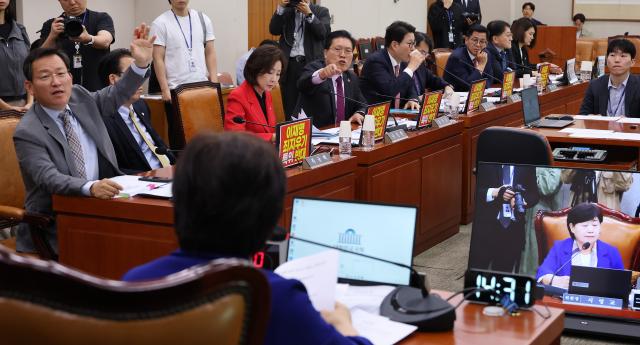
People Power Party lawmakers protest to committee chair Seo Young-kyo during a full meeting of the National Assembly special committee probing allegations of politically motivated, fabricated indictments under the Yoon Suk Yeol administration, at the National Assembly on April 30. [Photo=Yonhap]
A National Assembly special committee investigating allegations of politically driven, fabricated indictments under the Yoon Suk Yeol administration effectively wrapped up its work on April 30, 42 days after it began, as the Democratic Party-led panel adopted its final report. The committee also voted to file complaints against 31 people on allegations including perjury.
After the committee ended, the Democratic Party said it would “realize judicial justice” and introduced a special counsel bill. The People Power Party countered that “judicial justice has been damaged” and separately filed complaints against four hearing witnesses. With the ruling party planning to process the special counsel bill next month, clashes between the parties are expected ahead of the June 3 local elections.
At a full meeting, the committee approved a report summarizing more than 40 days of work, including three agency briefings, two on-site inspections and four hearings. The committee ended its activities eight days earlier than the date stated in its plan (May 8).
The panel approved an agenda item to file complaints against 31 people — including prosecutor Park Sang-yong, who investigated the Ssangbangwool North Korea remittance case, and former Ssangbangwool Chairman Kim Seong-tae and former Vice Chairman Bang Yong-cheol — on allegations such as perjury, refusing to take an oath or testify, and failing to appear. Complaints sought by the People Power Party against National Intelligence Service Director Lee Jong-seok and acting head of the Seoul High Prosecutors’ Office Jeong Yong-hwan were rejected.
With the parties unable to narrow differences over the report and the complaint list, the People Power Party declared the meeting disrupted. It also filed perjury complaints on its own against four people it said it could report directly: KH Group Vice Chairman Cho Kyung-sik, former Gyeonggi Province Peace Vice Governor Lee Hwa-young, attorney Nam Wook, and one National Intelligence Service employee.
People Power Party members of the committee criticized the ruling party at a news conference. Rep. Kim Hyeong-dong, the party’s floor spokesperson on the panel, said, “They say through this investigation that our judicial system is very solid and safe — so what is the purpose of shaking it?” Rep. Yoon Sang-hyun said the Democratic Party “failed to prove the reality of prosecutorial coercion and fabricated indictments,” adding, “Please do not turn the National Assembly into a ‘bulletproof factory’ that wipes away crimes.”
The Democratic Party, citing the committee’s findings, introduced a “fabricated indictment” special counsel bill on April 30, saying it would set the justice system right. Under the bill, the special counsel would be granted authority to take follow-up steps as needed, including seeking dismissal of indictments. The special counsel could appoint up to six assistant special counsels and receive up to 30 seconded prosecutors. The initial term would be 90 days, extendable three times by 30 days each. Cheon Jun-ho, acting floor leader, said, “We intend to process the special counsel bill as quickly as possible, and within next month if we can.”
People Power Party floor leader Song Eon-seok wrote on Facebook that he “strongly condemns” what he called an “Lee Jae-myung self-pardon special counsel,” alleging it would be used to eliminate trials involving “a special counsel appointed by President Lee Jae-myung.” He also criticized it as “cowardly politics” that, he said, would use the Democratic Party and a special counsel to erase the president’s own trial.
In May, the Democratic Party is set to install new floor leadership, and negotiations are scheduled over the National Assembly’s second-half committee assignments. Lawmakers expect the parties to clash sharply during the special counsel bill’s handling. Some analysts also say passing the bill next month could prove difficult in practice, given concerns it could affect the June 3 local elections and by-elections for National Assembly seats.
After the committee ended, the Democratic Party said it would “realize judicial justice” and introduced a special counsel bill. The People Power Party countered that “judicial justice has been damaged” and separately filed complaints against four hearing witnesses. With the ruling party planning to process the special counsel bill next month, clashes between the parties are expected ahead of the June 3 local elections.
At a full meeting, the committee approved a report summarizing more than 40 days of work, including three agency briefings, two on-site inspections and four hearings. The committee ended its activities eight days earlier than the date stated in its plan (May 8).
The panel approved an agenda item to file complaints against 31 people — including prosecutor Park Sang-yong, who investigated the Ssangbangwool North Korea remittance case, and former Ssangbangwool Chairman Kim Seong-tae and former Vice Chairman Bang Yong-cheol — on allegations such as perjury, refusing to take an oath or testify, and failing to appear. Complaints sought by the People Power Party against National Intelligence Service Director Lee Jong-seok and acting head of the Seoul High Prosecutors’ Office Jeong Yong-hwan were rejected.
With the parties unable to narrow differences over the report and the complaint list, the People Power Party declared the meeting disrupted. It also filed perjury complaints on its own against four people it said it could report directly: KH Group Vice Chairman Cho Kyung-sik, former Gyeonggi Province Peace Vice Governor Lee Hwa-young, attorney Nam Wook, and one National Intelligence Service employee.
People Power Party members of the committee criticized the ruling party at a news conference. Rep. Kim Hyeong-dong, the party’s floor spokesperson on the panel, said, “They say through this investigation that our judicial system is very solid and safe — so what is the purpose of shaking it?” Rep. Yoon Sang-hyun said the Democratic Party “failed to prove the reality of prosecutorial coercion and fabricated indictments,” adding, “Please do not turn the National Assembly into a ‘bulletproof factory’ that wipes away crimes.”
The Democratic Party, citing the committee’s findings, introduced a “fabricated indictment” special counsel bill on April 30, saying it would set the justice system right. Under the bill, the special counsel would be granted authority to take follow-up steps as needed, including seeking dismissal of indictments. The special counsel could appoint up to six assistant special counsels and receive up to 30 seconded prosecutors. The initial term would be 90 days, extendable three times by 30 days each. Cheon Jun-ho, acting floor leader, said, “We intend to process the special counsel bill as quickly as possible, and within next month if we can.”
People Power Party floor leader Song Eon-seok wrote on Facebook that he “strongly condemns” what he called an “Lee Jae-myung self-pardon special counsel,” alleging it would be used to eliminate trials involving “a special counsel appointed by President Lee Jae-myung.” He also criticized it as “cowardly politics” that, he said, would use the Democratic Party and a special counsel to erase the president’s own trial.
In May, the Democratic Party is set to install new floor leadership, and negotiations are scheduled over the National Assembly’s second-half committee assignments. Lawmakers expect the parties to clash sharply during the special counsel bill’s handling. Some analysts also say passing the bill next month could prove difficult in practice, given concerns it could affect the June 3 local elections and by-elections for National Assembly seats.
* This article has been translated by AI.
Copyright ⓒ Aju Press All rights reserved.