
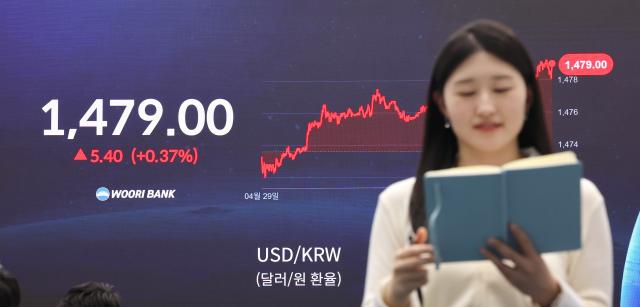
The won-dollar exchange rate, which swung in the 1,500-won range in early April, has recently struggled to break above the 1,480s. Analysts said expectations of easing Middle East tensions have increased downward pressure, but U.S. monetary policy and high oil prices remain upside risks.
In Seoul’s foreign exchange market, the won closed at 1,483.3 per dollar in daytime trading on April 30, according to market data released Saturday. The rate stayed capped in the 1,480s even as international oil prices jumped on renewed Middle East tensions and expectations for U.S. rate cuts weakened.
After moving above and below 1,500 in early April, the exchange rate traded in the 1,470-1,480 range last week. The upper end has been held down as markets priced in hopes that U.S.-Iran tensions could shift toward negotiations rather than escalation.
Market participants also expect a gradual decline in the exchange rate after South Korea’s first-quarter gross domestic product growth far exceeded forecasts. They said easing geopolitical risks and improving domestic conditions have tilted factors toward a stronger won.
Still, analysts cautioned that volatility could pick up because upside risks remain. The Federal Reserve kept its benchmark rate unchanged at 3.50%-3.75% at the Federal Open Market Committee meeting on April 29 local time and maintained a hawkish stance by emphasizing inflation risks. If the dollar strengthens again, the won could face renewed downward pressure.
With Fed Chair Jerome Powell’s term set to end on the 15th, markets are also watching whether the policy stance shifts at the June FOMC meeting, which would be chaired for the first time by incoming Chair Kevin Warsh. Park Sang-hyun, an analyst at iM Securities, said stalled U.S.-Iran talks helped drive oil prices sharply higher, with WTI at $106.88 and Brent at $118.03, the highest in four years. If high oil prices persist, he said, the June meeting could reinforce a more hawkish tone.
South Korea’s April consumer price index and U.S. employment data due this week are also expected to influence the exchange rate. In March, South Korea’s CPI rose 2.2% from a year earlier. Petroleum product prices climbed 9.9%, adding 0.39 percentage points to overall inflation. Markets expect April inflation to approach 3%, and a continued rise in oil prices could widen inflation and weigh on the won.
If U.S. nonfarm payrolls for April, due May 8, remain strong, concerns about tighter U.S. policy could resurface and add to dollar strength, analysts said.
Persistently high oil prices could also pressure global financial markets. Analysts warned that the stock rally fueled by an artificial intelligence investment boom could be affected, and market volatility could increase if the U.S. 10-year Treasury yield rises above 4.5%.
Park said the AI investment boom has partly offset the oil shock, but that support could fade if oil prices keep rising. “The market’s focus is on AI expectations now, but it can shift at any time to oil and interest-rate factors,” he said.
* This article has been translated by AI.
Copyright ⓒ Aju Press All rights reserved.