

Over the medium to long term, Kakao aims to onboard all 50 million KakaoTalk users to AI services. It plans to expand in-house offerings including “ChatGPT for Kakao,” “Kanana in KakaoTalk” and “Kanana Search,” and is preparing to unveil its next model, “Kanana 2.5.”
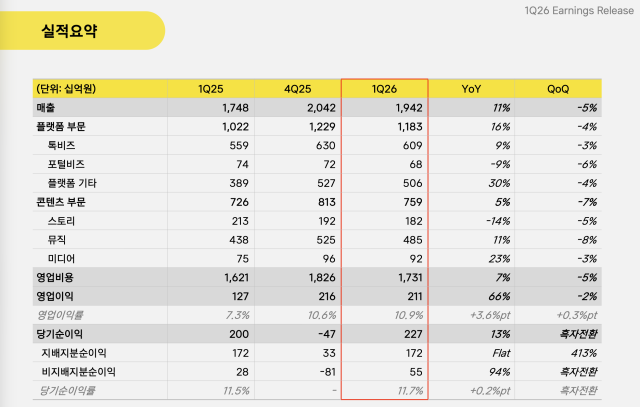
Kakao said in a regulatory filing that first-quarter revenue on a consolidated basis rose 11% from a year earlier to 1.9421 trillion won, while operating profit jumped 66% to 211.4 billion won.
By segment, platform revenue increased 16% to 1.1827 trillion won. Within that, Tok Biz revenue rose 9% to 608.6 billion won, and Tok Biz advertising revenue climbed 16% to 338.4 billion won.
Demand from financial-sector advertisers helped lift overall message volume, and a broader lineup of messaging products expanded how advertisers used the service. Business messaging revenue rose 27% from a year earlier, while display advertising revenue increased 10%.
Tok Biz commerce, which includes Gift and Tok Deal, posted combined gross transaction value of 2.9 trillion won, up 10% from a year earlier. Kakao attributed the gain to a stronger product mix centered on fresh food and home appliances and more tailored user benefits. During the “Kakao Shopping Festa” held in March, Tok Store transaction value rose 18% year over year, and self-purchase transaction value within Gift surged 53%. First-quarter commerce revenue rose 1% to 270 billion won.
Other platform revenue, including mobility and payments, rose 30% to 506.5 billion won. Kakao said its mobility business — spanning taxis, parking, last-mile logistics and advertising — delivered double-digit year-over-year revenue growth for a third straight quarter. Payments revenue topped 300 billion won for the first time, driven by growth across payments, financial and platform services.
Content revenue rose 5% to 759.4 billion won. Music revenue increased 11% to 484.6 billion won, and media revenue climbed 23% to 92.4 billion won. Story revenue totaled 182.4 billion won.
Kakao said profitability typically is weaker in the first quarter due to seasonal factors, but this year improved as efficiency efforts focused on core businesses were reflected in results.
Kakao has already launched AI services that use KakaoTalk chat context, including Kanana in KakaoTalk and Kakao Search, in stages. The company said it is building a flow that links identifying user needs in conversation to reservations and payments.
Jeong Shin-a, Kakao’s CEO, said on a first-quarter 2026 earnings conference call Thursday that “the second half will be an important turning point when anyone can experience an agent that starts from a domestic conversation and completes payment.”
Kakao’s AI services currently available in KakaoTalk are ChatGPT for Kakao, Kanana in KakaoTalk and Kanana Search. Kakao said it segments target users based on AI familiarity and whether they use paid services — offering ChatGPT for Kakao to users with higher AI understanding, and positioning Kanana in KakaoTalk for users who can experience AI naturally in daily life without paying.
ChatGPT for Kakao has surpassed 11 million cumulative sign-ups. Compared with the previous quarter, monthly active users and monthly messages sent per user more than doubled. Jeong said the service is moving beyond one-time visits into repeated use.
Kanana in KakaoTalk is designed to identify user needs from conversational context and connect information delivery to reservations and payments. Kakao said it linked Kanana in KakaoTalk with its Gift service starting last month.
Jeong said she expects 31 million users to download and use the Kanana in KakaoTalk model by year’s end. She said positive evaluations of AI response quality are “around 80%,” adding that Kakao will continue improving the model and raise service completeness so more users can experience higher-quality AI.
Kakao also said it will focus on upgrading Kanana Search, a conversational-context-based discovery service that provides place and product search results and trend-topic exploration within KakaoTalk chat rooms.
Kakao is also strengthening its in-house AI models. Following Kanana 2, unveiled last year, the company is preparing to release Kanana 2.5, sized at 150B parameters. Jeong said Kakao has confirmed Kanana 2.5 delivers the best performance among domestic and overseas large language models of similar parameter size, and that it showed strong performance in execution-focused areas such as function calling compared with top global models.
Jeong said Kanana in KakaoTalk and Kanana Search are new types of services even in global markets and could become key entry points for expansion into agent AI. Kakao’s medium- to long-term AI vision, she said, is for all 50 million KakaoTalk users to have personalized agents.
* This article has been translated by AI.
Copyright ⓒ Aju Press All rights reserved.