
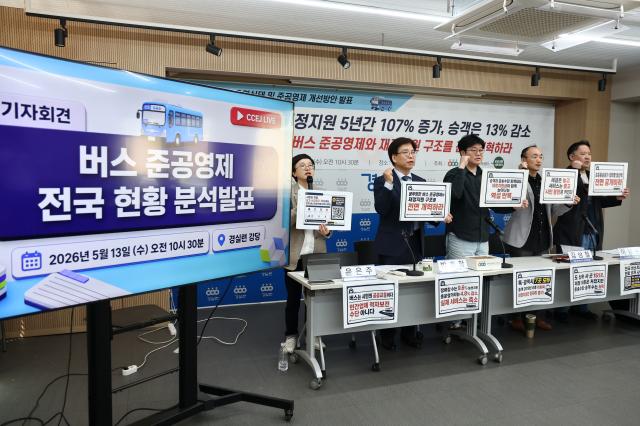
This year marks the 20th anniversary of the quasi-public bus system in South Korea. Despite a more than twofold increase in national bus funding over the past five years, passenger numbers have dropped by over 12%, failing to recover to pre-COVID-19 levels.
The Citizens' Coalition for Economic Justice and the Public Transport Network released an analysis on May 13, examining bus operations data from 2019 to 2024 across the country, including the status of quasi-public bus operations in seven major cities and 151 local governments.
According to the analysis, national bus funding rose from 1.98 trillion won in 2019 to 4.1 trillion won in 2024, an increase of 107.1%. However, during the same period, the number of passengers fell from 4.22 billion to 3.69 billion, a decrease of 12.6%.
All seven cities implementing the quasi-public system—Seoul, Incheon, Daegu, Gwangju, Daejeon, Busan, and Ulsan—failed to recover their passenger numbers compared to 2019, even as funding increased. Specifically, Seoul saw a 7.7% decline in passengers, while funding rose by 37.2%. In Busan, passenger numbers dropped by 27.1%, yet funding doubled. Ulsan experienced a 21.6% decrease in passengers, with funding increasing by 135.8%.
The 151 local governments also saw an increase in funding, but both transport revenue and passenger numbers declined. Additionally, while the number of bus stops increased, the actual distance buses traveled decreased, indicating a deterioration in service supply. Among the 151 local governments, 99 had continuous data available, showing a total operating distance that fell from 735.71 million kilometers in 2019 to 707.12 million kilometers in 2024, a 4.8% reduction. In contrast, the number of bus stops increased from 75,323 to 82,532, a rise of 9.6%.
These regions were found to have inadequate levels of information disclosure and data provision. Only 66 local governments had comprehensive data available for seven key indicators—funding, transport revenue, passenger numbers, total operating distance, number of stops, number of routes, and number of operating vehicles—between 2019 and 2024. Twenty-four local governments lacked continuous data for all seven indicators, making analysis virtually impossible.
The Citizens' Coalition stated, "While national bus funding has significantly increased, passenger numbers have not recovered. Some local governments are experiencing declines in transport revenue and reduced operating distances. The current bus operating system is becoming entrenched in a structure that prioritizes compensating private companies for losses over restoring citizens' mobility rights."
Based on the analysis results, the coalition and the Public Transport Network called for seven measures: full disclosure of funding, standard transport costs, settlement amounts by company, and itemized expenditure; reestablishment of evaluation criteria focusing on total operating distance, frequency of service, operational counts, connectivity, and accessibility for vulnerable populations; establishment of an audit and verification system for maintenance and safety costs; creation of a citizen participation governance model for bus policy; experimentation with public operation models including public routes, contracted operations, non-profit operations, demand-responsive transport, and community-centered route systems; expansion of information disclosure regarding operating distances, daily service counts, frequency, monthly costs, and complaint status; and institutionalization of inter-local government cooperation systems.
A representative from the Citizens' Coalition urged, "Candidates in local elections should adopt the seven proposed pledges to enhance bus publicness and present them as key transportation commitments. The government and the National Assembly must also immediately initiate institutional reforms to address the opacity of the quasi-public system and the privatization of route rights."
* This article has been translated by AI.
Copyright ⓒ Aju Press All rights reserved.