
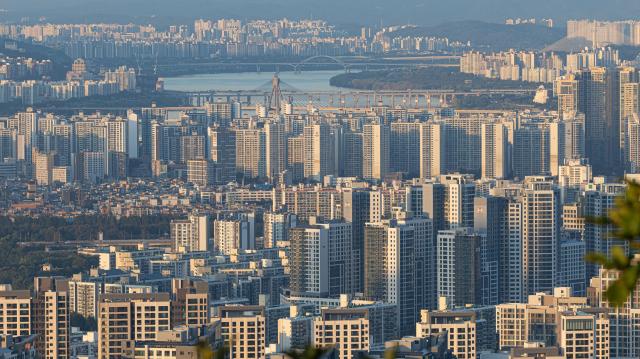
Gangnam District, a key area in the Gangnam region, has reversed its 11-week decline and is now experiencing an increase in apartment prices, significantly boosting the overall sales prices in Seoul.
According to the Korea Real Estate Agency's weekly apartment price trends released on May 14, the average apartment sales price in Seoul rose by 0.28% compared to the previous week, nearly doubling last week's increase of 0.15% and indicating a strong rebound.
After three weeks of stagnation with price fluctuations around 0.15%, the demand for purchases surged this week across Seoul, including the Gangnam area. Notably, Gangnam District saw a shift from a decline of -0.04% to an increase of 0.19%, joining Seocho District (0.17%) and Songpa District (0.35%) in the upward trend.
A representative from the Real Estate Agency stated, "While some areas continue to show a wait-and-see attitude, the increase in inquiries for well-located complexes and those undergoing reconstruction has led to rising contracts, contributing to an overall increase in Seoul's prices."
In the northern regions, Seongbuk District (0.54%) recorded the highest increase, particularly in large complexes in the Gileum and Donam-dong areas, followed by Seodaemun District (0.45%) and Jongno District (0.36%). In the Gangnam area, Gangseo District (0.39%), influenced by reconstruction projects, topped the increase, with Songpa District (0.35%) and Guro District (0.33%) also showing notable rises.
In Gyeonggi Province, prices rose by 0.11%, led by Anyang's Dongan District (0.69%) and Gwangmyeong City (0.67%), which saw significant increases due to reconstruction and major complexes. In Incheon, prices remained stable at 0.00%, with rises in Bupyeong District offset by declines in Namdong District. Overall, the metropolitan area saw a 0.14% increase.
In contrast, non-metropolitan areas experienced a slight decline of -0.02%, particularly in the five major cities (-0.04%), although Sejong (0.01%) saw a minor increase in newly built complexes. Nationwide, the average sales price rose by 0.06%.
Meanwhile, nationwide apartment rental prices increased by 0.11% compared to the previous week.
In Seoul (0.28%), demand for rentals remained steady, particularly in large complexes and preferred school districts, leading to an increase from last week's 0.23%. Seongbuk District (0.51%) showed a significant rise, especially in the Gileum and Jongam-dong areas, while Songpa District (0.50%), Seongdong District (0.40%), and Gangbuk District (0.40%) also continued to see strong rental prices.
Gyeonggi Province (0.18%) and Incheon (0.09%) maintained their upward trends, with the metropolitan area overall rising by 0.20%. Non-metropolitan areas (0.03%) saw slight increases in Ulsan (0.12%) and Sejong (0.09%), with growth slightly expanding from the previous week.
Nam Hyuk-woo, a researcher at Woori Bank's Real Estate Institute, noted, "The active trading of high-priced reconstruction complexes during the 'bargain sale' period for multiple homeowners has led to a reduction in available listings and an increase in asking prices, driving the turnaround in Gangnam District. The trend of depleting urgent sales that began in Songpa District is now spreading to Seocho and Gangdong, reaching key areas in Gyeonggi Province such as Gwacheon, Bundang, and Gwangmyeong." He added, "Demand for upgrading in mid- to low-tier areas of Seoul is also continuing, resulting in a price adjustment phenomenon."
* This article has been translated by AI.
Copyright ⓒ Aju Press All rights reserved.