
Jeju Air announced on May 14 that it has exceeded 1 million passengers for four consecutive months from January to April this year.
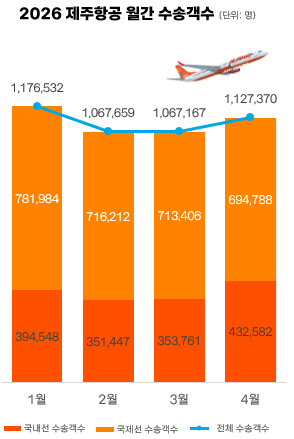
According to the Ministry of Land, Infrastructure and Transport's aviation information portal, Jeju Air transported 1,127,370 passengers in April, a 20.3% increase from 936,899 during the same period last year.
Domestic flights saw an increase from 387,429 to 432,582, a rise of 11.7%, while international flights grew from 549,470 to 694,788, marking a 26.4% increase.
In particular, Jeju Air recorded 1,176,532 passengers in January, 1,067,659 in February, and 1,067,167 in March, making it the only South Korean low-cost carrier (LCC) to achieve over 1 million passengers each month.
In April, Jeju Air accounted for 23.8% of the total passengers among nine domestic LCCs, with 25.3% on domestic routes and 23.1% on international routes.
The airline's load factor also exceeded the LCC average, with an overall load factor of 91.9% in April, surpassing the LCC average of 89.5% by 2.4 percentage points. Domestic flights achieved a load factor of 97%, while international flights recorded 89.1%.
Jeju Air is responding flexibly to travel demand through efficient route operations.
Since the start of the winter schedule on October 26 last year, the airline has increased its Incheon-Osaka route from four to seven flights per day. Additionally, as part of a corporate merger remedy, it has utilized all slots allocated for the Gimpo-Jeju route, increasing service to four round trips daily starting March 29.
On May 12, Jeju Air began trial operations on the Incheon-Jeju route with two flights per week. Starting June 11, it will launch a new route from Incheon to Kobe, further enhancing its competitiveness on Japanese routes.
Jeju Air is accelerating its market share growth by expanding its domestic routes and focusing on medium-haul international flights.
The airline plans to adjust its supply of medium-haul routes, which are popular during the summer vacation season, to actively attract passengers during peak periods.
As competition among LCCs intensifies, Jeju Air aims to maximize its competitiveness through efficient fleet operations and rapid route restructuring.
A Jeju Air official stated, "We are continuing flexible route operations to respond to changes in travel demand due to fluctuations in fuel prices and exchange rates, and we will strengthen our competitiveness through efficient route management even in a volatile market."
* This article has been translated by AI.
Copyright ⓒ Aju Press All rights reserved.