
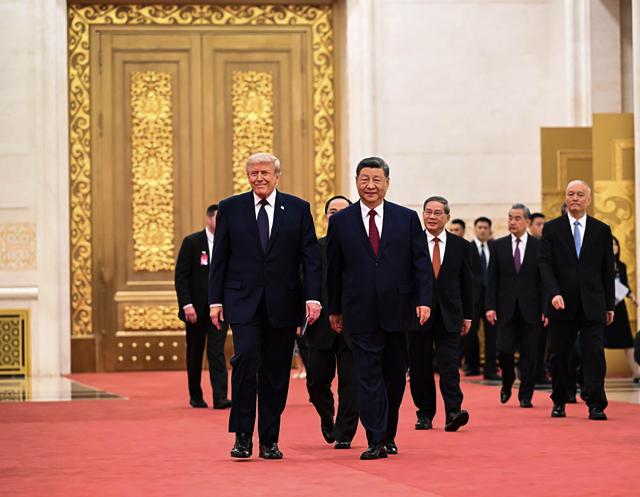
The atmosphere was neither openly confrontational nor genuinely warm. It carried something more consequential: the careful restraint of two powers that understand they are now shaping the architecture of the twenty-first century.
Later that evening, during the state banquet at the Great Hall of the People, Xi Jinping delivered a sentence that immediately reverberated far beyond Beijing.
“The great rejuvenation of the Chinese nation and Make America Great Again are fully compatible.”
It was a brief diplomatic phrase, but the world understood its deeper meaning. Behind those words stood the defining geopolitical question of our age: Can the United States and China escape the Thucydides Trap?
The phrase itself originates from the ancient Greek historian Thucydides, whose account of the Peloponnesian War remains one of history’s most enduring studies of power transition. Reflecting on the conflict between Sparta and Athens, he wrote: “It was the rise of Athens and the fear that this instilled in Sparta that made war inevitable.”
More than two millennia later, the concept was revived and expanded by the Harvard political scientist Graham Allison, who argued that when a rising power threatens to displace an established one, structural tensions often push nations toward confrontation, even when neither side truly desires war.
Today, that historical framework has become inseparable from the evolving relationship between Washington and Beijing.
For nearly eight decades, the United States has presided over the global order through the dominance of the dollar, unmatched naval power, technological leadership, financial institutions, and a vast alliance network. China, meanwhile, has risen with extraordinary speed, transforming itself from a manufacturing platform into a strategic superpower with ambitions that extend across artificial intelligence, semiconductors, electric vehicles, quantum technology, rare earth supply chains, and global infrastructure.
What unsettles Washington is not merely the scale of China’s economy. The deeper anxiety lies in the possibility that Beijing may eventually construct a parallel system of power — one capable of functioning independently of the American-led order.
From Beijing’s perspective, however, the United States is no longer seen simply as a competitor. Chinese leaders increasingly interpret American export controls, semiconductor restrictions, investment barriers, alliance restructuring, and Indo-Pacific strategy as elements of a broader containment effort aimed at slowing China’s ascent.
The result is a widening spiral of strategic distrust. Yet unlike the rival powers of ancient Greece, the United States and China are bound together in ways that make outright conflict extraordinarily dangerous.
American consumers remain deeply connected to Chinese manufacturing. Chinese growth, in turn, still relies heavily on global dollar liquidity and access to international markets. The world’s semiconductor ecosystem stretches across America, Taiwan, South Korea, Japan, and China in a web of mutual dependence. Even the fiercest technological rivalry unfolds within a shared economic bloodstream.
This is why the modern version of the Thucydides Trap is unlikely to resemble a conventional great-power war.
The struggle is instead unfolding through overlapping forms of competition: semiconductor restrictions, artificial intelligence supremacy, supply-chain fragmentation, financial sanctions, maritime rivalry, currency pressures, energy corridors, cyber influence, and technological sovereignty.
In that sense, Xi Jinping’s vision of “national rejuvenation” and Donald Trump’s MAGA movement are not simply political slogans. They are competing civilizational narratives.
MAGA seeks to restore American industrial strength, revive the middle class, secure energy independence, reinforce borders, and bring manufacturing back home. China’s national rejuvenation, meanwhile, reflects a much deeper historical ambition: the determination to overcome what Beijing calls the “Century of Humiliation” and restore China to what it sees as its rightful position at the center of global civilization.
The difficulty is that both visions are rooted in forms of national primacy.
Washington seeks to rebuild supply chains around American strategic interests. Beijing pursues technological self-sufficiency and broader international use of the renminbi. The United States reinforces alliances; China expands influence through BRICS, the Global South, and alternative trade and infrastructure systems.
Can these two trajectories coexist? Perhaps not harmoniously. But coexistence through disciplined management may still be possible. That would require several forms of strategic restraint.
First, both powers must separate economic competition from military confrontation wherever possible. Mechanisms preventing accidental escalation around Taiwan and the South China Sea are no longer optional; they are essential safeguards for global stability.
Second, both sides must recognize that complete economic decoupling is neither realistic nor sustainable. Excessive restrictions and retaliatory measures risk weakening not only their rival, but the global economy itself.
Third, political rhetoric intended for domestic audiences must not be allowed to harden into irreversible geopolitical miscalculation. Strong leadership may generate applause at home, but in an age of nuclear weapons and artificial intelligence, recklessness carries civilizational consequences.
Perhaps the most important image from the Beijing summit was not the banquet itself, but the quiet walk through the Temple of Heaven.
For centuries, Chinese emperors came there to pray for harmony between heaven and earth. That the president of the United States and the leader of China walked those grounds together was more than ceremonial symbolism. It reflected a deeper reality: neither nation can erase the other from the future of the international order.
Global markets understand this well. If Washington and Beijing stabilize their relationship, financial markets may regain confidence, while semiconductor, logistics, energy, and technology sectors could recover momentum. But if tensions intensify again, supply-chain fragmentation and inflationary pressures may once more destabilize the world economy. Any serious crisis in the Taiwan Strait would immediately reverberate through the global semiconductor industry and beyond.
For South Korea, the challenge is especially delicate.
Seoul depends on the United States for security while remaining deeply connected to China economically. Its semiconductor, battery, automotive, shipbuilding, and artificial-intelligence industries all stand directly within the fault line of U.S.-China rivalry. South Korea therefore cannot afford simplistic alignment. It must instead cultivate the strategic flexibility and industrial resilience expected of a sophisticated middle power.
History never repeats itself precisely. But human fear often does.
What Thucydides ultimately understood was not merely the movement of armies, but the psychology of rising and declining powers. When the insecurity of an established power collides with the confidence of an ascending one, the international order becomes dangerously unstable.
And yet humanity today possesses something ancient Greece did not: the awareness that total war between great powers would likely mean mutual ruin.
The future of U.S.-China relations, therefore, may depend less on which nation becomes stronger than on which proves more capable of restraint.
Trump’s MAGA vision and Xi Jinping’s national rejuvenation project are moving along different historical paths. But they must still find a way to coexist without destruction.
That may be the only path by which the twenty-first century avoids falling fully into the Thucydides Trap .
* contribution from Aju correspondent Bae In-sun in Beijing
Copyright ⓒ Aju Press All rights reserved.
