
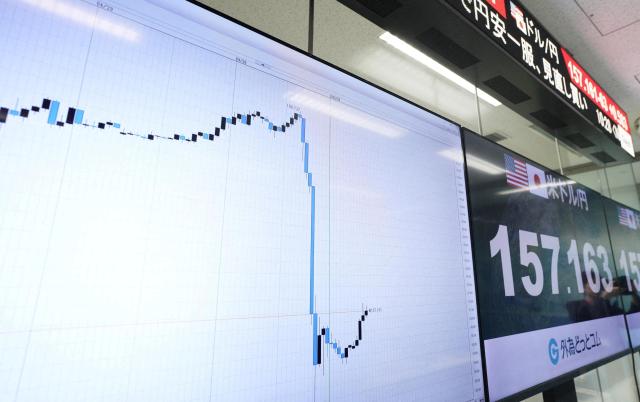
The Japanese yen has risen to around 160 yen per dollar, indicating a decline in its value, as the effects of the Japanese government's large-scale yen-buying intervention at the end of April have faded within a month. Amid ongoing tensions in the Middle East, rising oil prices, and expectations of interest rate hikes in the U.S., the market is now focused on the possibility of further intervention by Japanese authorities and the pace of additional tightening by the Bank of Japan (BOJ).
The Nihon Keizai Shimbun reported on June 3 that the yen's exchange rate had climbed to approximately 160.09 yen per dollar in European and U.S. foreign exchange markets. The yen's value is nearing the 160.72 yen recorded just before the Japanese government and the BOJ intervened to buy yen and sell dollars on April 30. From the end of April to the end of May, the scale of Japan's foreign exchange market intervention reached 11.7349 trillion yen (about $112.45 billion).
The renewed weakness of the yen is attributed to the strength of the dollar. With no significant progress in negotiations to end hostilities between the U.S. and Iran, there has been a growing trend in the foreign exchange market to purchase the safe-haven dollar. Concerns about renewed inflation in the U.S. due to rising oil prices, combined with the resilience of the U.S. economy, have fueled speculation about interest rate hikes by the Federal Reserve, further encouraging the sale of yen and purchase of dollars.
The BOJ has hinted at the possibility of interest rate hikes to counter the yen's weakness, but market reactions have been limited. BOJ Governor Kazuo Ueda stated in a speech on June 3 that if inflationary pressures increase, it would be necessary to closely discuss the possibility of a rate hike at the monetary policy meeting on June 15-16. Following his remarks, the market nearly accepted a June rate hike as a certainty, and the yen briefly rose to the low 159 yen range against the dollar. However, the buying momentum for the yen did not last long, and the exchange rate quickly returned to levels seen before the speech.
Market analysts believe that even if the BOJ raises interest rates at the June meeting, it will be difficult to reverse the trend of yen weakness. Mari Iwashita, a rate strategist at Nomura Securities, stated, "One rate hike will not change the trend of yen weakness," noting that market attention is shifting to the timing of the next rate increase. The current policy interest rate set by the BOJ is 0.75%. The BOJ estimates the neutral interest rate to be around 1.1% to 2.5%, and the speed at which rates are raised toward the midpoint of this range, around 1.8%, is seen as a key factor influencing the yen's trajectory.
The BOJ's inability to signal a strong tightening response to market demands is also contributing to the yen's weakness. The Nikkei reported that, according to Asian hedge fund managers, Ueda's remarks reflect the cautious nature of the BOJ, suggesting that he may be mindful of the Takaiichi Sanae administration's preference for monetary easing. The perception that the BOJ has consistently lagged in responding to inflation has already spread abroad, making it difficult for mere indications of potential rate hikes to serve as a catalyst for yen appreciation.
Among foreign investors, there is also a lack of enthusiasm for actively buying yen. According to the Nikkei, Bank of America (BofA) raised its medium-term outlook for the yen from "weak" to "neutral" in mid-May, projecting an exchange rate of 152 yen per dollar by the end of 2026, a decrease of 5 yen from previous estimates (indicating a stronger yen). The median forecast from about 40 securities firms compiled by LSEG in the UK also suggests that the yen will strengthen to around 154 yen per dollar by the end of 2026. However, the Nikkei noted that investors view yen purchases as a "trap of undervaluation." Alres Kutni from Vanguard Asset Management predicted that even if the BOJ raises rates this month, it will only do so once every six months, and the yen could fall to 170 yen per dollar.
Ironically, the possibility of renewed intervention by Japanese authorities is also fueling yen weakness. While speculation about intervention makes it difficult for traders to openly sell yen, Japanese importers and long-term investors in overseas stocks are unable to wait for a rebound in the yen and are preemptively buying dollars. In a low volatility environment, yen carry trades, which aim to profit from interest rate differentials, are also likely to expand. The trend of borrowing low-interest yen to invest in high-interest currencies or risk assets is increasing pressure on the yen's value. According to the Commodity Futures Trading Commission (CFTC), as of May 26, the net short position in yen held by non-commercial traders classified as speculators reached 114,667 contracts. In yen terms, this amounts to approximately 1.4 trillion yen, exceeding the roughly 100,000 contracts seen before the intervention and reaching the highest level since July 2024.
The yen's weakness is deepening the BOJ's concerns about inflation. The consumer price index for April, calculated by the BOJ after removing the effects of government subsidies and tax cuts, rose by 2.8% compared to the same month last year. Although the official inflation rate has slowed, this indicates that inflationary pressures are actually strengthening when excluding the effects of energy subsidies and free education policies. If the yen's weakness leads to rising import prices, the BOJ may face even stronger tightening pressures.
Prime Minister Takaiichi Sanae also stated on June 3 during a meeting of the House of Councillors that the government would respond appropriately to fluctuations in the exchange rate as needed. The market is once again viewing the 160 yen per dollar level as a threshold for assessing the likelihood of renewed intervention by Japanese authorities. However, with the simultaneous pressures of a strong dollar, the U.S.-Japan interest rate differential, and rising oil prices, there is a strong belief that intervention alone will not be sufficient to change the trend. The Nikkei quoted a foreign exchange dealer as saying, "Unless the BOJ acknowledges that its policy response has lagged and shows a willingness to accelerate the pace of rate hikes, it will be difficult to expect yen appreciation." The yen's return to the 160 yen level within a month indicates that Japanese authorities are once again facing the challenge of managing exchange rates, inflation, and interest rates simultaneously.
* This article has been translated by AI.
Copyright ⓒ Aju Press All rights reserved.