
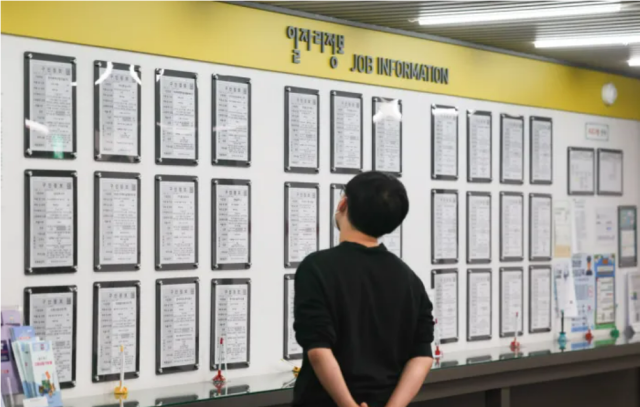
South Korea's job market is experiencing deepening K-shaped polarization, with an increasing number of young people disengaging from the labor force. Despite rising employment figures, job growth is primarily concentrated in large companies and among older workers, while opportunities for youth and small businesses are dwindling.
The Korea Employers Federation (KEF) released a report on May 17, highlighting key trends in the current employment landscape. The report indicates a worsening of K-shaped employment polarization, a rise in the number of young people classified as inactive, and a slowdown in labor mobility.
Particularly concerning is the growing employment insecurity among young people. Last year, the number of individuals aged 20 to 30 who were inactive reached 717,000, the highest figure since such statistics began being tracked. This indicates that over 700,000 young people have exited the labor market at the entry stage. The number of inactive individuals in this age group has surged from 644,000 in 2023 to 691,000 in 2024.
KEF attributes the increase in inactivity among young people to a vulnerable job structure rather than merely a lack of available positions. There is a clear trend of young individuals leaving small businesses and temporary or seasonal jobs, contributing to the inactive population. Among those aged 20 to 30 who have been inactive in the past year, the reasons for leaving their jobs were personal reasons (36.6%), dissatisfaction with working conditions (29.9%), and the end of temporary or seasonal work (19.1%).
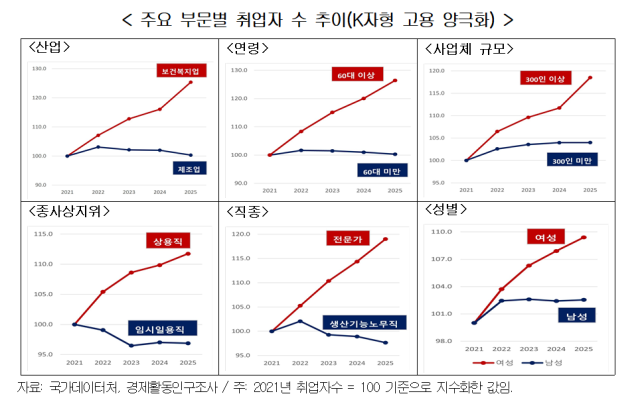
The current job market is expanding primarily in new industries, among those aged 60 and older, and within large companies, while employment in traditional industries, among those under 60, and in small businesses and temporary jobs is contracting.
According to analysis from the National Data Agency, the number of employed individuals under 60 last year was approximately 21.94 million, a decrease of 0.7% from the previous year (22.08 million). In contrast, the number of employed individuals aged 60 and older rose from 6.49 million to 6.83 million, an increase of 5.3% during the same period.
Polarization by company size is becoming increasingly pronounced. Small businesses, which account for about 90% of total employment, have seen their employment growth rate stagnate at around 0% since 2023. Meanwhile, employment in companies with over 300 employees increased by 6.1% last year, reaching 3.34 million, up from 3.15 million the previous year. This growth is attributed to strong exports led by large companies, particularly in the semiconductor sector.
Labor mobility is also on a downward trend. Last year, the labor mobility rate was 9.8%, continuing a steady decline. This rate measures the proportion of new hires and job changes relative to the total workforce over a specific period. Both the hiring and turnover rates fell from 5.1% in 2024 to 4.9% last year.
KEF analyzed that the simultaneous strengthening of companies' hiring reductions and workers' reluctance to change jobs could further entrench the dual structure of the labor market. This trend could exacerbate income inequality and dampen consumption, weakening the overall growth foundation of the economy.
Lee Sang-cheol, head of KEF's Employment and Social Policy Division, stated, "While recent employment indicators show a quantitative expansion, structural imbalances such as K-shaped polarization are actually deepening. The disengagement of young people from the labor market and the slowdown in labor mobility pose warning signs that could constrain our economy's growth potential."
* This article has been translated by AI.
Copyright ⓒ Aju Press All rights reserved.