
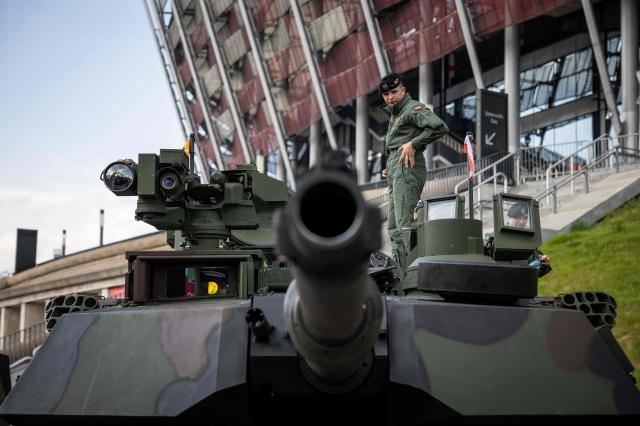
The United States has suspended plans to deploy over 4,000 Army troops to Poland.
On May 15, U.S. Defense Secretary Pete Hegseth announced the cancellation of the rotational deployment of the 2nd Armored Brigade Combat Team, part of the 1st Cavalry Division stationed at Fort Hood, Texas. This unit includes more than 4,000 personnel and equipment, with some troops and gear reportedly already en route to Europe.
A Pentagon official expressed surprise to Politico, stating, "We did not expect this decision at all." U.S. and European officials have reportedly convened urgently to understand the reasons behind the decision and to discuss potential further actions.
The specific reasons for the cancellation of the deployment to Poland have not been disclosed. Hegseth has previously praised Poland for its defense spending, which approaches 5% of its GDP. Former President Donald Trump also suggested relocating U.S. troops from Germany to neighboring Poland. Polish President Karol Nawrocki, a close ally of Trump, has publicly called for the transfer of U.S. troops stationed in Germany to Poland.
Earlier, Trump announced the withdrawal of 5,000 U.S. troops from Germany immediately after German Chancellor Friedrich Merz criticized the U.S. response to the Iran conflict. In contrast, Poland has had minimal public disputes with the Trump administration, making this decision particularly unexpected.
Retired General Ben Hodges, former commander of U.S. Army Europe, told Politico that the role of U.S. forces in Europe is primarily to deter Russia, protect U.S. strategic interests, and reassure allies. He noted, "Now, a very important asset that was supposed to be part of that deterrence has disappeared."
The Pentagon clarified that this decision was not abrupt. Acting Pentagon spokesperson Joel Valdez stated, "The decision to withdraw troops followed a comprehensive and multilayered process reflecting the views of key commanders and the entire command structure of U.S. forces in Europe," adding that it was not an unexpected last-minute decision.
However, concerns remain about the overall clarity of U.S. strategy in Europe. Bloomberg reported that the decision is part of a broader review of U.S. troop presence in Europe.
Lithuanian Defense Minister Robertaas Kaunas told Bloomberg that Lithuania had been informed about the potential changes to U.S. troop rotations in Europe, indicating that the U.S. had alerted allies about a possible temporary halt in troop rotations while reviewing its deployment plans. However, he noted that he had not received any information regarding the withdrawal of U.S. troops from Lithuania.
Poland, which was not notified in advance, expressed its surprise but sought to downplay the implications. Prime Minister Donald Tusk assured reporters, "We have been guaranteed that changes in U.S. troop deployments will not affect Poland's security," emphasizing that the decision is logistical and will not directly impact deterrence or our security.
Polish Defense Minister Włodzimierz Kosiniak-Kamysz also stated on X (formerly Twitter) that this issue relates to previously announced changes in U.S. troop deployments in Europe and is not related to Poland.
Currently, about 500 U.S. troops are permanently stationed in Poland, while approximately 10,000 are deployed on a rotational basis.
* This article has been translated by AI.
Copyright ⓒ Aju Press All rights reserved.