
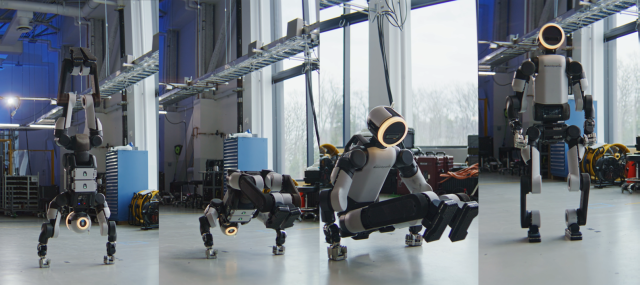
Hyundai Motor Group's robotics subsidiary, Boston Dynamics (BD), is ramping up its efforts to penetrate the industrial robot market with its humanoid robot, Atlas. The company has already established a strong foothold in the industry with its quadrupedal robot Spot and logistics robot Stretch, leveraging decades of operational experience and a vast testing ground within the group. However, building a production system for Atlas and improving profitability remain significant challenges.
According to industry sources, BD is focusing on advancing the technology needed to deploy the prototype of the bipedal robot Atlas, which garnered attention at CES 2026 in January, into manufacturing settings.
The foundation of BD's commercialization strategy lies in the robot hardware and motion control technologies it has developed over decades, along with operational experience gained in industrial environments. While Chinese startups excel in cost and production speed, and U.S. AI companies have strengths in software capabilities, BD's competitive edge is its ability to commercialize various technologies and demonstrate their effectiveness in real production processes. Notably, Spot and Stretch have already been supplied to several companies, proving their utility in the field.
Another advantage is BD's high accessibility to manufacturing sites. The company plans to utilize major production hubs, such as Hyundai Motor Group's Meta Plant America in Georgia in 2028 and the Kia plant in Georgia in the second half of 2029, as initial testing grounds for Atlas. This could establish a trust base for expanding its external client base.
However, there are considerable hurdles to overcome before Atlas can be commercialized. BD aims to establish a production system capable of manufacturing 30,000 units annually by 2028, but it has yet to create a stable profit structure. Last year, BD's revenue reached 150.1 billion won, a 30% increase from the previous year, but it recorded a net loss of 528.4 billion won, widening the loss by about 20% compared to 2024 (440.5 billion won).
Additionally, the possibility of an initial public offering (IPO) next month has increased management uncertainty. The plan is to secure investment funds for establishing the Atlas production system through the IPO, but if the company fails to enter a profit-making phase post-listing, its corporate value could plummet.
When Hyundai Motor Group acquired BD from SoftBank in June 2021, a put option clause was established. If BD does not go public within four or five years after the acquisition, Hyundai Motor Group is obligated to buy back the 20% stake held by SoftBank at a pre-agreed price. The deadline for this option is next month, and if exercised, it could increase Hyundai Motor Group's burden of additional share purchases.
Ultimately, for BD to dominate the humanoid market, it must translate its strong brand recognition and technological prowess into actual profits. Securing external clients quickly will also be crucial for successfully integrating Atlas into manufacturing environments. An industry insider stated, "Stably deploying Atlas in the field and converting that into recurring revenue is essential. The results from testing at Hyundai Motor Group's production sites will be a turning point for securing external clients."
* This article has been translated by AI.
Copyright ⓒ Aju Press All rights reserved.