
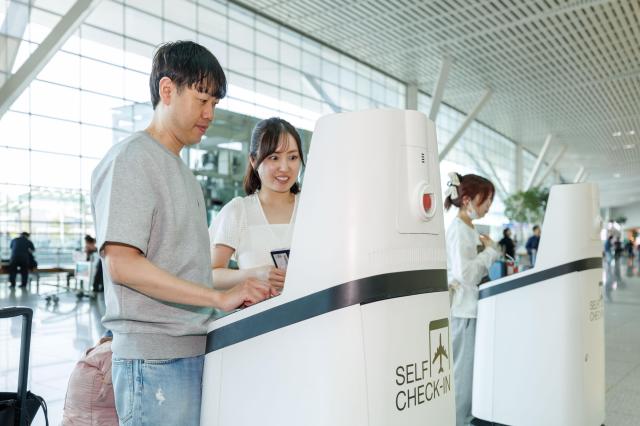
SEOUL, May 18 (AJP) - South Korea’s main gateway, Incheon International Airport, has deployed autonomous service robots as the country accelerates automation across service industries amid rising wage costs and labor shortages.
Incheon International Airport Corporation said Monday that it has begun full-scale operations of 31 autonomous robots, including self-check-in robots, guidance and patrol robots, and docent robots designed to assist passengers and provide cultural information across airport facilities.
The rollout reflects a nationwide shift toward automation as South Korean businesses and major companies increasingly turn to service robots to offset mounting labor costs and staffing shortages.
South Korea’s minimum wage rose to 10,320 won ($7.5) per hour in 2026, bringing minimum monthly pay for full-time workers to about 2.16 million won based on a 209-hour work month. As labor costs continue to climb, businesses in labor-intensive sectors such as tourism, retail and hospitality are increasingly adopting kiosks and service robots to reduce staffing burdens and maintain round-the-clock operations with fewer workers.
According to pricing released by B-ROBOTICS, a robotics affiliate of Woowa Brothers, the operator of Baemin, South Korea’s largest food delivery platform, serving robots can be rented for as low as 299,000 won ($218) per month under a 36-month contract. By comparison, employing a full-time worker at a low-cost eatery such as Gimbap Cheonguk can cost restaurant owners roughly 2.4 million won to 2.8 million won ($1,750-$2,040) a month.
The large cost gap is accelerating adoption among small business owners already struggling with rising wages and labor shortages.
A survey conducted by part-time job portal Mediawill Networks on April 26 found that 73.7 percent of 114 small business owners said they had used unmanned devices such as kiosks, cooking robots or serving robots over the past year. 48.6 percent of respondents said kiosks helped reduce operating costs, reflecting growing interest in automation tools among small businesses facing rising labor expenses.
The shift is also reshaping employment patterns in South Korea’s service sector. In a 2024 report based on surveys of 2,000 restaurants and bars in Seoul, the Korea Employment Information Service found that restaurants introducing kiosks reduced sales and serving staff by about 11.5 percent on average, while tablet ordering systems cut such jobs by roughly 7.5 percent. The report said 55 to 76 percent of businesses cited labor cost reduction as the main reason for adopting digital devices such as kiosks, tablets and service robots.
The trend in service-sector automation reflects South Korea’s broader embrace of robotics across the economy.
According to the International Federation of Robotics’ “World Robotics 2025” report released in April, South Korea has the highest concentration of industrial robots in the world, with 1,220 robots for every 10,000 manufacturing workers — more than six times the global average.
Behind the trend is a deeper structural shift. South Korea officially became a “super-aged” society in 2025, with people aged 65 or older accounting for more than 20 percent of the population, according to the International Labour Organization. At the same time, the country’s working-age population has continued to shrink, intensifying labor shortages across service and manufacturing industries and pushing companies to accelerate investment in robotics and AI-powered automation technologies.

Copyright ⓒ Aju Press All rights reserved.
