
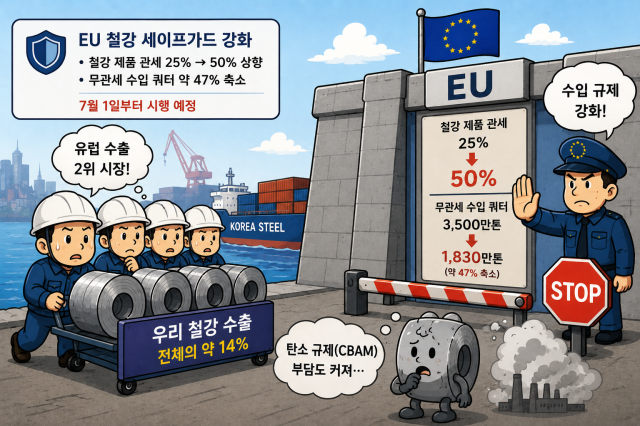
As the European Union (EU) joins the United States in tightening steel import regulations, experts suggest that the immediate impact on South Korea may be limited. This is largely due to the absence of finalized country-specific regulations and the focus of these measures on curbing the influx of low-cost steel from China.
According to industry sources on May 21, South Korean steel companies are closely monitoring the EU's moves to strengthen steel import regulations.
On May 19, the European Parliament approved a plan to raise tariffs on steel products from 25% to 50% and reduce the duty-free import quota to about half of its previous level. This measure is set to take effect on July 1, following approval from member states.
While the specific application methods and detailed regulations by product category have yet to be disclosed, the reduction of the duty-free quota from the previous annual level of 35 million tons to 18.3 million tons—approximately a 47% decrease—is expected to impose significant burdens on domestic companies.
The EU is the second-largest market for South Korean steel exports. According to the Korea Iron and Steel Association, South Korea exported 1.386 million tons of steel to the EU from January to April this year, accounting for about 14% of total exports of 9.644 million tons.
High-value-added products, such as hot-rolled, cold-rolled, and galvanized steel sheets, make up a significant portion of these exports, raising concerns that increased regulations could further strain the price competitiveness of South Korean steelmakers.
Additionally, with the implementation of the EU's Carbon Border Adjustment Mechanism (CBAM) gaining momentum, South Korean steel companies are facing growing export burdens. CBAM imposes costs based on the carbon emissions generated during the production of carbon-intensive products, such as steel, exported to the EU.
Industry analysts warn that if both tariff barriers and carbon regulations are strengthened simultaneously, the export cost burden on South Korean steelmakers could increase significantly. Among domestic steel companies, POSCO has the highest export share to the European market, with European exports accounting for 15% to 17% of its total overseas sales. Hyundai Steel, Dongkuk Steel, and SeAH Steel follow in this regard.
However, some industry insiders believe that the actual impact may be limited, as specific implementation plans have not yet been disclosed. Given that the measures primarily target low-cost steel from China, there is a possibility that the quota for South Korean steel products will remain at current levels.
A representative from the steel industry stated, "The EU's regulatory tightening is primarily aimed at preventing the influx of low-cost steel from China, so the likelihood of direct regulations affecting South Korean steel products remains low. However, the overall trend of increasing global protectionism may necessitate changes in export strategies in the long term."
* This article has been translated by AI.
Copyright ⓒ Aju Press All rights reserved.