
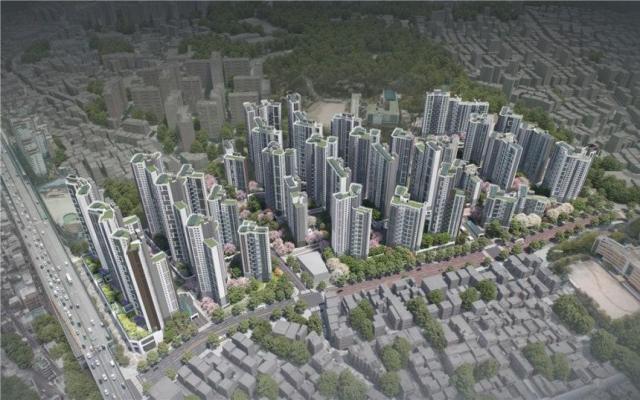
According to the Seoul city government, the 9th Integrated Review Committee convened on May 21 and approved plans for the Jangwi 15 district, Sangdo 15 district, Noryangjin 1 district, as well as the Mia 3 district and the Gwan-su-dong small-scale redevelopment area. The city expects that the integrated review process will shorten project timelines by up to four to six months.
The Jangwi 15 district, located near the Sangwolgok and Dolgok subway stations on Line 6, is characterized by a dense area of aging low-rise housing. The redevelopment will create a complex with a maximum height of 36 stories and 3,316 units, including 697 public rental apartments.
To accommodate increased traffic, the city plans to construct a new 25-meter-wide road, Jangwol-ro, on the eastern side of the complex, and develop a neighborhood park to connect Odong Neighborhood Park and the North Seoul Dream Forest, enhancing green space in the area.
Additionally, the redevelopment plans for the Jangwi 8, 9, and 14 districts are expected to gain momentum as integrated reviews are scheduled to continue through next year.
The Sangdo 15 district redevelopment project also received approval. This project will feature a maximum of 35 stories, 32 buildings, and 3,204 units, with 481 of those designated as public housing.
The city anticipates that this project will improve the residential environment in the Sangdo area while also providing a significant supply of housing.
The Noryangjin 1 district will be redeveloped into a complex with a maximum height of 49 stories, comprising 22 buildings and 3,103 units, including 526 public rental apartments.
Located near Noryangjin Station on Lines 1 and 9, the Noryangjin 1 district received approval for its management plan in April and is set to begin relocation in the second half of this year. The city aims to start construction by the end of next year, concurrently managing demolition and project plan modifications.
The complex will include a multi-purpose community center with integrated childcare facilities, sports amenities, a citizens' university, senior facilities, and a community center. Plans also include open spaces that connect parks and public walkways.
With the approval of these plans, the city believes that the overall redevelopment of the Noryangjin area will accelerate the supply of approximately 9,000 housing units.
The Mia 3 redevelopment area in Gangbuk-gu also passed the integrated review, allowing for the development of a complex with 1,053 units, located near Mia Intersection Station on Line 4, with 158 units designated as public housing.
Relocation has already been completed, and the city expects to expedite subsequent procedures, including demolition and project plan approvals, aiming for construction to begin in the second half of next year.
The redevelopment project for the small-scale Gwan-su-dong area in Jongno-gu also received approval. This area, situated between Tapgol Park and Jongno 3-ga Station, will feature a mixed-use facility with four underground floors and 18 above-ground floors.
Notably, the fourth floor will be dedicated to spaces for venture companies and integrated facilities, which the city hopes will enhance urban industrial competitiveness.
A city official stated, "We plan to transform aging commercial areas into mixed-use facilities and expand public spaces for citizens, creating a harmonious urban environment for work, commerce, relaxation, and pedestrian access in the Gwan-su-dong area."
Redevelopment promotion zones are designated areas aimed at improving residential environments and expanding infrastructure in underdeveloped urban areas through systematic and efficient planning. The city is also supporting rapid redevelopment and reconstruction projects through its expedited integrated planning system from the initial stages of planning and administrative procedures.
* This article has been translated by AI.
Copyright ⓒ Aju Press All rights reserved.