
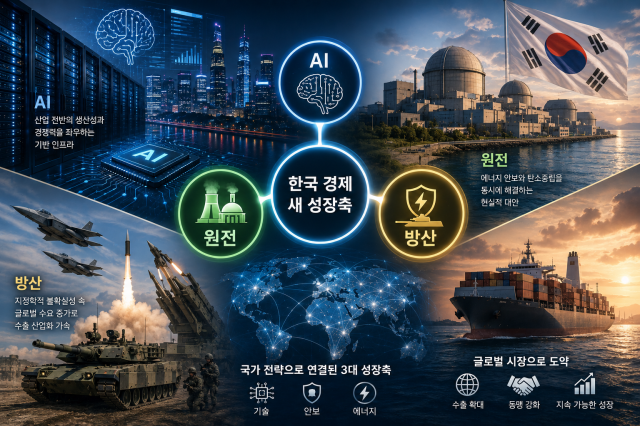
The foundation of South Korea's economy is gradually shifting. A new industrial axis is emerging on top of the traditional manufacturing sectors, which have been dominated by semiconductors, automobiles, and shipbuilding. This new axis includes artificial intelligence (AI), nuclear power, and the defense industry. These three sectors share a commonality beyond being promising industries; they are strategic sectors intertwined with the global reordering of power. This convergence of technology, security, and energy signifies a critical national agenda.
AI is no longer just a tool for specific industries; it has become a foundational infrastructure that influences productivity and competitiveness across all sectors. The AI ecosystem, which connects data centers, semiconductors, and power grids, is expanding into a national-level competition. As the United States and China clash over AI supremacy, South Korea finds itself in a position where it cannot delay its decisions. Building an AI infrastructure based on semiconductor competitiveness is one of the few opportunities we have and a card we cannot afford to miss.
Nuclear power is being re-evaluated as a practical solution to address both energy security and carbon neutrality. While the expansion of renewable energy is an inevitable trend, issues of intermittency and grid stability remain unresolved. The role of nuclear power as a baseload energy source is becoming increasingly significant. Furthermore, expectations for nuclear power exports to countries like the Czech Republic and Poland are adding to its potential as an export industry, extending beyond mere energy production.
The defense industry is benefiting from a time of heightened geopolitical uncertainty. With a surge in demand for weapons, particularly in Europe and the Middle East, the competitiveness of South Korean arms is rapidly gaining recognition. The balance of price and performance, quick delivery times, and stable production capabilities have already been validated in the global market. The defense sector is no longer a 'secondary industry' but has established itself as a core industry driving both exports and technological accumulation.
However, a significant concern remains: these three sectors are still largely confined to 'declarative expectations.' Without the establishment of inter-industry connections and ecosystems, there is a high risk that achievements will be short-lived. AI requires an integrated infrastructure involving power, data, and semiconductors, while nuclear power is a long-term industry that needs consistent policy and financial support. Similarly, the defense industry must align with diplomatic strategies, export financing, and technology transfer to ensure sustainable growth. Ultimately, all three sectors must operate on the common denominator of a 'national strategy.'
A more fundamental question arises: Can this new growth axis transform the structure of the South Korean economy? Until now, we have relied on the boom of specific industries to elevate growth rates. However, AI, nuclear power, and defense demand a shift not just in individual industry performance but in the overall industrial structure. Comprehensive approaches are needed, including workforce development, regulatory innovation, and financial support.
The current changes present both opportunities and challenges. As the global supply chain becomes more fragmented and technology and security intertwine, the choices South Korea makes will significantly influence its growth trajectory over the next decade. The three axes of AI, nuclear power, and defense have already begun to move. What remains is the speed and direction of this movement.
* This article has been translated by AI.
Copyright ⓒ Aju Press All rights reserved.