
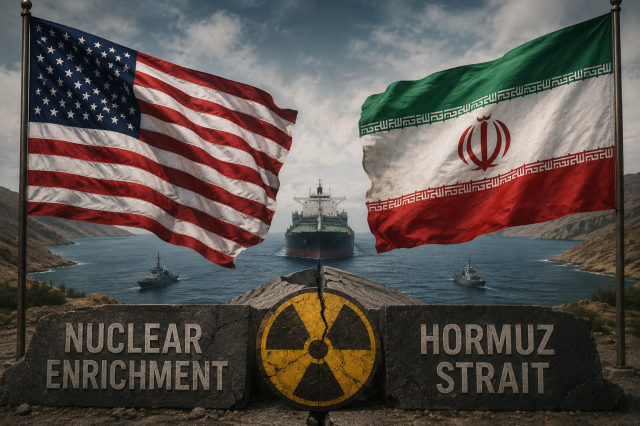
U.S. and Iranian ceasefire and peace negotiations have reached a critical juncture. Both sides have reportedly made significant progress toward a draft peace agreement through messages exchanged via a mediator. However, issues surrounding Iran's export of enriched uranium and navigation through the Hormuz Strait have emerged as key obstacles, preventing a final agreement.
On May 21, Ayatollah Ali Khamenei, Iran's Supreme Leader, issued a directive against the export of enriched uranium. Senior Iranian officials indicated that this policy reflects Khamenei's wishes and a consensus within Iran's power structure.
This stance directly contradicts a core demand from the United States, which insists that Iran must export its stockpile of 60% enriched uranium. This level of enrichment is significantly higher than that used for civilian nuclear power and could drastically reduce the time needed to further enrich it to weapons-grade levels of 90%. On the same day, President Donald Trump stated at the White House regarding Iran's uranium, "We will take it. We do not need it or want it. After we take it, we will probably destroy it."
Iran's calculations differ. The Iranian leadership believes that exporting uranium would make them more vulnerable to further attacks from the U.S. and Israel. They insist that they need to secure guarantees against additional attacks before entering detailed negotiations on their nuclear program. While Iran is open to discussing the dilution of uranium under the supervision of the International Atomic Energy Agency (IAEA), they have drawn a line at exporting it.
The issue of navigation through the Hormuz Strait has also surfaced as a significant barrier to agreement. U.S. Secretary of State Marco Rubio stated that if Iran pushes for a toll system in the Strait, a diplomatic agreement would become impossible. He emphasized, "No one in the world supports a toll system; it is unacceptable, completely illegal, and a threat to the world."
Rubio's comments address more than just the toll issue. If Iran were to operate the Hormuz Strait under a selective permit system and demand tolls, accepting such a system would imply U.S. recognition of Iran's maritime control, which is why the U.S. has classified this as a non-negotiable issue.
Rubio acknowledged some "progress" and "good signals" in talks with Tehran but noted that Iran's internal decision-making appears "somewhat divided," suggesting that further observation is necessary. Even if practical agreements are reached, the alignment of interests among Iran's internal power factions remains a variable for a final agreement.
Ultimately, the crux of this negotiation hinges not just on the peace agreement itself but on how far the U.S. is willing to recognize Iran's nuclear capabilities and maritime control post-war. For the U.S., extracting enriched uranium from Iran and restoring freedom of navigation in the Hormuz Strait are essential justifications for accepting any agreement. Conversely, Iran needs to retain its uranium and control over the Strait to maintain its narrative of regime security.
Both sides face significant pressure to compromise. Reuters reported that "Tehran views its stockpile of enriched uranium and control over the Hormuz Strait as 'vital strategic assets for survival.'" A senior Iranian official also stated, "Surrender is not an option."
* This article has been translated by AI.
Copyright ⓒ Aju Press All rights reserved.