
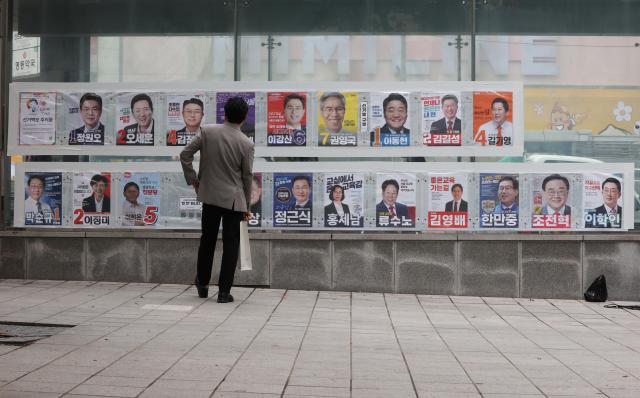
Ahead of the June 3 local elections, a survey indicates that more voters believe candidates from the ruling party should win than those from the opposition.
According to a Korea Gallup poll conducted from May 19 to 21 with 1,002 eligible voters aged 18 and older, 46% of respondents said that more candidates from the ruling party should be elected, a 2 percentage point increase from the previous survey. In contrast, 33% expressed support for more opposition candidates, unchanged from the last poll. Additionally, 21% of respondents were undecided.
The gap between the two parties has widened from about 3 percentage points last October to an average of 17 percentage points from April this year. However, it has narrowed to an average of 12 percentage points this month.
By political orientation, 76% of progressive respondents anticipated a victory for the ruling party, while 63% of conservatives expected the opposition to win. Among moderates, 45% favored the ruling party, compared to 32% for the opposition.
Age-wise, support for the ruling party was particularly strong among voters in their 40s, 50s, and 60s. In the 50s age group, 66% expected a ruling party victory, followed by 56% in their 40s and 48% in their 60s. Conversely, younger voters showed more support for the opposition, with 37% of those in their 20s and 45% of those in their 30s favoring the opposition. Among those aged 70 and older, 44% supported the opposition compared to 39% for the ruling party.
Regionally, only Daegu and North Gyeongsang Province showed a preference for the opposition, with 40% supporting the opposition and 27% supporting the ruling party. In contrast, Gwangju and Jeolla Province exhibited the largest margin in favor of the ruling party, with 62% supporting it and only 13% for the opposition.
In other regions, the ruling party led in Seoul (44% to 39%), Incheon and Gyeonggi Province (49% to 32%), Busan, Ulsan, and South Gyeongsang Province (43% to 35%), and Daejeon, Sejong, and Chungcheong Province (41% to 34%).
In the party support survey, the Democratic Party maintained a support rate of 45%, consistent with the previous survey. The People Power Party saw a slight decline of 1 percentage point to 22%. The gap in support between the two parties has decreased from 30 percentage points in early April to 23 percentage points in mid-May.
Regionally, the Democratic Party was favored in most areas, but in Daegu and North Gyeongsang Province, the People Power Party led with 34% compared to the Democratic Party's 30%.
This survey was conducted through random sampling of mobile phone numbers via telephone interviews. The margin of error is ±3.1 percentage points at a 95% confidence level, with a response rate of 12%. For more details, please refer to the website of the National Election Survey Deliberation Commission.
* This article has been translated by AI.
Copyright ⓒ Aju Press All rights reserved.