
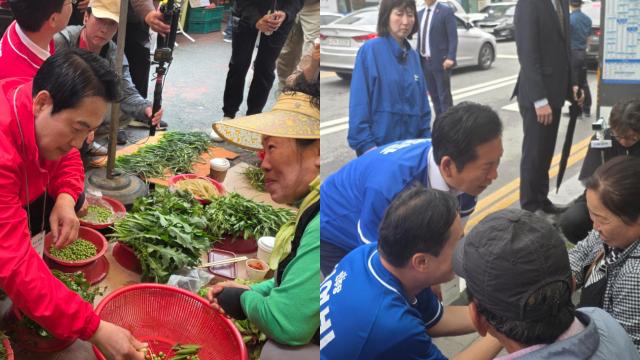
As the June 3 local elections and by-elections for the National Assembly approach in ten days, the Democratic Party and the People Power Party are engaged in fierce competition. Initially, the Democratic Party appeared to have the upper hand, promising to create effective local governments alongside the Lee Jae-myung administration. However, with a consolidation of conservative support in key battlegrounds, the People Power Party is also gaining ground.
According to political analysts on May 24, the Democratic Party is favored in most of the 16 regional governor races. However, the gap is narrowing in key districts, prompting both parties to intensify their efforts in Seoul, Busan, and Daegu to secure voter support.
In the Seoul mayoral race, recent polls show a mere 0.1 percentage point difference between candidates. A survey conducted by Ace Research for Newsis from May 19 to 20 among 1,002 adults aged 18 and older in Seoul revealed that Jeong Won-o of the Democratic Party garnered 41.7%, while Oh Se-hoon of the People Power Party received 41.6%. Although Jeong initially led in the early stages of the campaign, support for Oh has been rising as the election date approaches.
In this tight race, both candidates have launched attacks against each other. On the first weekend following the official campaign kickoff, Jeong targeted Oh over issues related to missing rebar at the Samsung Station construction site, while Oh retaliated by raising allegations of corruption in the redevelopment of the Seongdong-gu area.
Daegu is also witnessing a heated contest. While Kim Boo-kyum of the Democratic Party is reportedly performing well in this conservative stronghold, the People Power Party's Choo Kyung-ho is working to rally conservative voters, having visited Chilseong Market with former President Park Geun-hye the previous day, creating an unpredictable electoral landscape.
In Busan, the incumbent mayor Park Hyung-jun of the People Power Party and Jeon Jae-soo of the Democratic Party are engaged in a fierce back-and-forth. In Ulsan, Kim Sang-wook of the Democratic Party and Kim Du-gyeom of the People Power Party are in a close race, while in Gyeongnam, Kim Kyung-soo of the Democratic Party and Park Wan-soo of the People Power Party are also competing intensely.
The Democratic Party is expected to maintain an advantage in eight regions, including Incheon, Gyeonggi, Sejong, Daejeon, Chungbuk, Gangwon, Jeonnam/Gwangju, and Jeju, while the People Power Party is projected to lead in the Gyeongbuk area.
In the 14 by-elections taking place simultaneously, the Democratic Party is anticipated to secure a majority of seats. They are expected to perform well in eight districts, including Ansan Gap in Gyeonggi, Incheon Gyeyang, and Jeju Seogwipo. Conversely, the People Power Party is likely to lead in Daegu Dalseong-gun, the constituency of the late Choo, and in Ulsan Nam-gap, where candidate Kim is running.
Some districts are showing extremely close races. Pyeongtaek and Busan Buk-gap are among those with multiple candidates competing fiercely. In Pyeongtaek, Kim Yong-nam of the Democratic Party, Yoo Ui-dong of the People Power Party, and Jo Guk of the Justice Party are in a tight contest, while in Busan Buk-gap, independent candidate Han Dong-hoon, Hah Jung-woo of the Democratic Party, and Park Min-sik of the People Power Party are also vying for votes.
Meanwhile, the opinion poll related to the Seoul mayoral race was conducted using a 100% automated response system with virtual numbers provided by the three major telecommunications companies. The response rate was 5.5%, with a margin of error of ±3.1 percentage points at a 95% confidence level. For more details, please refer to the Central Election Survey Deliberation Commission's website.
* This article has been translated by AI.
Copyright ⓒ Aju Press All rights reserved.