
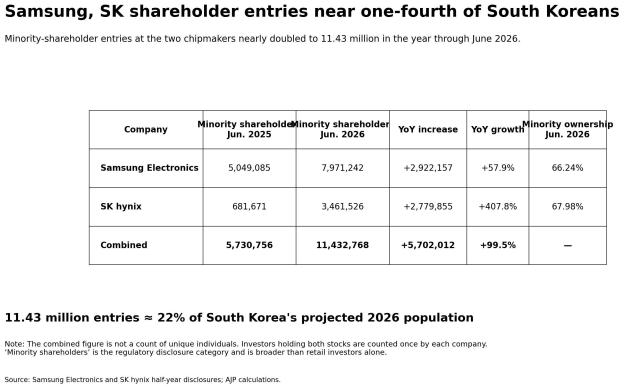
SEOUL, August 15 (AJP) - Minority-shareholder entries at Samsung Electronics and SK hynix nearly doubled from a year earlier to 11.43 million at the end of June, a tally equivalent to about 22 percent of South Korea's population, underscoring how the first-half chip frenzy dramatically broadened ownership of the country's two memory giants.
Minority shareholders held nearly seven out of every 10 shares in both chipmakers — 66.24 percent of Samsung Electronics and 67.98 percent of SK hynix.
The comparison is illustrative rather than a literal head count. Investors owning both Samsung and SK hynix are counted once by each company.
Still, the pace expansion has been extraordinary.
The two chipmakers had a combined 5.73 million minority-shareholder entries at the end of June 2025. The number increased by 5.70 million, or 99.5 percent, over the following 12 months.
At the end of 2025, Samsung had 4,195,927 minority shareholders, while SK hynix had 1,186,328, putting their combined total at 5.38 million.
In just six months, the two companies added about 6.05 million shareholder entries, an increase of 112 percent. Samsung's year-end figure comes from its business report, while SK hynix's filing put its end-2025 minority-shareholder base at 1.19 million.
Samsung remained by far the more widely held stock as its price is more accessible. It closed Friday at 274,500 won ($193.77), roughly one-sixth of SK hynix's 1,645,000 won.
Its minority-shareholder count reached a record 7,971,242 at the end of June, up 2.92 million from 5,049,085 a year earlier and 3.78 million from the end of 2025. The six-month increase alone was about 90 percent.
The two stocks had a spectacular run this year, helped by AI chip boom.
After turning higher in the second half of last year, the stock's monthly average price climbed from 65,087 won in July 2025 to 108,724 won in December. The rally accelerated this year, with Samsung moving above 150,000 won in January to peak at 374,500 won on June 19.
SK hynix's pull was even greater. Its minority-shareholder base jumped to 3,461,526 at end-June from 681,671 a year earlier — an increase of 2.78 million, or about 408 percent. From the end of 2025 alone, the number nearly tripled. Minority shareholders held 67.98 percent of its issued shares at the end of June.
The influx tracked SK hynix's rise to the center of the global artificial-intelligence investment boom.
Demand for high-bandwidth memory, or HBM, used alongside AI processors propelled its earnings and valuation to unprecedented levels. On June 22, SK hynix briefly overtook Samsung Electronics as South Korea's most valuable listed company, ending the session with a market capitalization of about 2,080 trillion won.
Samsung's minority shareholders held 66.24 percent of its issued shares at end-June, remarkably close to the 67.98 percent held by their counterparts at SK hynix.
Minority shareholders collectively owned roughly two-thirds of each of Korea's flagship chipmakers, giving changes in dividends, buybacks, capital expenditure and governance unusually broad consequences for the investing public.
Samsung has carried the nickname of a "people's stock" for years. Its minority-shareholder population jumped from 2.15 million at the end of 2020 to more than 5 million in 2021 during the pandemic-era retail-investing boom.
The number later retreated as the stock struggled. By the end of 2025, Samsung's minority-shareholder count had fallen to 4.20 million, down from 5.16 million a year earlier, as recovering share prices encouraged some investors to take profits.
The first half of 2026 reversed that trend with force.
SK hynix followed an even steeper trajectory. Its minority-shareholder base stood at just 681,671 in June last year and 1.19 million at year-end before vaulting above 3.46 million six months later.
After both stocks reached record highs in June, the market turned violently in July as leveraged positions unwound and investors reassessed valuations across the global AI trade. By July 30, Samsung had fallen 44.7 percent from its recent peak, while SK hynix had dropped 55.7 percent from its high, although both subsequently recovered part of those losses.
The KOSPI ended July down about 22 percent, its worst monthly performance in years, after a rally heavily concentrated in its two semiconductor giants reversed.
The first-half chip boom did more than reshape profits, market capitalization and the KOSPI. It expanded direct exposure to the semiconductor cycle across a far wider swath of Korean investors — spreading both the rewards of the AI boom and the risks of its volatility.
AJP Takeaways
- Samsung Electronics and SK hynix recorded 11.43 million minority-shareholder entries at end-June, nearly double the 5.73 million recorded a year earlier and equivalent to about 22 percent of Korea's population.
- The influx accelerated during the first-half chip frenzy: their combined shareholder tally more than doubled from 5.38 million at the end of 2025, with SK hynix's count nearly tripling in six months.
- The boom also widened exposure to the downside. The shareholder figures were recorded near June's market peak, shortly before Samsung and SK hynix suffered steep declines during July's market rout.
Copyright ⓒ Aju Press All rights reserved.
