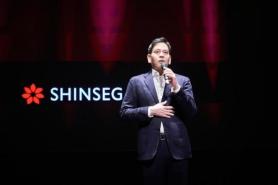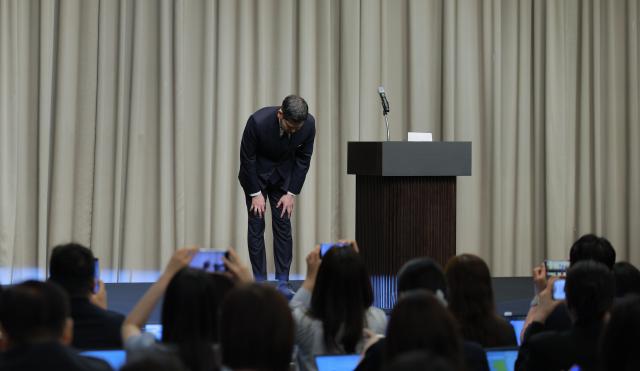
SEOUL, May 26 (AJP) - Shinsegae Group Chairman Chung Yong-jin on Tuesday delivered a second public apology within a week over Starbucks Korea’s controversial “Tank Day” promotion, bowing repeatedly in a televised appearance and pledging to restore public trust through action rather than words after what the group described as a “serious” failure in historical awareness.
Speaking at the Josun Palace hotel in Seoul, Chung bowed deeply three times during a five-minute apology addressing bereaved families of the May 18 Democratization Movement, the family of late student activist Park Jong-chul, citizens of Gwangju and the broader Korean public.
“I will not make any excuses. This is my fault,” Chung said. “We will regain the public’s trust not through words, but through actions.”
The apology came eight days after Starbucks Korea promoted tumblers branded with the word “Tank” on May 18, the anniversary of the 1980 Gwangju pro-democracy uprising. Critics also condemned the campaign’s use of the phrase “Tak! on the desk,” saying it evoked the infamous explanation once used to cover up the 1987 torture death of student activist Park Jong-chul.
What initially appeared to be a marketing blunder quickly escalated into one of the most serious reputational crises faced by the Shinsegae Group in recent years, triggering boycott campaigns, police complaints, mounting political pressure and public criticism from President Lee Jae Myung.
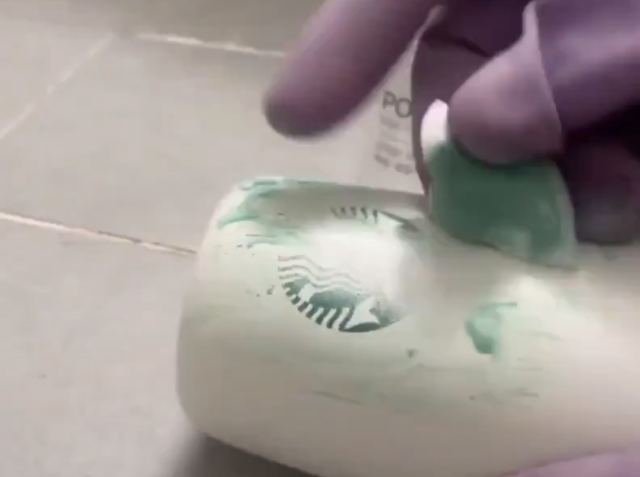
Social media became a major battleground for the backlash. One video posted on X showing a consumer removing a Starbucks logo from a tumbler with nail polish remover drew 4.8 million views, while another post showing an unusually empty Starbucks outlet during the holiday weekend amassed nearly 4 million views alongside thousands of reposts and boycott messages.
Internal review finds systemic failures
In a follow-up briefing, Yang Jong-hwan, managing director of Shinsegae’s internal audit team, said investigators reviewed company emails, work laptops, internal messenger records and other communication channels involving 15 employees, including five executives, using digital forensic methods. Cross-check interviews were also conducted with more than 10 employees.
The probe did not uncover evidence of deliberate coordination or intentional political messaging, according to the company. But the review also exposed clear limitations.
Of the five key employees directly involved in handling the “Tank” naming process, only two voluntarily submitted personal mobile phones for forensic analysis. Three declined, citing privacy concerns. Yang acknowledged that while the company wanted broader access, it lacked authority to compel employees to surrender personal devices.
Executives nevertheless insisted that internal messenger records and work-related data showed no evidence of premeditated collusion.
Kim Su-wan, vice president and head of external affairs, described the controversy as a symptom of an organization overly focused on speed and sales performance at the expense of historical sensitivity.
“This case showed that speed and sales considerations had taken priority over historical awareness and social sensitivity,” Kim said.
According to Kim, the promotion was handled by a small e-commerce team composed largely of younger employees, including two workers in their early 20s. Internal communications after the controversy suggested that some staff members did not fully grasp the historical weight associated with May 18 or the wording used in the campaign.
“The task now is to create programs that can strengthen historical awareness across generations, from younger employees to senior staff,” Kim said.
Executives acknowledged that the campaign should have passed through multiple review layers including corporate social responsibility and legal checks, but said several safeguards either failed or were bypassed altogether.
“Even if the original planner made a poor judgment, this situation would not have escalated this far if the internal filtering system had functioned properly,” Kim said. “The core problem was that the review system failed to work as it should have.”
Why the backlash became so explosive
The controversy touched two of the most painful episodes in South Korea’s democratic history.
The May 18 Democratization Movement refers to the 1980 uprising in Gwangju against military rule under the Chun Doo-hwan regime. The movement was violently suppressed by troops and later became one of the defining symbols of South Korea’s democratization struggle.
Critics argued that using the word “Tank” on May 18 inevitably evoked memories of military violence and authoritarian repression tied to the uprising.
The phrase “Tak! on the desk” carried a separate historical resonance linked to the death of Park Jong-chul, a Seoul National University student activist tortured to death during police interrogation in 1987. Authorities initially attempted to explain his death by claiming an investigator had struck the desk — “tak” — causing Park to collapse suddenly, a story later exposed as a cover-up. His death helped ignite the June Democracy Movement that accelerated South Korea’s transition to direct presidential elections.
For many South Koreans, the combination of “Tank Day” and wording associated with Park’s death appeared to trivialize two defining traumas of the country’s authoritarian era.
Growing commercial fallout
Shinsegae said former Starbucks Korea CEO Sohn Jung-hyun and the executive overseeing e-commerce operations were dismissed immediately after the controversy erupted, with additional disciplinary action under review.
Chung’s first apology, issued shortly after the backlash began, failed to calm public anger as boycott campaigns intensified online and civic groups filed criminal complaints.
At Tuesday’s press conference, Chung repeatedly stressed that front-line Starbucks employees should not bear the blame.
“The responsibility lies with the organization and management, including myself,” he said. “I earnestly ask that people look more warmly upon Starbucks partners and field employees at stores across the country.”
He described store workers as “diligent employees” serving customers from early morning until late at night, while pledging a fundamental overhaul of the group’s risk management and social responsibility systems.
“Today’s apology will not be the end, but a beginning,” Chung said. “We will start again from the beginning.”
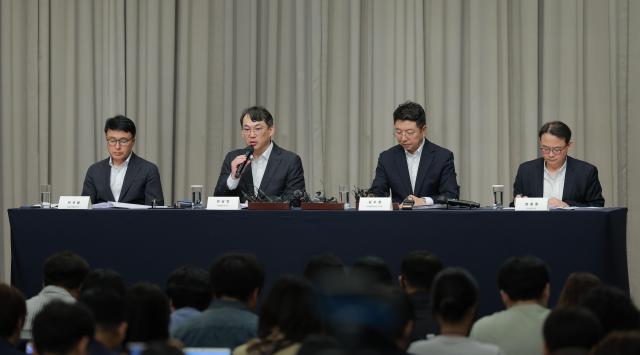
Executives also acknowledged the growing financial impact. Jeon Sang-jin, executive vice president overseeing corporate management, said sales had fallen “considerably” since the controversy, though the company declined to provide figures. He said the priority was restoring trust rather than minimizing short-term damage.
The company said it is reviewing refund requests for prepaid Starbucks cards and account cancellations with relevant authorities because such products are governed by Fair Trade Commission regulations.
Executives added that Starbucks’ U.S. headquarters had been fully informed of the incident and is discussing improvements to internal risk-control systems with the Korean operation. However, Shinsegae said the controversy does not currently appear to trigger contractual issues involving Starbucks’ U.S. parent company.
The episode has also revived scrutiny of earlier marketing controversies among Korean consumer brands. In 2024, Starbucks Korea faced criticism for releasing a “Siren Classic Mug” on the anniversary of the Sewol ferry disaster, while fashion platform Musinsa issued a renewed apology after the Starbucks controversy resurfaced attention on a similar “Tak! on the desk” phrase used in one of its 2019 advertisements.
For Shinsegae, the central challenge now extends beyond whether the campaign was intentional. The deeper question is whether one of South Korea’s most influential consumer groups can convince the public that its internal systems are capable of preventing another breakdown where commercial marketing collides with unresolved national trauma.

Copyright ⓒ Aju Press All rights reserved.