
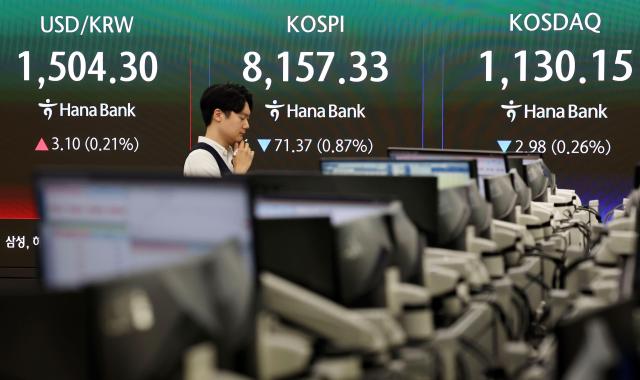
The KOSPI index, which had reached a record high, opened lower on the 28th at Hana Bank's main dealing room in Jung-gu, Seoul, falling 62.97 points (0.77%) to start at 8165.73, showing weakness. [Photo=Yonhap News]
The won-dollar exchange rate is fluctuating in the low 1500s amid uncertainty surrounding negotiations between the U.S. and Iran.
As of 9:35 a.m. on the 28th in the Seoul foreign exchange market, the exchange rate is trading at 1504.7 won per dollar. The rate opened at 1504.0 won, up 2.8 won from the previous trading day, and is fluctuating within a narrow range.
Negotiations have shown signs of strain as the U.S. and Iran differ on issues such as the blockade of the Strait of Hormuz and the easing of sanctions. On the 27th, U.S. President Donald Trump stated regarding the peace negotiations with Iran, "So far, they have not reached a level that satisfies us."
The dollar is showing renewed strength. Market participants are paying attention to the potential for increased dollar buying sentiment ahead of the release of the U.S. Personal Consumption Expenditures (PCE) price index for April, scheduled for later that evening.
The Bank of Korea's monetary policy committee meeting taking place today is also a key variable. While the market leans toward the possibility of keeping the benchmark interest rate unchanged at 2.50%, there is heightened interest in the comments from Governor Lee Ju-yeol during the press conference.
Considering recent inflationary pressures and signs of economic recovery, any hawkish messages suggesting future interest rate hikes could strengthen the won.
Min Kyung-won, an economist at Woori Bank, noted, "With the exchange rate rising back to the 1500 won level, there will be sufficient incentive for profit-taking on high prices. In a situation where risk appetite remains intact, a shift to net foreign buying in the domestic stock market could lead to increased dollar supply through custody sales."
* This article has been translated by AI.
Copyright ⓒ Aju Press All rights reserved.