
The Bank of Korea has kept its key interest rate steady for the eighth consecutive time. The economic growth forecast has been raised by 0.6 percentage points, bolstered by a semiconductor boom. As the Middle East conflict continues, inflation expectations have also been adjusted upward.
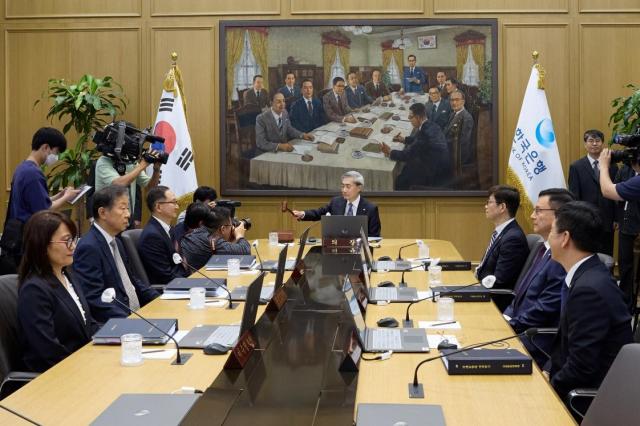
During its monetary policy meeting on May 28, the Bank of Korea's Monetary Policy Committee decided to maintain the key interest rate at 2.50% for the eighth time, following freezes in July, August, October, and November of last year, as well as January, February, and April of this year.
The committee stated, "While inflationary pressures have increased due to the Middle East conflict, growth is expanding more than expected, supported by strong exports, and risks to financial stability persist. However, given the high uncertainty surrounding the developments in the Middle East and their ripple effects, we believe it is appropriate to maintain the current key interest rate and continue to monitor the situation's impact on growth and inflation."
The economic growth outlook has shown stronger-than-expected performance. On this day, the Bank of Korea revised its real GDP growth forecast for the year to 2.6%, also raising next year's forecast to 2.1%. Previously, in February, the forecasts were set at 2.0% for this year and 1.8% for next year.
Earlier this year, South Korea achieved a surprising growth rate that significantly exceeded the Bank of Korea's initial forecast of 0.9%. The GDP growth rate for the first quarter was 1.7%, driven by the semiconductor sector. With the semiconductor boom, the possibility of achieving $900 billion in exports this year has also emerged.
The ongoing Middle East conflict is believed to have influenced this monetary policy decision. In April, the Monetary Policy Committee noted the significant uncertainty stemming from the conflict and indicated it would maintain the current key interest rate while monitoring the situation.
The conflict has also put upward pressure on prices. Consequently, the Bank of Korea has adjusted its consumer price inflation forecast for the year from 2.0% to 2.7%, an increase of 0.5 percentage points. The inflation forecast for next year has also been raised from 2.0% to 2.3%.
The exchange rate has remained around 1,500 won. As of 10:15 a.m. on this day, the won-dollar exchange rate stood at 1,503.8 won in the Seoul foreign exchange market. The ongoing difficulties in ceasefire negotiations in the Middle East have heightened the preference for safe-haven assets, with the exchange rate maintaining the 1,500 won level for nine consecutive trading days since May 15.
* This article has been translated by AI.
Copyright ⓒ Aju Press All rights reserved.